
What Is IT Procurement Management (and Why It Matters for Your Budget)
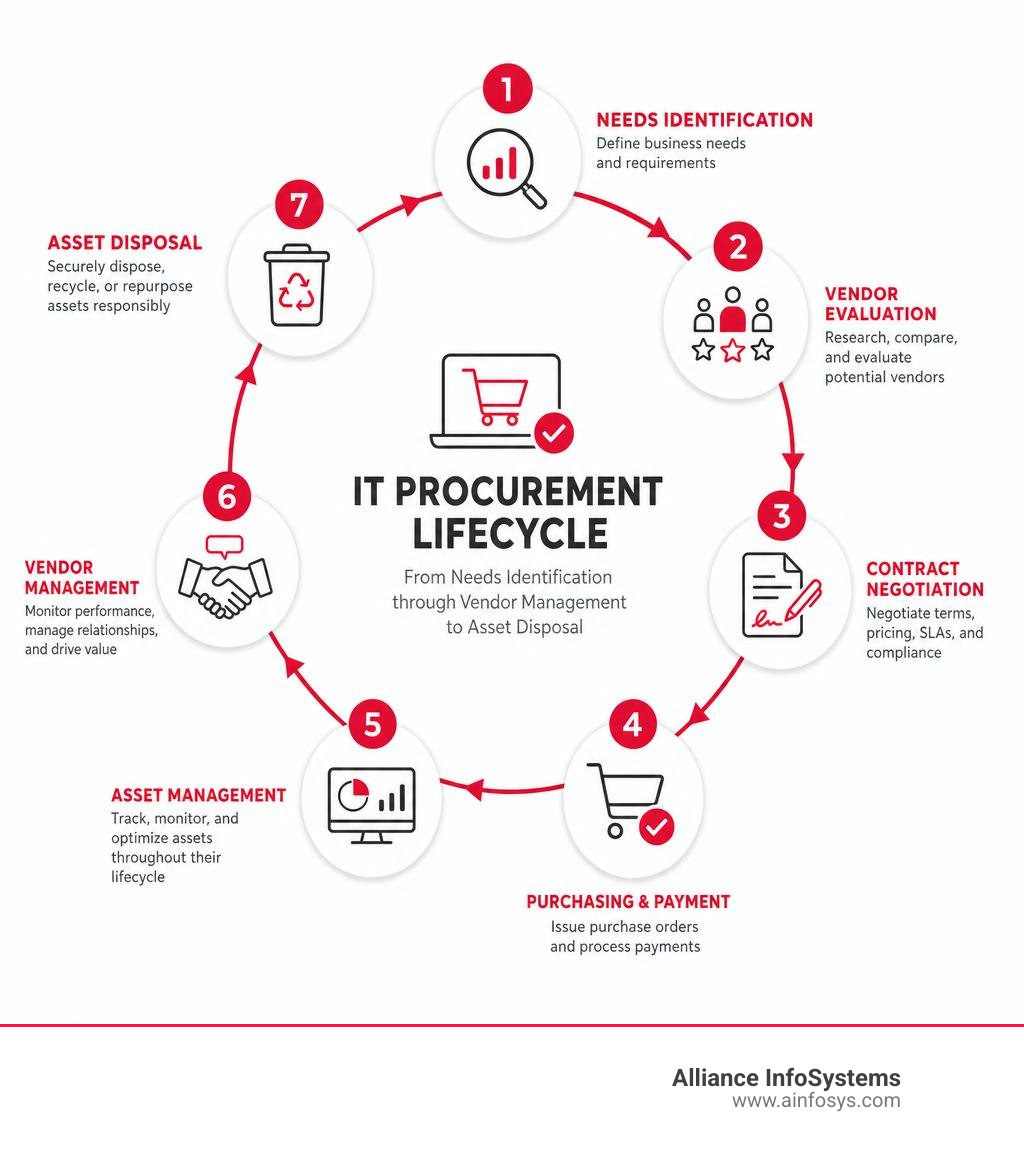
IT procurement management is the end-to-end process of planning, sourcing, purchasing, and managing the technology goods and services your organization needs to operate. It goes well beyond simply buying hardware or software. It includes vendor evaluation, contract negotiation, compliance oversight, asset lifecycle tracking, and supplier relationship management.
Here is a quick summary of what IT procurement management covers:
- Identifying needs – Defining what technology your organization requires and why
- Sourcing suppliers – Researching and evaluating vendors who can meet those needs
- Negotiating contracts – Agreeing on pricing, terms, service levels, and compliance requirements
- Purchasing and payment – Issuing purchase orders and processing invoices accurately
- Asset management – Tracking IT assets throughout their useful life
- Vendor relationship management – Monitoring supplier performance and managing renewals
This is not a purchasing department function alone. Done right, it is a strategic discipline that directly affects your bottom line, your security posture, and your ability to scale.
For years, the guiding principle in technology acquisition was simple: buy cheap. But that mindset is now a liability. IT spending is not a minor line item. Depending on the type of organization, IT procurement and buying expenses can account for anywhere from 39% to over 72% of every sales dollar. When those dollars are not managed strategically, the losses compound fast through duplicate software licenses, unused SaaS subscriptions, poor vendor contracts, and compliance gaps that expose the business to real risk.
The stakes are even higher for small and mid-sized businesses. Without a dedicated procurement team or a clear process, technology decisions often get made in silos. One department signs up for a cloud tool without IT review. Another auto-renews a vendor contract that should have been renegotiated. These are not rare edge cases. They are the norm in organizations without a structured approach to IT procurement.
The good news is that smarter IT procurement does not require a massive team or an enterprise-level budget. It requires the right process, the right tools, and a clear understanding of what you are trying to achieve. That is exactly what this guide is built to help you with.
Demystifying IT Procurement: Definition and Core Differences
To build a smarter technology budget, we first need to clear up some common terminology confusion. Many professionals use “sourcing,” “purchasing,” and “procurement” interchangeably. However, in technology, conflating these terms can lead to expensive operational gaps.
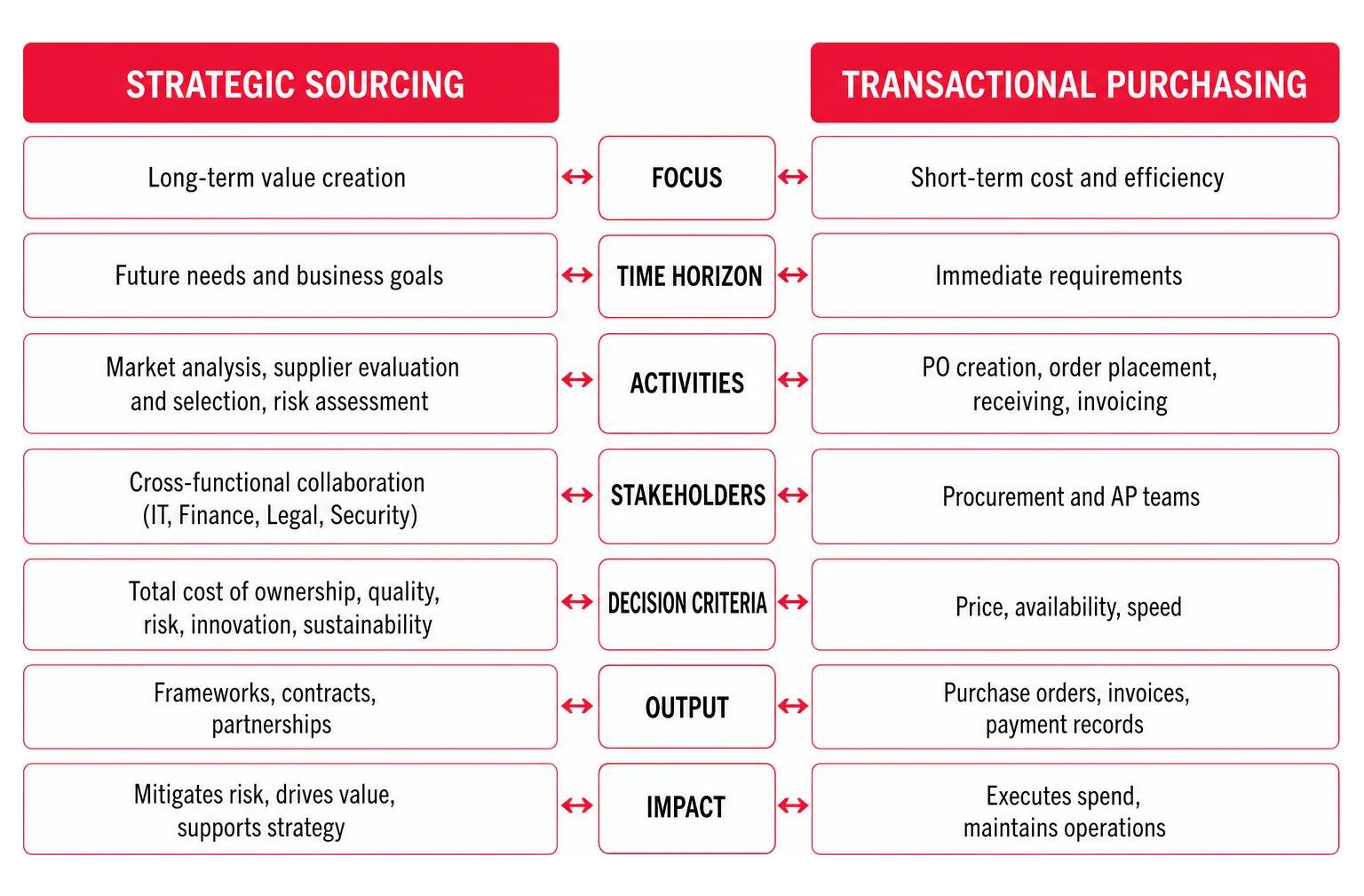
Sourcing is the strategic phase where the organization defines its technology needs, researches the market, and compares potential vendors. Purchasing is the tactical step that follows, covering purchase orders, delivery, invoice processing, and payment. IT procurement management is the full end-to-end framework that includes both sourcing and purchasing, plus post-purchase work like asset tracking, cybersecurity risk monitoring, and vendor relationship management.
The Strategic Shift in Modern IT Procurement Management
In July 2026, IT procurement is no longer just about cost control. It has evolved from a tactical back-office task into a key driver of corporate value. Modern organizations use technology procurement to build resilient supplier partnerships, drive sustainability, and ensure ESG (Environmental, Social, and Governance) compliance.
A major element of this strategic shift is supply chain resilience. High-performing organizations actively avoid single-source bottlenecks. In fact, 65% of top Chief Procurement Officers (CPOs) have integrated a supply chain diversification strategy into their processes, compared to just 25% of lower-performing CPOs. By diversifying vendors, businesses protect themselves against sudden service disruptions, software price spikes, and vendor lock-in.
IT Procurement vs. General Purchasing
Why can’t your standard purchasing department handle IT acquisitions the same way they buy office supplies? Because technology assets carry unique risks and complexities.
General purchasing typically ends once an item is delivered and the invoice is cleared. In contrast, IT procurement requires extensive pre-transaction and post-transaction activities. Before a contract is signed, IT assets must undergo rigorous cybersecurity vetting and compliance checks. After the transaction, they require continuous monitoring, internal auditing, software patch management, and eventually, secure decommissioning to prevent data breaches.
The Critical Business Impact of Technology Sourcing

When technology sourcing is unmanaged, it directly drains your company’s bottom line. The most common culprit is “maverick spend”—when individual departments or employees purchase software, SaaS subscriptions, or cloud resources without going through the proper channels.
Without centralized oversight, organizations end up with duplicate tools, unused licenses, and orphaned accounts. This waste is incredibly common; research shows that a massive portion of software budgets is wasted on tools that employees rarely or never use.
Beyond direct financial waste, unmanaged procurement introduces severe operational and security risks. If your team adopts SaaS applications without guidance from security or compliance specialists, they risk exposing sensitive company and customer data.
Smarter technology sourcing acts as an enabler for digital transformation. By aligning your technology purchases with your broader business goals, you ensure that every dollar spent actively supports productivity and growth. To establish this alignment, it helps to understand How to Build a Better IT Procurement Process and learn What Should You Look for in a Business Technology Partner? to guide your organization through these complex decisions.
Key Stages of the IT Procurement Lifecycle
Managing the IT procurement lifecycle requires a structured workflow that extends far beyond the traditional procure-to-pay (P2P) process.
According to the comprehensive guidelines in the Buy IT: IT procurement manual (spring 2025) , a rigorous procurement process includes several distinct phases:
IT procurement typically starts with specifying and planning: defining the business need, researching the market, and deciding whether to build, buy, lease, or subscribe. From there, teams move into supplier selection by sending RFPs or RFQs and comparing vendor capabilities. Once a supplier is chosen, contract negotiation sets pricing, service level agreements, and data security requirements. The purchasing stage then issues the purchase order and coordinates delivery. Before payment, the team performs a three-way match between the PO, receiving slip, and invoice. Finally, asset disposal ensures hardware is securely decommissioned and software licenses are properly offboarded at the end of their lifecycle.
To see how this differs from standard purchasing, consider this comparison:
| Stage | Standard P2P Workflow | IT Procurement Workflow |
|---|---|---|
| Planning | Simple inventory check | Build-vs.-buy analysis & technical architecture review |
| Vetting | Price and delivery speed check | Cybersecurity risk assessments & compliance audits |
| Negotiation | Standard volume discounts | SLAs, data ownership clauses, and software renewal caps |
| Post-Purchase | Delivery confirmation | Continuous performance tracking & asset lifecycle management |
A critical detail to remember during the planning phase is that 70% of software costs occur after implementation. This means that upfront licensing costs are only a small fraction of the total cost of ownership (TCO). Maintenance, support, cloud hosting, and eventual disposal must all be factored into your initial budget.
Overcoming Unique Challenges in IT Procurement Management
IT procurement is uniquely challenging because technology is constantly shifting. Here are the primary hurdles organizations face today:
Software licensing can be hard to manage because agreements often include confusing rules around virtualization, user types, and usage limits. SaaS sprawl adds another layer of waste, since teams can easily buy overlapping tools with a credit card. Cloud services create similar challenges because usage changes constantly, and costs can rise fast without tracking and forecasting. Cybersecurity and data privacy also need close attention, because every new vendor can introduce risk if their security practices are not properly reviewed.
To keep productivity high while keeping costs low, check out Your How-To Guide for the Right Tech to Increase Productivity. Additionally, learning about strategic sourcing frameworks through resources like the guide on IT Procurement: Strategies, Metrics & Best Practices can help your team navigate these complex licensing and cloud management challenges.
Roles, Responsibilities, and Cross-Departmental Collaboration
Successful technology procurement is a team sport. It requires close collaboration among several key organizational players:
- Chief Procurement Officer (CPO): Drives the high-level sourcing strategy and supplier diversification. Notably, CPO positions have grown rapidly, ranking among the fastest-growing C-suite titles in recent years.
- IT Department: Evaluates technical compatibility, architectural fit, and ongoing support requirements.
- Finance: Manages budget allocations, conducts lease-vs.-buy financial analyses, and tracks ROI.
- Legal: Reviews contract terms, liability limits, and data privacy clauses.
Because of this complexity, specialized roles are highly valued. If you look at the job market, you will find hundreds of active listings, such as the 459 It Procurement jobs in Maryland – LinkedIn , highlighting the strong demand for skilled professionals who can bridge the gap between technology and business operations.
Building a Collaborative IT Procurement Management Team
To prevent communication silos, organizations must establish clear procurement governance. This includes setting up cross-functional workflows where IT, finance, and legal review purchases simultaneously rather than sequentially. This integration speeds up approval times and ensures that no critical security or financial check is missed.
Best Practices and Tools to Optimize Your Technology Spend

To stop wasting your technology budget, you need to move away from manual spreadsheets and adopt modern, automated tools.
Automation is one of the fastest ways to remove friction from IT procurement. Manual workflows take time, create errors, and make approvals harder to track. Many procurement leaders now automate routine tasks to control costs and improve efficiency, especially around requisitions, purchase orders, invoice matching, and approvals.
Spend analytics should also be centralized. When software, cloud, and hardware expenses live in one dashboard, teams can see where money is going. That makes it easier to find duplicate subscriptions, unused licenses, overlapping tools, and opportunities to negotiate better volume pricing.
Vendor lifecycle management matters just as much. Do not wait until a contract is about to renew. Set renewal alerts at least 90 days in advance so your team has time to review performance, compare options, renegotiate terms, or replace a vendor if needed.
For many growing businesses in Maryland, managing this level of complexity in-house is simply too resource-intensive. Partnering with an experienced IT Provider can streamline this process. To understand how a partner can help, read about the 4 Next-Level Reasons to Partner with an MSP and check out our IT Consulting Services blog to see how we assist businesses in aligning their technology with their long-term objectives.
Frequently Asked Questions about IT Procurement
What is the difference between IT procurement and purchasing?
Purchasing is a transactional activity focused on buying goods, processing POs, and making payments. IT procurement is a strategic, end-to-end framework that includes market research, vendor risk vetting, contract negotiation, and post-purchase asset lifecycle management.
How do you measure the success of IT procurement?
Success is measured using key performance indicators (KPIs) such as total cost savings, vendor contract compliance, first-time invoice match rates, requisition-to-order cycle times, and vendor lead times.
Why is cybersecurity critical in IT procurement?
Every technology vendor you work with has potential access to your network or data. Vetting their cybersecurity posture during the procurement process is essential to prevent supply chain data breaches, ensure regulatory compliance, and mitigate zero-day threats.
Conclusion
Smarter IT procurement is not about cutting corners—it is about spending strategically to drive growth, protect your assets, and eliminate waste. Managing this lifecycle effectively requires deep technical expertise, robust security practices, and constant vigilance.
As a Maryland-based IT Provider with over 20 years of experience, Alliance InfoSystems delivers flexible, customized, and cost-efficient services. We help organizations optimize their technology spend and secure their operations. Our team of experts specializes in managed IT, cybersecurity, cloud migration, SOC services, data backup, network security, and IT staffing.
Ready to stop wasting your technology budget? Explore Our Services today to see how we can help your business succeed.