
What Are IT Solutions for Finance? A Quick-Start Guide
IT solutions for finance cover a broad set of technologies that help financial institutions run more securely, efficiently, and competitively. If you’re looking for a fast overview, here’s what modern financial IT solutions typically include:
- Cybersecurity and managed security – protecting sensitive financial data from breaches, fraud, and evolving threats
- Cloud infrastructure – enabling scalable, low-latency core banking and payments processing
- Data backup and disaster recovery – ensuring business continuity when systems fail
- AI and automation tools – streamlining fraud detection, customer service, and compliance workflows
- Network security and SOC services – monitoring and responding to threats around the clock
- Unified data platforms – breaking down data silos to support better decision-making
- IT staffing and managed services – giving financial teams access to expert support without building it all in-house
The financial sector runs on data, speed, and trust. Lose any one of those and the consequences are immediate. A payment system goes down, a customer’s account gets compromised, or a compliance deadline gets missed, and the damage can take months to repair.
This is not a new problem. But the scale and complexity of it in 2026 is unlike anything financial organizations have faced before. Legacy systems built decades ago sit alongside cloud-based tools and AI-powered applications, creating a patchwork that’s hard to secure and even harder to modernize. At the same time, regulators keep raising the bar, and cybercriminals keep getting smarter. Ninety percent of financial institutions are already using AI to speed up fraud investigations and catch new attack patterns in real time. That tells you where the industry is headed.
For small to mid-sized financial firms, the pressure is just as real as it is for the big banks, but the resources are not. You may not have a large in-house IT department. You may be running on systems that haven’t been updated in years. And you may be responsible for protecting client data that criminals would pay a lot to get their hands on.
That’s where working with a trusted IT provider makes a real difference. The right partner brings managed IT, cybersecurity, cloud migration, data backup, network security, SOC services, and IT staffing expertise together in a way that fits your size and your budget.
This guide breaks down the full landscape of financial IT solutions so you can make smarter decisions about where to invest, what to prioritize, and how to build a technology foundation that keeps your business protected and growing.
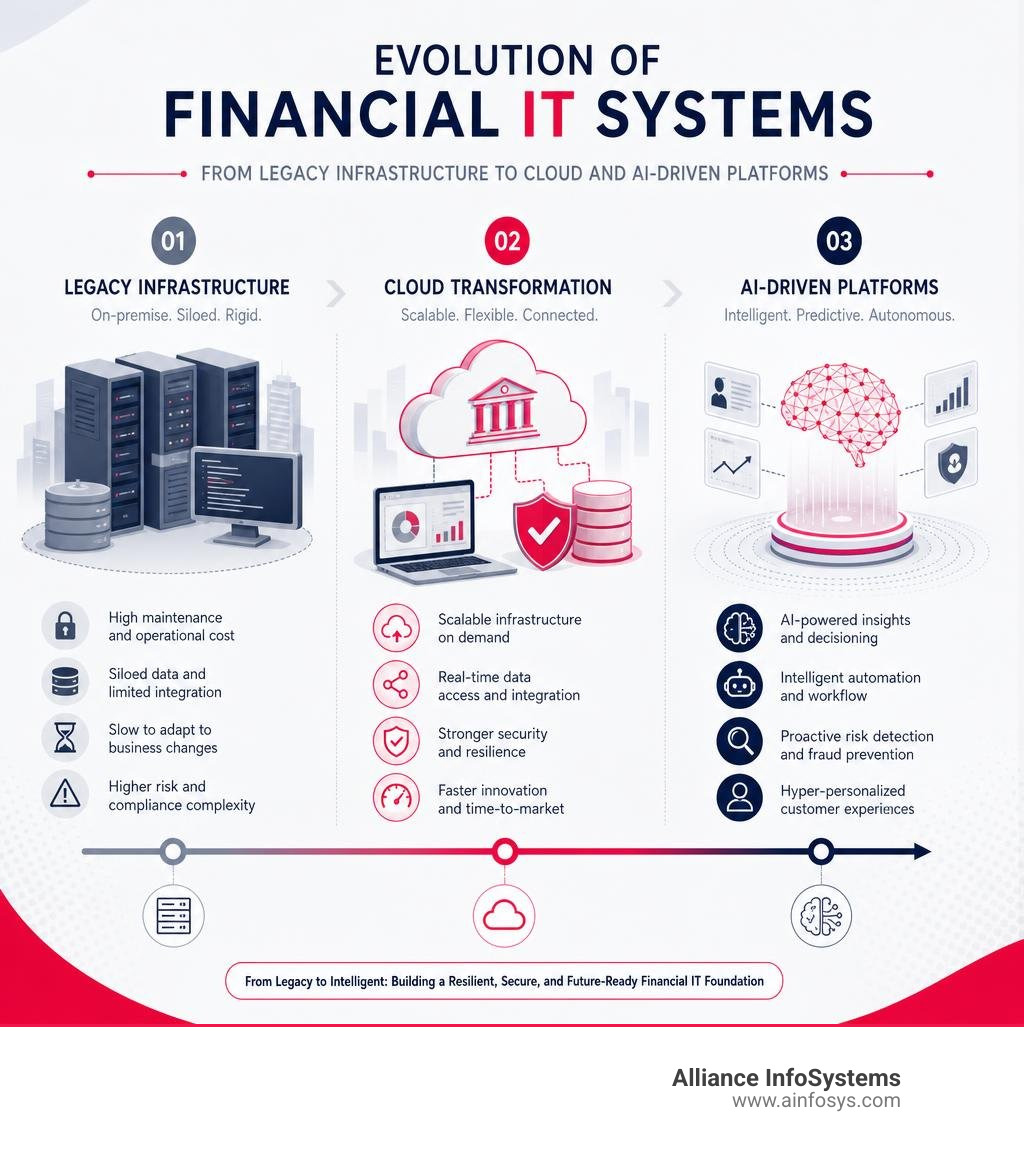
Quick look at IT solutions for finance:
The Core IT Challenges and Cybersecurity Risks in Finance
Modern financial institutions are caught in a technological tug-of-war. On one side, they must innovate constantly to meet customer expectations. On the other side, they face highly sophisticated cyber threats and strict regulatory demands.
Legacy systems are one of the biggest hurdles. Many institutions still run on monolithic, decades-old core software. These legacy platforms are fragile, expensive to maintain, and create massive data silos that prevent different departments from sharing information easily. This fragmentation often leads to operational downtime, which is a nightmare when customers expect 24/7 access to their money.
To make matters worse, financial firms are prime targets for cybercriminals. Ransomware, phishing, and advanced social engineering attacks are rising in frequency and complexity. When planning budgets, security must be front and center. To see how your peers are allocating resources to tackle these issues, you can Learn more about 2025 IT budgets.
Balancing Innovation with Cybersecurity and Compliance Requirements
How do you adopt game-changing technology without opening the door to hackers? The answer lies in zero-trust architecture. In a zero-trust model, we assume that threats exist both outside and inside the network. No user or device is trusted by default; everyone must be verified at every step.
Data privacy is another area where you cannot afford to cut corners. Whether it is protecting personal banking details or complying with regional regulations, robust risk mitigation is essential. Partnering with an experienced IT Provider helps you deploy advanced defenses like multi-factor authentication (MFA), endpoint detection, and continuous threat monitoring. To see how we keep financial networks secure, Discover our managed security services.
Building a Robust DevSecOps Strategy
In the past, software developers focused on speed, while security teams focused on safety. This often led to friction and delayed product launches. DevSecOps solves this by embedding security directly into the development lifecycle from day one.
A modern DevSecOps strategy uses continuous integration and continuous deployment (CI/CD) pipelines with built-in, automated compliance checks. This “shift-left” approach means code is tested for security vulnerabilities as it is written, rather than right before release. It allows financial institutions to launch secure, compliant applications faster than ever. Of course, secure software is only as strong as the network it runs on. To learn how to protect your entire infrastructure, check out our guide on How to choose best network security services.
Safeguarding Financial Data with Backup and Recovery
When disaster strikes—whether it is a cyberattack, a hardware failure, or a severe storm in Maryland—your business continuity depends entirely on your backup strategy. A single hour of downtime can cost a financial institution thousands of dollars and severely damage client trust.
A reliable disaster recovery plan must include automated, encrypted, and offsite backups. We recommend implementing a defense-in-depth approach where backups are isolated from the main network to prevent ransomware from infecting your clean data copies. To understand why this is non-negotiable, read about why Professional data backup solutions essential for business are critical, and explore our Best practices server backup data protection to keep your servers safe.
Cloud Infrastructure and Modern IT Solutions for Finance
The cloud is no longer a luxury; it is the backbone of modern financial operations. Cloud migration allows institutions to move away from rigid, on-premises hardware and adopt flexible, scalable, and highly resilient environments.
For many financial firms, a hybrid cloud approach offers the best of both worlds. It allows you to keep highly sensitive core systems on secure, private servers while leveraging the public cloud for customer-facing apps that require rapid scalability. Deciding on the right setup can be tricky, so it helps to Explore cloud hosting services and Read about cloud vs on-premises setups to find the right fit for your firm.
Modernizing Core Banking and Payments with Cloud Server Computing
Legacy core banking systems simply cannot keep up with the high-speed demands of modern payment processing. Cloud server computing provides the low-latency infrastructure required to process millions of transactions instantly and securely.
By running core operations on optimized cloud servers, financial institutions gain built-in redundancy and automated disaster recovery capabilities. This ensures that even if one server node experiences an issue, transactions continue to process smoothly without interruption. For a deeper look into how this technology works, review our Guide to cloud server computing.
Post-Trade Processing and Treasury Management IT Solutions for Finance
Back-office operations like post-trade processing and treasury management have historically been slow and heavily manual. Today, specialized software solutions automate these complex workflows to reduce human error and optimize capital usage.
For example, platforms like the Post Trade Processing Solution – Megara Vermeg help firms automate settlement, custody, and collateral management across multiple asset classes. At the same time, enterprise-grade systems like the Wallstreet Suite Enterprise Treasury Management Software handle high-volume payments, advanced risk management, and real-time treasury analytics for complex, multi-entity organizations.
Driving Efficiency with AI, Automation, and Unified Data Platforms
Artificial intelligence and automated workflows are transforming how financial decisions are made and how customer service is delivered. By pairing AI with unified data platforms, financial institutions can eliminate data silos and build a single source of truth for their operations.

To understand the practical impact of these technologies, consider how automated workflows compare to traditional, manual processes:
| Workflow Area | Traditional Manual Process | Modern AI-Automated Process |
|---|---|---|
| Fraud Detection | Manual review of flagged accounts; slow response times. | Real-time transaction monitoring and instant anomaly detection. |
| Credit Scoring | Rigid, slow manual underwriting based on basic credit history. | Fast, multi-dimensional risk assessment using machine learning. |
| Customer Support | Long phone queues and delayed email responses. | 24/7 instant assistance via intelligent conversational AI. |
| Data Consolidation | Manual data entry across multiple disconnected spreadsheets. | Real-time automated data integration across all business units. |
Leveraging AI and Automation for Operational Efficiency
Automation is a massive timesaver for repetitive tasks. In customer service, conversational AI and advanced chatbots handle routine inquiries, freeing up your team to focus on complex client relationships.
On the investment side, algorithmic trading and advanced analytics process massive market datasets in milliseconds to identify emerging trends. Specialized tools like Rogo AI for finance are designed specifically to automate complex financial workflows, enabling analysts to conduct research and generate reports with unprecedented speed and precision.
Unified Data Platforms and Analytics as Key IT Solutions for Finance
You cannot run effective AI or make accurate business decisions if your data is scattered across five different legacy databases. Unified data platforms bring your transaction, customer, and compliance data together under a single, highly governed framework.
This unified approach gives executive teams a clear, real-time view of the organization’s financial health. Platforms like The Complete CFO Solution Platform :: Lucanet integrate diverse data sources seamlessly, allowing finance and tax teams to handle consolidation, financial planning, and compliance reporting from one definitive, secure system.
Best Practices for Selecting and Implementing Financial IT Solutions
Selecting the right technology is only half the battle; implementing it successfully requires careful planning. Many IT projects fail not because the software is bad, but because the transition process was rushed or poorly managed.
When entering the IT procurement phase, start by identifying your most critical pain points. Avoid the temptation to buy over-complicated systems with features you will never use. Instead, look for flexible, modular solutions that can grow alongside your business.
It is also crucial to choose a technology partner with deep industry experience who understands the specific regulatory and security challenges of the financial sector. To set your business up for success, learn How to build a better IT procurement process and discover What should you look for in a business technology partner.
Frequently Asked Questions about Financial IT Solutions
How do modern IT solutions address fraud detection and risk management?
Modern platforms use machine learning algorithms and real-time monitoring to analyze transaction patterns as they happen. By establishing a baseline of normal user behavior, these systems can instantly flag anomalies—such as unusual transaction locations or sudden large transfers—and block suspicious activity before any damage is done.
How can financial institutions ensure regulatory compliance during digital transformation?
Compliance must be built into your IT architecture, not added as an afterthought. This involves using automated reporting tools, maintaining immutable audit trails, and enforcing strict data encryption both in transit and at rest. Working with an experienced IT Provider ensures that your cloud migrations and system upgrades align with current regulatory standards.
What is the difference between IT procurement and AI implementation in finance?
IT procurement is the strategic process of sourcing, selecting, and purchasing the physical infrastructure, cloud services, and software licenses your business needs to run. AI implementation, on the other hand, is the specialized process of deploying machine learning models and automated workflows to analyze data and improve decision-making. These are distinct processes, where procurement builds the foundational digital infrastructure, while AI implementation installs the smart technology inside it.
Conclusion
Navigating the complex world of IT solutions for finance requires a careful balance of innovation, security, and regulatory compliance. Whether you need to migrate legacy workflows to the cloud, protect sensitive customer data from cyber threats, or build a resilient disaster recovery plan, you don’t have to tackle these challenges alone.
Alliance InfoSystems is a Maryland-based IT Provider with over 20 years of experience delivering flexible, customized, and cost-efficient technology solutions. We specialize in helping financial institutions design and maintain secure, high-performing digital infrastructures that keep operations running smoothly.
Our team of experts is ready to support your business with industry-leading managed IT, proactive system monitoring, advanced cybersecurity, threat mitigation, cloud migration, cloud server hosting, around-the-clock SOC services, network security, automated data backup, rapid disaster recovery, and specialized IT staffing that scales with your technical needs.
Let us handle your technology so you can focus on growing your business and serving your clients. Partner with Alliance InfoSystems for Managed IT Services today.