Understanding EDR End Point Security vs. Traditional Antivirus
Relying on legacy antivirus for your EDR end point is risky because signature-based tools only recognize known threats, leaving devices exposed to zero-day exploits, fileless attacks, and living-off-the-land techniques. Modern EDR endpoint security protects devices by continuously recording system telemetry and analyzing behavior, so security teams can detect and contain suspicious activity before it becomes a breach. An effective edr end point strategy has evolved far beyond running a daily file scan. The term endpoint threat detection and response was first coined by analyst Anton Chuvakin in 2013, recognizing that prevention alone is never foolproof. The market reflects this shift: valued at USD 6.5 billion in 2025, adoption is projected to climb to USD 50.5 billion by 2034.
Traditional antivirus acts like a security guard checking IDs at the door against a list of known offenders. If an intruder wears a new disguise, they walk right in. An edr end point solution functions more like a digital video recorder (DVR) for your device, capturing continuous telemetry of system processes, network connections, and user actions.
By analyzing behavior rather than static file signatures, modern solutions identify malicious intentions early, helping organizations avoid ransomware in your business before critical files are compromised.
| Feature / Capability | Legacy Antivirus (AV) | Modern EDR Solution |
|---|---|---|
| Detection Method | Known file signatures, static hashes | Behavioral analysis, telemetry, heuristics |
| Visibility Scope | Point-in-time scanning of files | Continuous, historical telemetry recording |
| Unknown & Zero-Day Threats | Limited or ineffective | High detection via Indicators of Attack (IOAs) |
| Fileless & Identity Attacks | Blind to memory-only execution | Full visibility into scripts and credential abuse |
| Response Capabilities | File quarantine or basic deletion | Remote containment, process termination, rollback |
Limitations of Signature-Based Antivirus Tools
Legacy tools rely primarily on databases of known malicious signatures. When threat actors generate unique malware variants, these static databases quickly fall behind.
Modern cybercriminals increasingly leverage living-off-the-land (LotL) techniques. In fact, security researchers observed a 126% increase in unique legitimate executables used by attackers to evade detection. Because these native system tools (such as PowerShell, WMI, or remote management binaries) are trusted by default, legacy antivirus tools view their execution as normal administrative behavior, allowing adversaries to move freely without raising alarms.
Core Capabilities of Endpoint Detection and Response
Modern EDR platforms focus on continuous visibility and rapid remediation. Key capabilities include:
- Continuous Telemetry Collection: Monitoring process executions, file modifications, registry edits, and network connections in real time.
- Behavioral Analytics: Identifying anomalies and Indicators of Attack (IOAs) rather than waiting for known file hashes.
- Automated and Manual Containment: Instantly isolating a compromised device from the network to prevent lateral movement while preserving remote security access.
- Fast Remediation: Terminating unauthorized processes, deleting malicious persistence mechanisms, and rolling back unauthorized encryption.
These proactive capabilities make it easier to evaluate cyberattack risks across your enterprise environment.
How Modern Endpoint Detection Works Against Advanced Cyber Threats
Endpoint security works by capturing real-time telemetry from lightweight software agents running on workstations and servers. These agents send operational metadata back to an analytics engine, which evaluates actions against behavioral heuristics and contextual threat intelligence.
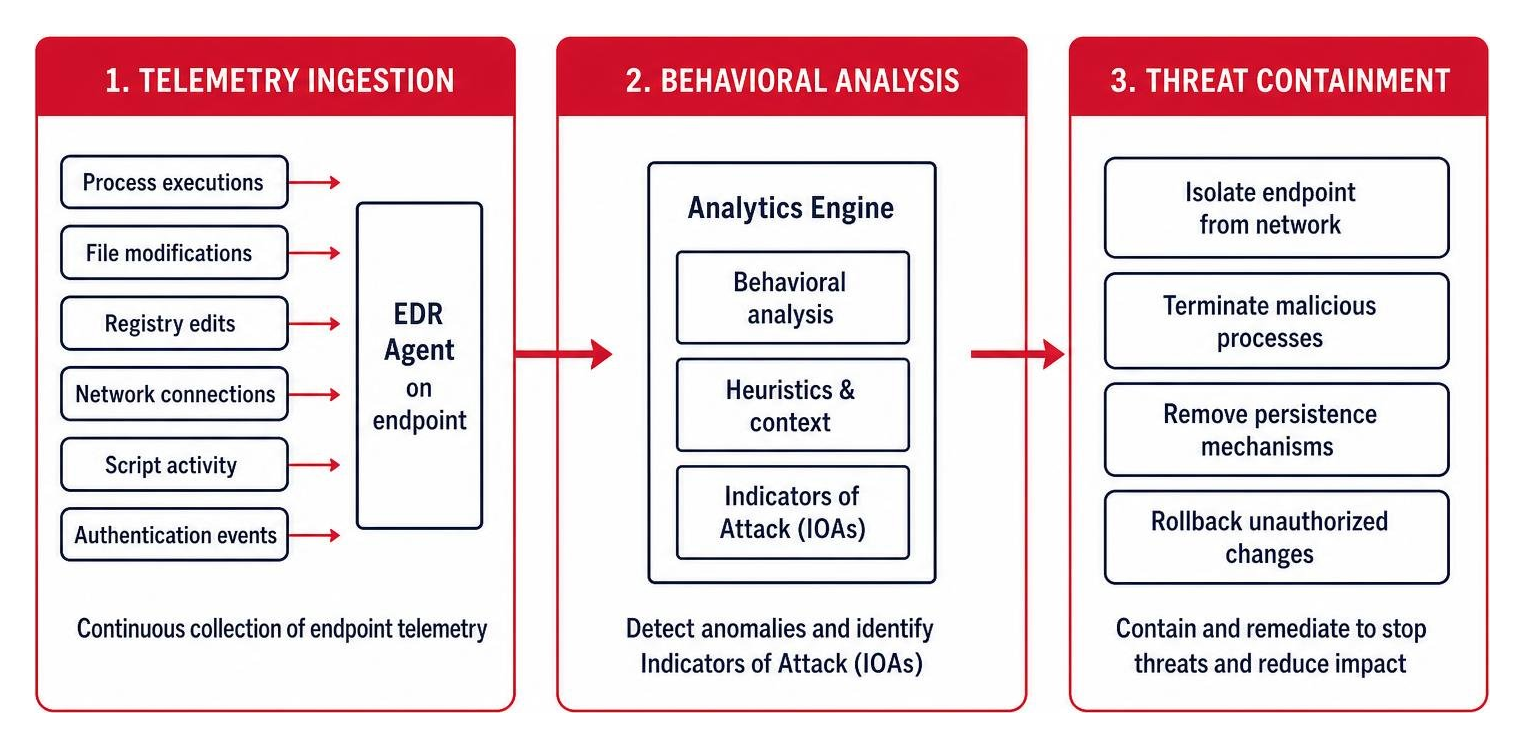
When an agent notices a series of suspicious actions—such as an unexpected macro spawning a shell that downloads an unverified script—it flags the sequence as an active incident. This gives defenders immediate insight into the root cause and the full attack chain, allowing security analysts to trace parent and child processes across multiple systems.
How an EDR End Point Detects Fileless and Identity Attacks
Fileless attacks execute directly in system memory without writing recognizable payloads to disk, evading signature scanners entirely. By injecting malicious code directly into legitimate processes such as PowerShell or Windows management instrumentation, adversaries bypass perimeter firewalls and traditional disk-based antivirus utilities.
At the same time, identity compromises represent one of the fastest-growing initial attack vectors. Roughly 67% of incident response and MDR investigations originate from identity-based intrusions. An EDR agent inspects process behavior and authentication attempts directly on the host, flagging anomalous privilege escalation, credential dumping from memory, or unauthorized access attempts that preventative tools cannot stop on their own.
Real-Time Incident Containment and Threat Remediation
When suspicious behavior exceeds risk thresholds, immediate action is essential to stop lateral movement before an adversary gains persistent domain access. Advanced platforms enable:
- Network Isolation: Quarantining the affected endpoint so it cannot communicate with other network assets, while maintaining an encrypted channel to the central console.
- Process Termination: Halting unauthorized background processes instantly to sever active command-and-control communication channels.
- Automated Rollback: Reverting affected files back to their unencrypted state if malicious encryption routines occur.
- Root-Cause Investigation: Mapping the entry point, whether it started from an email lure or an unpatched vulnerability.
Pairing endpoint controls with comprehensive network security solutions creates a layered defense that protects data both at rest and in transit.
The Strategic Difference: EDR, XDR, and MDR Frameworks
As cybersecurity demands have grown, security terminology has expanded across several detection and response models.
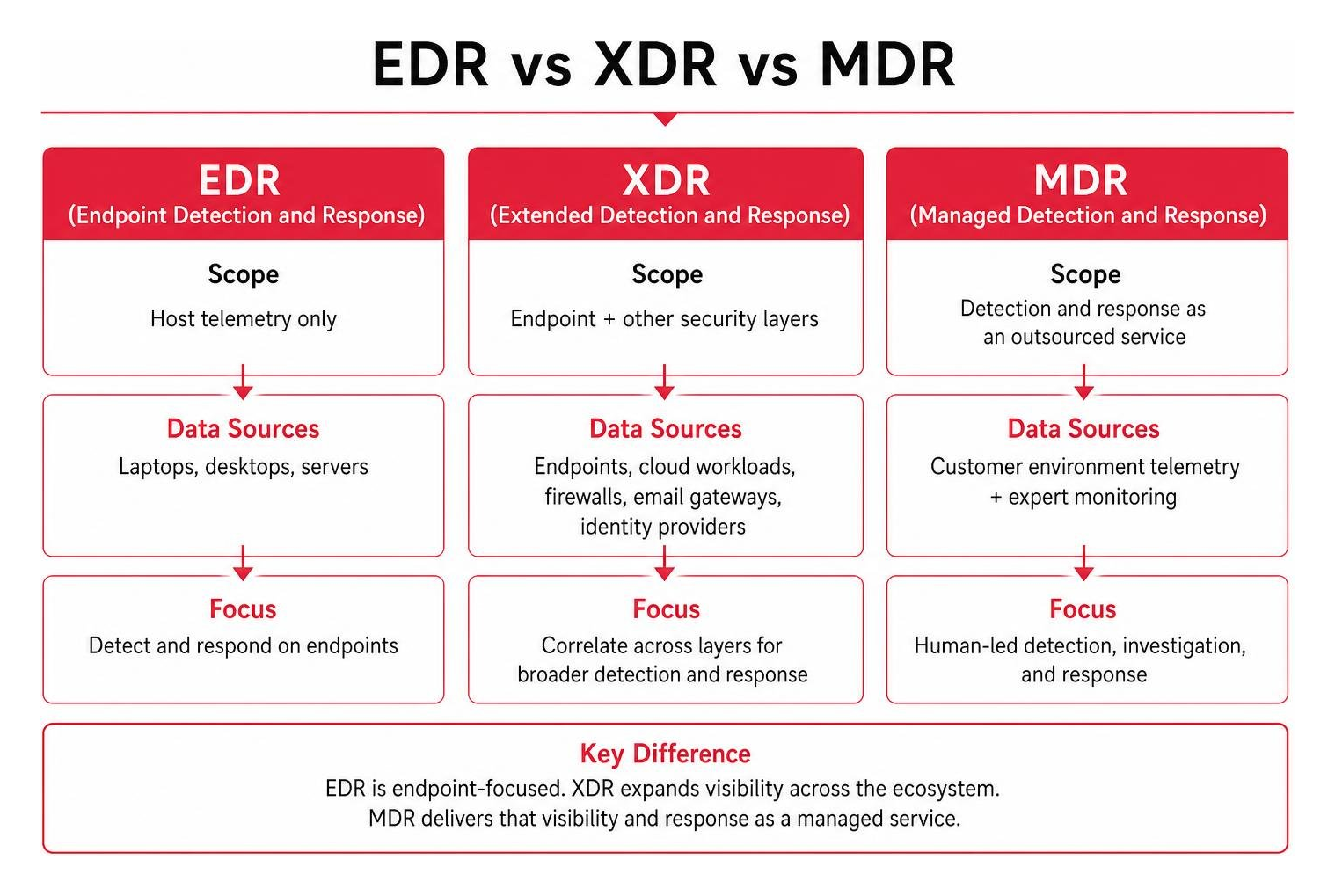
- EDR (Endpoint Detection and Response): Focuses strictly on host telemetry from laptops, desktops, and servers.
- XDR (Extended Detection and Response): Broadens visibility by integrating endpoint telemetry with cloud workloads, firewalls, email gateways, and identity providers.
- MDR (Managed Detection and Response): Delivers detection and response as an outsourced operational service powered by human analysts.
With 41% of IT and security professionals reporting heightened anxiety regarding future attacks, many organizations look toward specialized services like SOC as a Service to avoid alert fatigue.
Extended Detection and Response (XDR)
XDR breaks down security silos by correlating telemetry across multiple domains. Instead of viewing an endpoint alert in isolation, an XDR system correlates it with firewall logs, cloud access events, and email security gateways. This provides a unified timeline of an adversary’s path across the organization.
Managed Detection and Response (MDR)
Deploying powerful security software is only half the battle; having experts available around the clock to interpret alerts is what stops breaches. MDR provides 24/7 human-led threat hunting, alert triage, and active incident response. For organizations lacking an in-house security operations team, leveraging managed SOC operations ensures critical detections are investigated within minutes.
Essential Capabilities to Look for in Modern Endpoint Defense

Selecting an endpoint solution requires evaluating how effectively it delivers high protection while minimizing operational complexity. Leading platforms combine prevention-first technologies with AI-assisted alert prioritization to reduce noise and speed up response.
When evaluating endpoint technologies, focus on solutions that reinforce your efforts to secure IT infrastructure without overloading internal resources.
Cloud-Native Scalability and Fast Threat Querying
Cloud-native platforms eliminate the need for heavy on-premises management servers. By streaming telemetry to scalable cloud data lakes, security teams can run historical threat searches spanning weeks or months in seconds. This architecture ensures remote and hybrid workers remain fully protected and manageable regardless of where they connect.
Choosing the Right Architecture for Your EDR End Point
A modern security agent must remain lightweight, using minimal CPU and memory so user productivity remains uninterrupted. Furthermore, the architecture should enforce offline protection policies, maintaining behavioral blocking rules even when a laptop is disconnected from the internet. Adhering to these core cybersecurity principles ensures continuous defense without degrading device performance.
Frequently Asked Questions About EDR End Point Protection
How does EDR protect user privacy while monitoring endpoint activity?
EDR agents capture system and process telemetry (such as process names, file modifications, and IP connections) strictly for security analysis and threat hunting. They do not monitor personal communications, inspect private documents, track web browsing for surveillance, or record keystrokes. Monitoring parameters are governed by administrative policies designed to safeguard employee privacy while maintaining robust organizational cybersecurity posture.
Can EDR replace an existing antivirus solution entirely?
Most modern endpoint products integrate next-generation antivirus (NGAV) capabilities directly alongside EDR into a single unified agent. This unified structure blocks known malware proactively at pre-execution through machine learning and signature scanning, while maintaining continuous behavioral monitoring to catch evasive, behavioral, and fileless threats during runtime.
How does EDR integrate with the MITRE ATT&CK framework?
Leading EDR platforms automatically map detected system behaviors against the MITRE ATT&CK knowledge base of adversary tactics and techniques. By tagging alerts with standardized tactic and technique identifiers (such as T1059 for Command and Scripting Interpreter or T1003 for OS Credential Dumping), analysts can quickly understand the attacker’s objective, evaluate risk levels across the kill chain, and identify any gaps in defense coverage.
Conclusion: Upgrading Your Endpoint Defense for Total Resilience
Relying solely on legacy antivirus leaves organizations vulnerable to living-off-the-land attacks, stolen credentials, and memory-only exploits. Implementing modern endpoint detection and response delivers the continuous visibility, threat intelligence, and containment capabilities required to stop incidents before they become operational disruptions.
Alliance InfoSystems is a Maryland-based IT Provider founded in 2004 with over 20 years of experience delivering flexible, customized, and cost-efficient IT solutions. As specialists in managed IT, cybersecurity, cloud migration, SOC services, data backup, network security, and IT staffing, we help organizations build resilient, layered defenses. Contact us today to explore our comprehensive managed security services and modernize your endpoint defense.