
Why Choosing the Right Network Security Solutions Can Make or Break Your Business
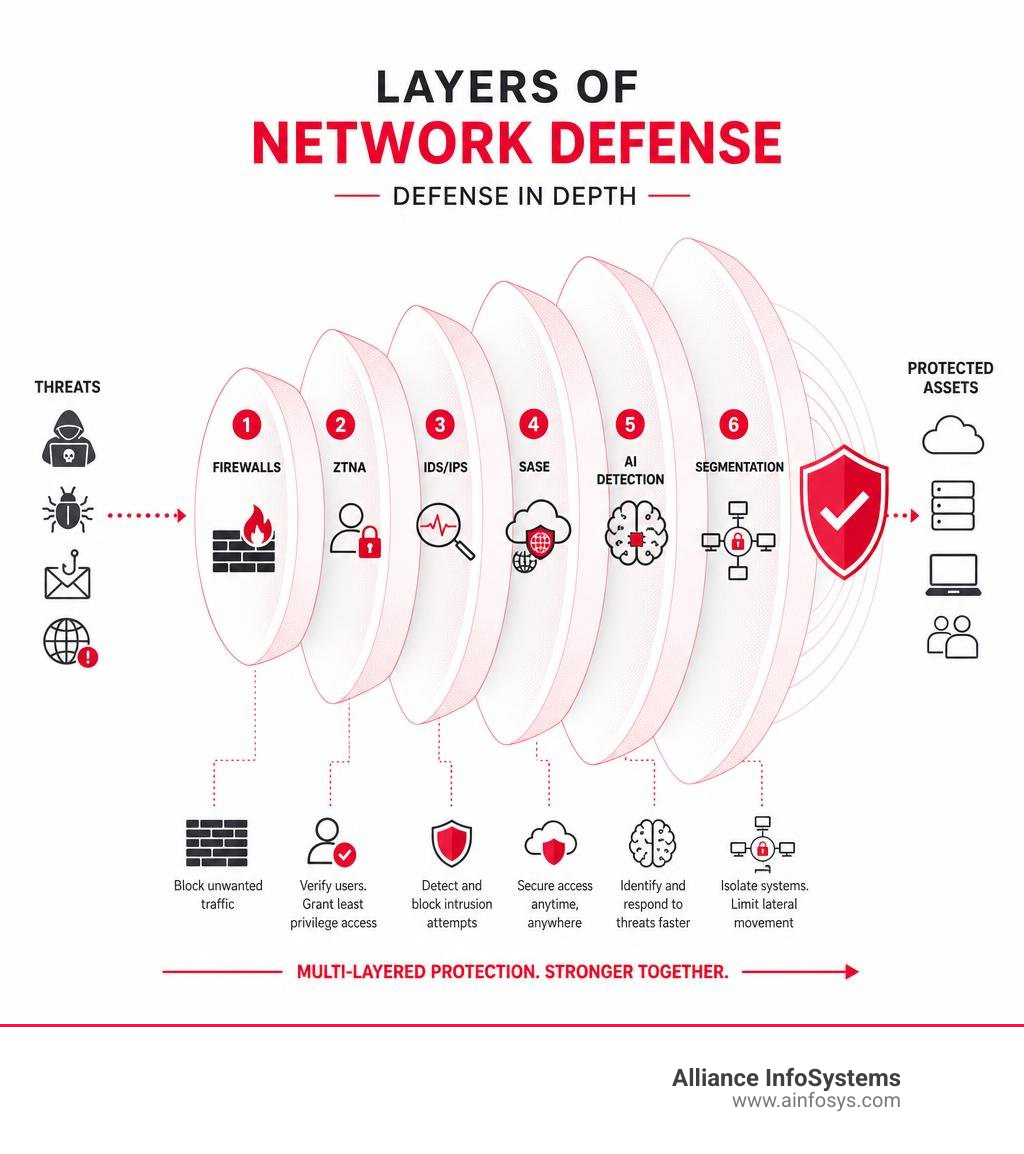
The best network security solutions for most small and medium-sized businesses in 2026 include:
- Next-Generation Firewalls (NGFW) – Deep packet inspection and application-layer threat blocking
- Zero Trust Network Access (ZTNA) – Continuous verification with least-privilege access controls
- SASE/SSE Platforms – Cloud-native security that unifies networking and protection in one platform
- IDS/IPS Systems – Real-time intrusion detection and prevention across your network traffic
- AI-Powered Threat Detection – Behavioral analysis and automated response to stop novel threats
- Network Segmentation – Isolating systems to limit how far an attacker can move if they get in
- SIEM and EDR – Centralized log correlation and endpoint-level visibility for faster detection
The stakes have never been higher. The global average cost of a data breach has reached $4.88 million, and attackers are not waiting around. A cyberattack happens somewhere every three seconds. For a small or mid-sized business, a single breach can wipe out years of hard-won customer trust and push you toward the door permanently. Research shows 60% of small companies shut down within six months of a serious security incident.
What makes this harder is that the threat landscape has shifted dramatically. More than 87% of threats today arrive over encrypted channels, which means traditional security tools that only inspect unencrypted traffic are effectively blind to most attacks. At the same time, 82% of breaches involve data stored in the cloud, and remote work has expanded the attack surface far beyond the office walls.
Your network is no longer just four walls and a server room. It is a sprawling mix of cloud apps, personal devices, remote employees, and third-party integrations. That shift has made the old model of simply building a strong perimeter around your data increasingly unreliable. Attackers now routinely bypass the perimeter entirely by targeting credentials, exploiting encrypted traffic, or moving laterally through systems that were never designed to stop internal threats.
This guide breaks down the major categories of network security solutions available today, explains how they differ, and helps you figure out which combination makes sense for your business size, budget, and risk profile.
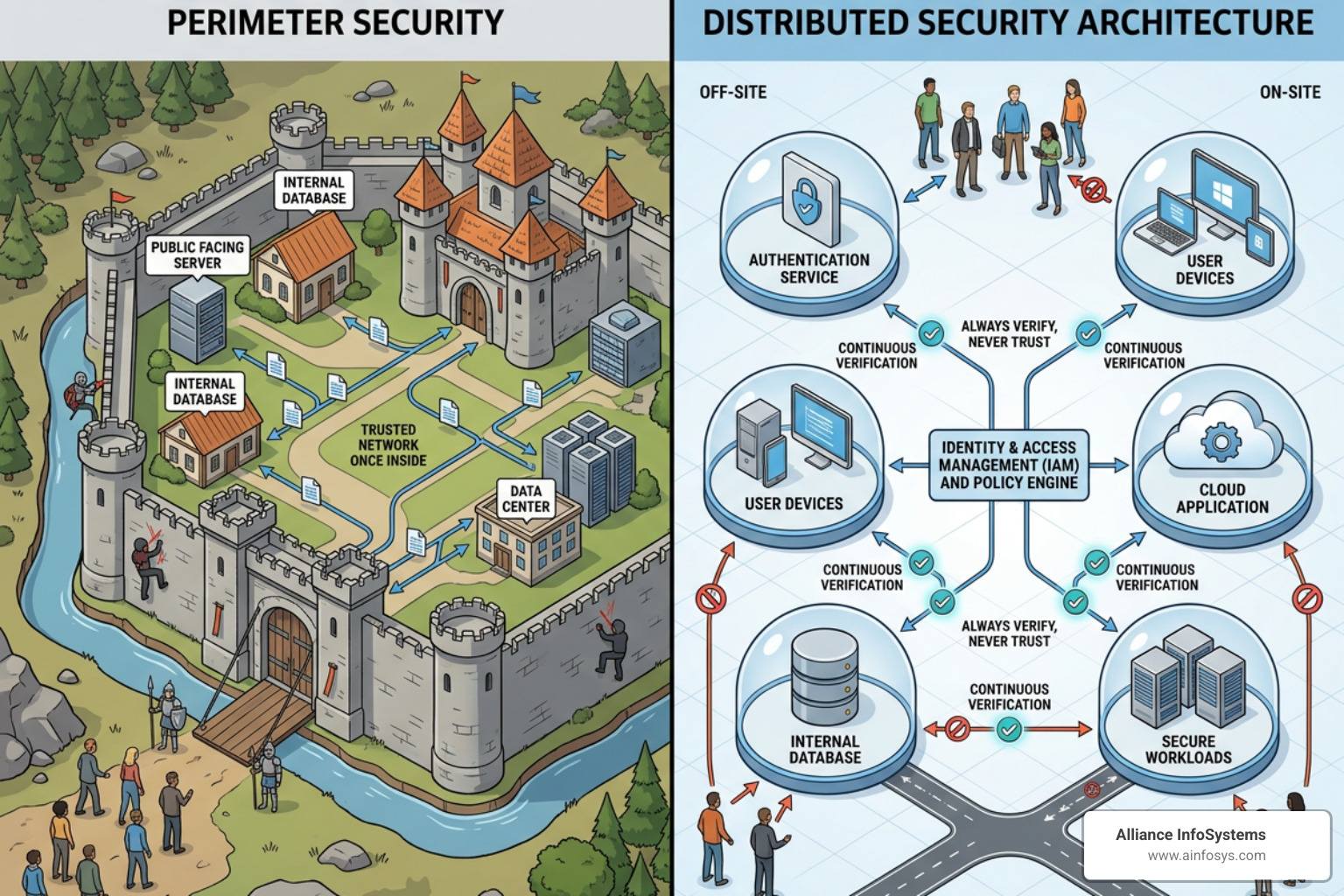
The Evolution of Network Security: Perimeter vs. Distributed Defense
Historically, network security operated under a simple “castle-and-moat” philosophy. The perimeter was the moat, and anyone inside the castle was automatically trusted. Today, this perimeter-based approach is functionally obsolete.
When organizations rely on implicit trust, an attacker who compromises a single endpoint or steals one set of credentials gains free rein over the entire network. This unrestricted lateral movement is how minor entry-point compromises spiral into catastrophic, organization-wide ransomware events.
Modern distributed defense shifts the focus from building taller walls to implementing continuous verification. To understand how to protect your modern infrastructure, it is helpful to look at How Network Security Services Protect Against Modern Cyber Threats.
Traditional Firewalls vs. Next-Generation Firewalls (NGFW)
Traditional firewalls operate at layers 3 and 4 of the OSI model. They inspect simple packet headers, making decisions to allow or block traffic based strictly on source IP, destination IP, and port numbers. While fast, they are blind to what is actually happening inside the data payload.
Next-Generation Firewalls (NGFWs) operate up to Layer 7 (the application layer). They utilize deep packet inspection (DPI) to look inside the actual data packets, identifying the specific applications generating the traffic. This level of visibility allows an NGFW to distinguish between safe traffic and malicious commands disguised as normal web activity. Leading options like SOPHOS Security Solutions – Columbia – Dresner Group and solutions from Fortinet: Global Leader of Cybersecurity Solutions and Services integrate these advanced application-layer controls directly into the hardware, blocking complex threats before they reach your internal systems.
Zero Trust Network Access (ZTNA) and Microsegmentation
Zero Trust operates on a simple guiding rule: never trust, always verify. Unlike traditional setups, ZTNA does not grant a user access to an entire network segment. Instead, it establishes secure micro-perimeters around individual applications and resources.
By leveraging continuous authentication, ZTNA constantly evaluates device posture, user identity, and contextual clues (like location and time) before granting access. This is supported by microsegmentation, which divides the network into tiny, isolated subnets. If an attacker manages to compromise a single device, microsegmentation prevents lateral movement, reducing the blast radius of the breach to that single isolated pocket. Implementing these controls is widely recognized as one of the Top 10 Cyber Security Practices for modern enterprises.
Core Architecture: Comparing NGFW, IDS/IPS, and SASE
Choosing the right architectural approach requires understanding how these core technologies compare in deployment and function:
| Feature | Next-Generation Firewall (NGFW) | Intrusion Detection/Prevention (IDS/IPS) | Secure Access Service Edge (SASE) |
|---|---|---|---|
| Primary Focus | Application-layer filtering & perimeter defense | Traffic monitoring & exploit blocking | Cloud-delivered security & secure remote access |
| Deployment | Physical appliance, virtual machine, or cloud | Inline hardware or software agent | Cloud-native, globally distributed platform |
| Key Advantage | High-throughput inspection at the edge | Identifies and stops known/unknown exploits | Consistent security for hybrid & remote workforces |
| Best For | Securing physical offices and data centers | Deep traffic analysis and compliance | Distributed enterprises & heavy cloud users |
Core Types of Network Security Solutions
To build a robust defense-in-depth model, organizations rely on a variety of specialized tools. Intrusion Detection Systems (IDS) act as security cameras, passively monitoring traffic and alerting administrators to suspicious behavior. Intrusion Prevention Systems (IPS) act as active security guards, sitting inline to analyze and block malicious packets in real time.
These systems generally utilize two primary detection methods:
- Signature-Based Detection: Compares traffic against a database of known threat patterns. It is highly effective for stopping established malware, but must be updated constantly to remain useful against new variants.
- Anomaly-Based Detection: Establishes a baseline of “normal” network behavior and flags anything that deviates from it. This is crucial for catching zero-day exploits that lack an established signature.
To see how these systems fit into a broader operational framework, refer to our comprehensive Network Security Services Guide 2026.
SASE and SSE: Unifying Security for Distributed Networks
Secure Access Service Edge (SASE) converges software-defined wide area networking (SD-WAN) with multiple cloud-native security services into a single, unified platform. For organizations that do not require full SD-WAN integration, Security Service Edge (SSE) focuses strictly on the security components—such as Secure Web Gateways (SWG), Cloud Access Security Brokers (CASB), and ZTNA.
Industry data highlights this rapid shift: by 2026, 85% of organizations seeking to secure their web, SaaS, and private applications will obtain their security capabilities from an SSE offering. Platforms like Security Service Edge (SSE) | Zscaler provide a seamless, cloud-native environment that secures users wherever they work, bypassing the latency and hardware costs of traditional backhauled data center architectures.
Securing Hybrid, Cloud, and Remote Work Environments
With business data spread across public clouds, private infrastructure, and SaaS applications, securing the network perimeter is no longer a physical task. The risk is highly distributed: more than 50% of security incidents are projected to come from cloud network activity by 2029. Determining if your current infrastructure is prepared for these shifts starts with asking, Are You at Risk of a Cyberattack?

Addressing the Vulnerabilities of Remote Access and BYOD
Traditional remote access rely heavily on Virtual Private Networks (VPNs). However, VPNs are a growing liability; 56% of enterprises were targeted by a VPN-related cyberattack in 2023. Once an attacker compromises a user’s VPN credentials, they gain broad access to the internal network.
This risk is compounded by Bring Your Own Device (BYOD) policies, with 81% of employees currently using personal, unmanaged devices at work. To mitigate these risks, organizations must enforce Multi-Factor Authentication (MFA), deploy Mobile Device Management (MDM) solutions, and implement strict email security controls to prevent credential harvesting. For practical advice on securing your primary communication channels, read about How to Stop Phishing Emails.
Cloud-Native Security and Hybrid Mesh Firewalls
Securing a hybrid environment requires consistent policy enforcement across both on-premises hardware and cloud instances. A hybrid mesh firewall approach solves this by running a unified operating system across all form factors. This allows security teams to manage policies through a single pane of glass, ensuring that a security rule created for an on-premises data center is automatically applied to workloads running in public or private clouds.
The Role of AI and Machine Learning in Threat Detection
Modern cyber threats evolve too quickly for human analysts to counter manually. Ransomware strains can encrypt entire servers in under two hours, making automated, intelligent defense systems a operational necessity. Understanding these automated threats is key to learning 7 Ways to Avoid Ransomware in Your Business.
The Role of AI in Modern Network Security Solutions
AI and machine learning (ML) allow network security solutions to move beyond static, signature-based defense. By processing billions of global security events in real time, AI-powered security engines can identify subtle patterns associated with zero-day attacks and block them instantly. Furthermore, machine learning automates incident response, isolating compromised devices and updating firewall policies at machine speed, which drastically reduces human error and operator fatigue.
Autonomous Response and Evasion Techniques
Attackers frequently use evasion techniques to bypass standard firewalls and IDS/IPS engines, such as:
- Packet Fragmentation: Splitting malicious payloads across tiny packets (using tools like Nmap with
-ffflags) to avoid detection. - Payload Manipulation: Encoding commands (such as using Base64 or Base32) to hide malicious strings.
- Proxy Evasion: Routing Command-and-Control (C2) traffic through legitimate proxy protocols.
AI-driven autonomous response platforms counter these tactics by analyzing traffic behavior over time rather than looking at individual packets in isolation. When an anomaly is detected, the system can instantly rewrite rules or quarantine the source. If a breach does occur, having a plan for What is Network Security Remediation Services? ensures your business can recover rapidly without prolonged operational disruption.
Evaluating and Choosing the Right Network Security Solutions
Selecting the appropriate security technologies requires a structured approach that aligns with your operational realities. To start this process, review our guide on How to Choose Best Network Security Services.
Mapping Business Requirements and Budget Constraints
Every organization has a unique risk profile and compliance burden. When mapping your requirements, consider:
- Asset-Specific Risks: Identify where your most sensitive data lives and prioritize protecting those pathways.
- Compliance Frameworks: Businesses in Maryland and the wider Mid-Atlantic region must often comply with strict regulations like HIPAA for healthcare data or CMMC for federal defense contracting.
- Total Cost of Ownership (TCO): Look beyond the initial purchase price of hardware. Factor in subscription renewals, management overhead, and the staff resources required to maintain the system.
Measuring Effectiveness and ROI of Security Investments
Evaluating the return on your security spend involves looking at both risk reduction and operational efficiency. For example, enterprises that converged their wired and wireless networking with secure LAN solutions boosted network operations efficiency by 50%, reduced the risk of external breaches by 60%, and recouped 70 hours of unplanned downtime over three years.
Key metrics to track include:
- Reduction in security incidents and successful breaches.
- Time-to-detect and time-to-remediate active threats.
- Hours of unplanned downtime avoided.
For a deeper dive into managing these metrics and maintaining your configuration keys securely, consult our resource on Network Security Management.
Frequently Asked Questions about Network Security
What is the difference between an IDS and an IPS?
An Intrusion Detection System (IDS) is a passive monitoring tool that analyzes network traffic copy and alerts administrators when it detects suspicious activity. An Intrusion Prevention System (IPS) is deployed inline, allowing it to actively block or drop malicious traffic the moment a threat is identified.
Why are traditional VPNs considered a security liability in 2026?
Traditional VPNs grant broad, network-level access once a user is authenticated, allowing attackers who steal credentials to move laterally across internal databases. Additionally, VPN hardware vulnerabilities are frequently targeted, and backhauling remote traffic through a central VPN gateway creates significant network latency.
How does network segmentation prevent lateral movement?
Network segmentation divides a large network into smaller, isolated subnets with distinct security policies. By restricting communication between these zones, an attacker who compromises a device in one segment cannot access resources in another, effectively containing the threat.
Secure Your Business with Alliance InfoSystems
Building and managing a modern network security architecture is a complex, continuous job. As a Maryland-based IT Provider with over 20 years of experience, Alliance InfoSystems delivers flexible, customized, and cost-efficient security solutions tailored to your business needs.
We specialize in managed IT, comprehensive cybersecurity, cloud migration, 24/7 SOC services, reliable data backup, network security, and specialized IT staffing. We help you eliminate security gaps, streamline your operations, and protect your business from evolving digital threats.
To protect your organization’s future, schedule your comprehensive security assessment with Alliance InfoSystems today.