What the EDR Acronym Means in Security
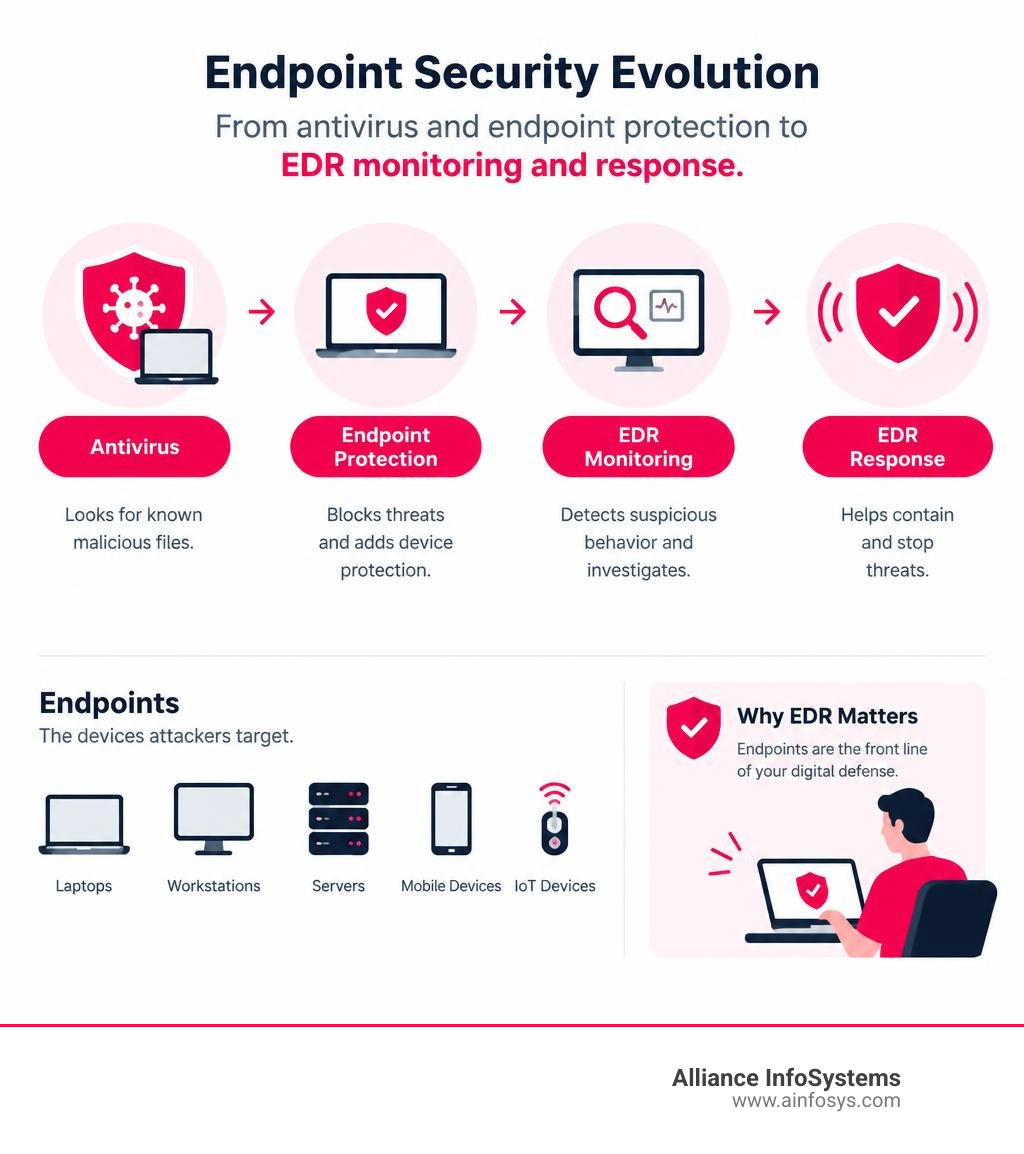
EDR stands for Endpoint Detection and Response. It monitors devices such as laptops and workstations for suspicious activity, then gives security teams tools to investigate and contain threats. Unlike traditional antivirus, which mainly looks for known malicious files, EDR also tracks behavior that may signal a new or hidden attack.
For a small business, the key question is not just whether an EDR tool can raise an alert. It is who will review that alert and respond. As a Maryland IT Provider with managed IT, cybersecurity, and SOC services expertise, Alliance InfoSystems understands why that distinction matters.
What Does EDR Stand for? Understanding the EDR Acronym in Security
Cybersecurity terminology can feel like a bowl of alphabet soup. When you hear security engineers throw around terms like EDR, NDR, SIEM, and SOAR, it is easy to get lost. However, understanding the EDR acronym in security is foundational because endpoints represent the front lines of modern digital defense.
An endpoint is any device that connects to your enterprise network—workstations, laptops, physical and virtual servers, mobile devices, and IoT hardware. Because employees interact with these endpoints daily, malicious actors target them relentlessly. In fact, research indicates that up to 70 percent of data breaches originate on endpoint devices.
The Core Definition: What EDR Acronym Security Means
At its heart, Endpoint Detection and Response refers to an integrated security toolset that continuously records system activity, analyzes behavioral events, and executes remediation actions. As formally recognized by the Endpoint Detection and Response definition maintained in federal standards, EDR focuses on granular system visibility to detect intrusions that bypass basic preventive barriers.
Instead of merely checking files when they download, EDR sits quietly on the host, capturing telemetry such as registry changes, network sockets, process execution trees, and user authentication events. By pairing continuous data collection with behavioral analysis, the software spots malicious intentions in real time. Knowing how these host sensors fit into your broader architecture is a vital component of how to secure IT infrastructure.
The Evolution from Traditional Antivirus and EPP to EDR
To appreciate why EDR exists, we have to look back at the limitations of early security tools:
- Traditional Antivirus (AV): Early antivirus relied on signature matching. When a vendor discovered malware, they created a unique file hash (a digital fingerprint). If a matching file appeared on your hard drive, AV quarantined it. Attackers quickly adapted by modifying malware code on the fly to generate new signatures, bypassing static scanners.
- Endpoint Protection Platforms (EPP): To combat mutating malware, security evolved into EPP. These suites combined signature engines with heuristic scanning, static machine learning, host firewalls, and data loss prevention. EPP stopped known threats at the perimeter, but struggled when attackers leveraged legitimate administrative tools.
- Endpoint Detection and Response (EDR): Coined originally as Endpoint Threat Detection and Response by Gartner analysts in 2013, EDR assumed that breaches will happen. Instead of just trying to keep threats out, EDR gives defenders continuous recording and response mechanisms to shrink adversary dwell time and halt living-off-the-land techniques or fileless malware.

Key Capabilities and How EDR Protects Modern Endpoints
Modern EDR platforms function like digital flight data recorders combined with active safety controls. If an anomalous event occurs, the system preserves the forensic evidence while giving analysts the tools to stop the attack cold.

Continuous Telemetry, Behavioral Detection, and Threat Hunting
EDR agents constantly aggregate endpoint telemetry. Rather than evaluating events in total isolation, the detection engine maps observed behaviors against structured frameworks like MITRE ATT&CK. This allows the system to recognize adversary techniques—such as process injection, credential dumping via LSASS, or lateral movement through PowerShell.
By establishing baselines of normal endpoint behavior, EDR platforms flag suspicious deviations. For example, if a PDF reader spawns a command shell that attempts to alter registry keys, the EDR flags this anomaly immediately. Security teams can also leverage proactive threat hunting to query across thousands of endpoints simultaneously, checking whether a newly disclosed indicator of compromise (IOC) exists anywhere within the environment. Integrating proactive hunting into your defense is one of the top cybersecurity practices for resilient enterprises.
Real-Time Incident Response and Remediation
Detection without decisive response leaves your systems exposed. EDR enables security operations teams to intervene through automated rules or direct analyst commands:
- Endpoint Isolation: Instantly sever an infected machine from the local network and internet while maintaining an encrypted channel to the security console for triage.
- Process Termination and File Quarantine: Automatically kill running malicious processes, freeze child executions, and quarantine unauthorized binaries.
- Rollback Capabilities: Restore modified system files and registry keys back to a clean, pre-infection state.
- Forensic Investigation: Trace the full attack timeline to see exactly how a malicious actor gained initial access, what files they touched, and whether they attempted to move laterally.
Decoding the Acronym Ecosystem: EDR vs. MDR, XDR, and NDR
As the cyber industry develops new ways to correlate threat telemetry, detection acronyms have multiplied. Differentiating these tools helps organizations make sound architectural investments.
Differentiating EDR Acronym Security from Other Detection Frameworks
The broader detection family addresses different layers of your technology stack:
- EDR (Endpoint Detection and Response): Focuses specifically on activity occurring directly on host operating systems.
- NDR (Network Detection and Response): Analyzes raw network traffic, flow records, and protocol metadata to detect anomalies across unmanaged devices, smart infrastructure, and legacy systems where agents cannot be installed.
- XDR (Extended Detection and Response): Integrates and correlates telemetry across multiple vectors—endpoints, cloud workloads, email gateways, identity providers, and networks—providing a single pane of glass.
- MDR (Managed Detection and Response): A managed service rather than a standalone software tool. MDR provides 24/7 human oversight, alert triage, proactive hunting, and incident remediation on behalf of your organization.
The following table summarizes how these approaches compare:
| Security Solution | Primary Focus Area | Deployment Nature | Best Suited For |
|---|---|---|---|
| EDR | Host devices, laptops, servers | Software agent installed on endpoints | Teams with dedicated analysts to manage alerts |
| NDR | Network traffic and packet analysis | Network taps, sensors, and virtual probes | Organizations with unmanaged devices and IoT |
| XDR | Multi-vector telemetry (Cloud, Email, Endpoint, Identity) | Unified multi-layered security ecosystem | Advanced enterprises seeking holistic visibility |
| MDR | 24/7 Human-led monitoring and containment | Managed security service model | Businesses lacking a 24/7 internal SOC |
When combined, EDR and NDR feed valuable telemetry into SIEM systems, forming what many industry analysts call the SOC Visibility Triad. For organizations implementing structured compliance frameworks, following authoritative NIST EDR guidelines ensures consistent policy alignment across all connected systems.
Self-Managed EDR Tools vs. Managed EDR (MEDR) Services
Purchasing a top-tier EDR license does not automatically secure an organization. EDR software is an investigative instrument; it requires experienced eyes to interpret complex detection graphs, validate true positives, and dismiss false alarms.
Without sufficient internal staff, organizations frequently encounter alert fatigue. High alert volumes can lead to missed notifications and burnout. This operational reality has driven the popularity of Managed EDR (MEDR) and outsourced security operations.
By leveraging an external SOC as a Service, businesses gain continuous, round-the-clock eyes on their endpoint sensors. Entrusting threat triage to managed SOC operations eliminates coverage gaps on nights and weekends without the massive capital expenditure required to staff a 24/7 internal security team.
Strategic Benefits, Limitations, and Future Trends in EDR
The endpoint security market is undergoing rapid growth. Industry evaluations place the adoption of cloud-based and on-premises EDR solutions at USD 6.5 billion in 2025, with projections estimating an expansion to USD 50.5 billion by 2034.
Weighing Advantages Against Implementation Challenges
Deploying modern EDR brings notable defensive strengths, including rapid breach containment, deep forensic visibility, and automated remediation. It closes the visibility blind spots that legacy antivirus left wide open.
However, organizations must prepare for practical implementation hurdles:
- Resource and Skill Demands: Tuning behavioral engines and responding to complex alerts requires seasoned cybersecurity talent.
- Agent Overhead: Running telemetry sensors on resource-constrained hardware or outdated legacy platforms requires careful pilot testing.
- Alert Volume: Out-of-the-box configurations can generate significant operational noise if baseline rules are not tuned to normal business software.
Addressing these friction points directly is vital to sustaining a sound corporate cybersecurity posture.
Emerging Trends: AI, Cloud Architecture, and Zero Trust
Endpoint security technologies continue to advance as adversaries develop new attack methodologies:
- Cloud-Native Telemetry: Modern EDR architectures leverage cloud data lakes to process behavioral telemetry at massive scale, decoupling heavy analysis from local device processing.
- AI and Predictive Analytics: Machine learning models identify zero-day exploit patterns and automate tier-one alert investigation, reducing dwell times from days to seconds.
- Zero Trust Integration: EDR agents act as continuous posture assessment engines. If an endpoint displays suspicious behavior, its risk score updates instantly, prompting the Zero Trust network access (ZTNA) layer to restrict access to sensitive applications.
- Edge Computing Adaptations: Specialized, lightweight micro-agents are being developed to monitor distributed edge computing nodes and industrial control systems where continuous cloud connectivity is unavailable.
Frequently Asked Questions About EDR Security
What does EDR stand for in cybersecurity?
EDR stands for Endpoint Detection and Response. It is a category of security software that monitors endpoint devices, collects detailed telemetry, identifies suspicious behaviors, and gives security professionals tools to isolate devices and remediate threats in real time.
Why is traditional antivirus insufficient without EDR?
Traditional antivirus relies primarily on known signatures and static file analysis. It struggles to detect modern attack methods such as living-off-the-land binaries, fileless malware executing in memory, and credential theft techniques. EDR inspects running behavior, catching intrusions that do not rely on malicious files.
Should small and mid-sized businesses choose EDR or MDR?
If a business employs a dedicated, around-the-clock internal security team capable of triaging alerts and performing forensic investigations, managing standalone EDR tools may suffice. For organizations with small IT teams, Managed Detection and Response (MDR) is usually the more practical choice because it provides 24/7 expert coverage and proactive response without the overhead of building an in-house security operations center.
Conclusion: Building a Resilient Endpoint Security Strategy
Understanding what the EDR acronym means in security is the first step toward closing endpoint vulnerabilities. Modern cyber threats move fast, and relying solely on legacy antivirus leaves vital business systems exposed. EDR provides the continuous visibility, behavioral analysis, and rapid remediation necessary to defend endpoints across complex hybrid environments.
Successfully defending your business requires pairing advanced tools with experienced human oversight. As a Maryland-based IT Provider founded in 2004, Alliance InfoSystems brings over two decades of experience delivering flexible, cost-efficient IT management, network security, cloud migration, data backup, IT staffing, and SOC services.
Whether you need to deploy modern endpoint telemetry or enhance your monitoring with comprehensive managed security services, our dedicated team can build a customized defense architecture that protects your critical data and keeps your business secure.