Why an IT Modernization Strategy Matters for Modern Enterprises
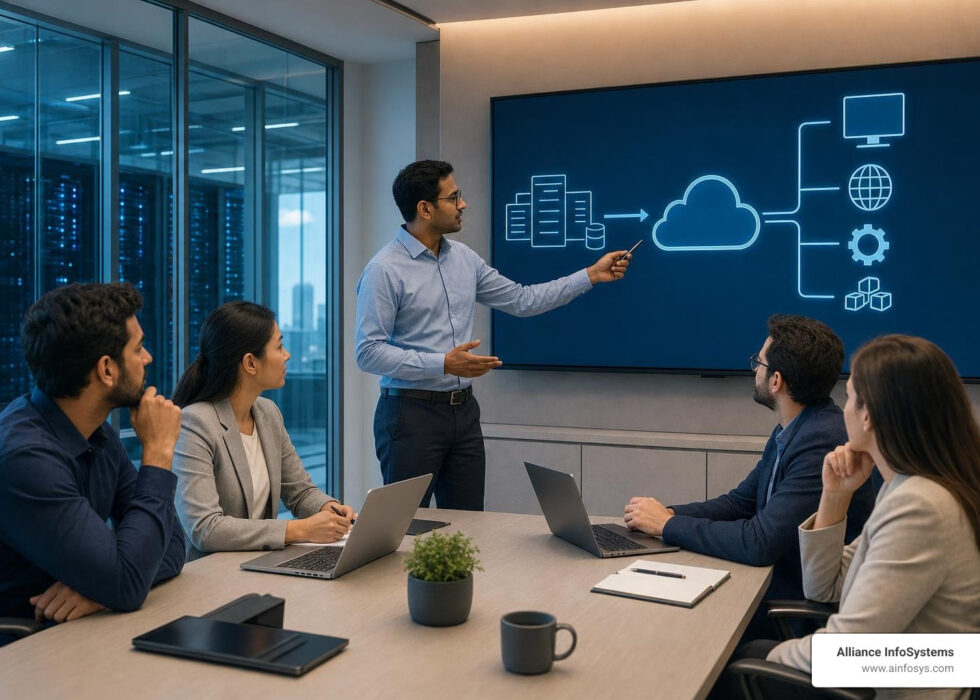
An IT modernization strategy is a practical plan for upgrading the applications, infrastructure, data practices, and workflows that support your business. Its goal is not simply to replace old technology. It is to make IT more secure, scalable, reliable, and easier to adapt as business needs change.
For a small or mid-sized organization, modernization often starts with a clear question: which systems create the most cost, risk, downtime, or frustration today? The answer may be an aging server, a hard-to-update business application, fragmented user accounts, manual processes, or cloud tools adopted without central oversight.
| IT modernization strategy | Legacy maintenance |
|---|---|
| Improves systems to support future business needs | Keeps existing systems running with minimal change |
| Reduces technical debt and operational risk | Often adds patches and workarounds over time |
| Can include cloud migration, automation, security, and application updates | Focuses mainly on break-fix support and routine upkeep |
| Uses phased improvements tied to measurable outcomes | Reacts to urgent problems as they appear |
Legacy technology can make even small changes slow and expensive. In one public-sector example, an agency estimated that changing a single rule in a mainframe system could require 2,000 to 6,000 development hours. Most businesses will not face that exact scenario, but the lesson is familiar: tightly connected, poorly documented systems can turn ordinary business needs into major IT projects.
A strong modernization effort does not require a risky, overnight replacement. It begins with visibility into assets, applications, costs, dependencies, and security gaps. Then, leaders can prioritize the work that protects operations and delivers value first. That may mean moving a stable workload to the cloud, automating repetitive support tasks, strengthening identity controls, or replacing a high-risk legacy application in manageable stages.
Modernization is also different from digital transformation. Digital transformation changes how an organization serves customers, delivers products, and operates. IT modernization strengthens the technical foundation that makes those changes possible. Without reliable networks, protected data, resilient backups, modern cloud environments, and secure access controls, new digital initiatives can struggle to scale.
For organizations managing limited internal IT resources, the right strategy connects technical decisions to business outcomes: fewer disruptions, better cybersecurity, faster service, clearer costs, and more room to grow. Alliance InfoSystems, an IT Provider with expertise in managed IT, cybersecurity, cloud migration, SOC services, data backup, network security, and IT staffing, helps organizations approach that work with business continuity and risk reduction in mind.
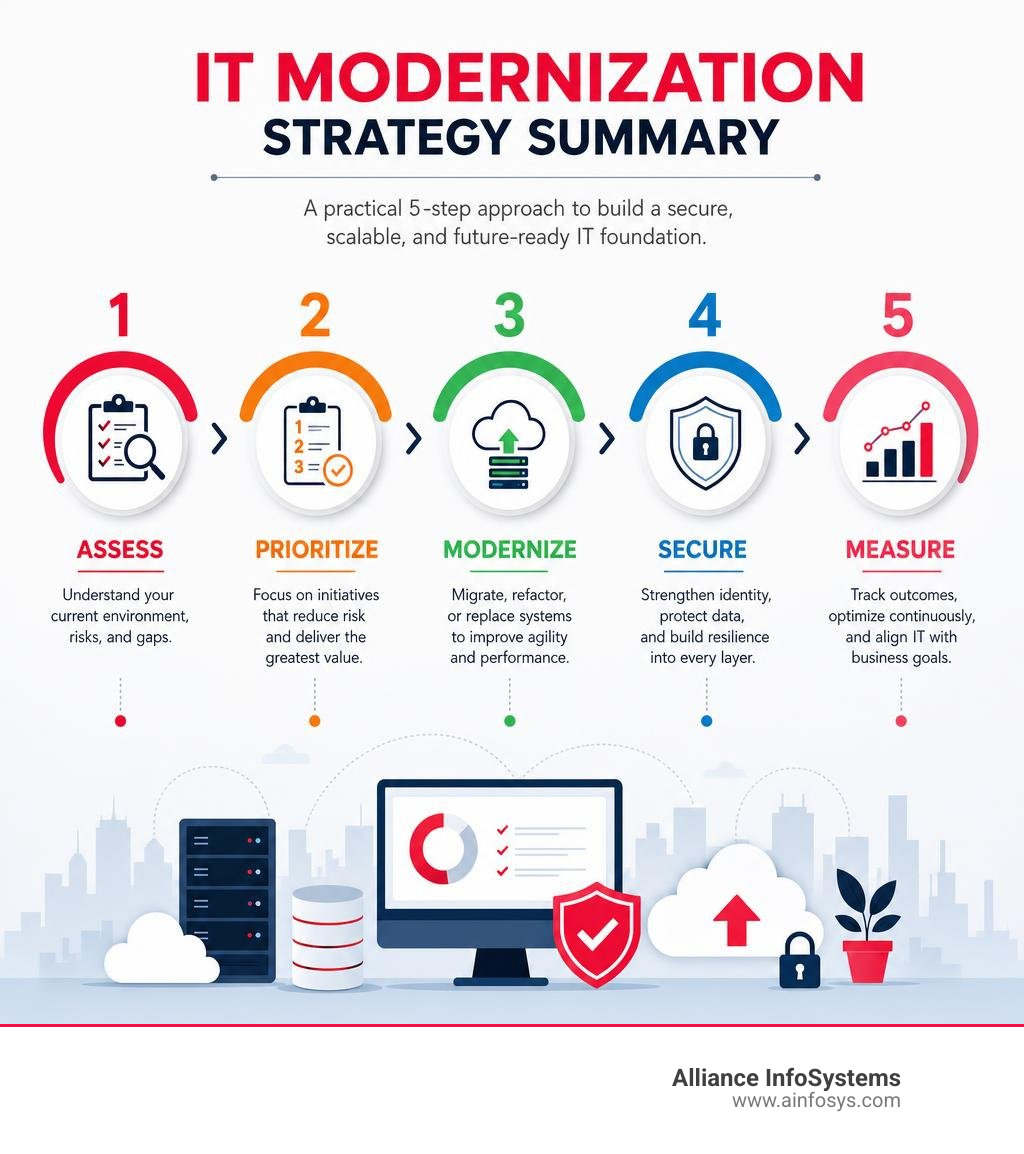
Simple guide to IT modernization strategy:
Understanding IT Modernization vs. Digital Transformation
To build a resilient technology landscape, business leaders must separate foundational infrastructure updates from broader business model shifts. While digital transformation reimagines how an organization interacts with customers or automates internal business processes, an IT modernization strategy focuses on renewing the software, servers, networks, and data architecture beneath those capabilities. Without updated infrastructure, ambitious digital programs frequently falter due to hidden technical debt and operational brittleness.
Modernization begins with establishing operational visibility. Complete insight into existing hardware assets, software licenses, and network entry points prevents hidden costs and reveals unapproved applications—often called shadow IT—that creep into unmanaged environments. Comprehensive asset management gives IT teams the baseline needed to evaluate software updates, consolidate server capacity, and align strategic spend. Leaders who evaluate their options using resources like the state-level Modernization Playbook or our guidance on Top IT Investments for 2025 Budget can ensure every technology expenditure supports long-term operational strength.
Key Pillars of an Enterprise IT Modernization Strategy
A balanced enterprise strategy rests on four distinct pillars that stabilize operations while supporting scalable business growth:
- Software renewal, which converts rigid code bases and unsupported legacy applications into manageable, updateable programs.
- Infrastructure modernization, which transitions physical server rooms into hybrid or public cloud hosting environments to increase uptime and elasticity.
- Intelligent automation, which removes repetitive manual tasks from daily support routines so internal teams can focus on strategic initiatives.
- Comprehensive asset management visibility, which provides central governance over user credentials, software licensing, and hardware life cycles.
Core Frameworks: Replatforming, Refactoring, and Rearchitecting
Choosing the right technical path for legacy applications requires matching business goals with workload requirements. Organizations rarely need to rebuild every application from scratch. Instead, technical leaders evaluate workloads across three primary cloud transition frameworks: replatforming, refactoring, and rearchitecting.
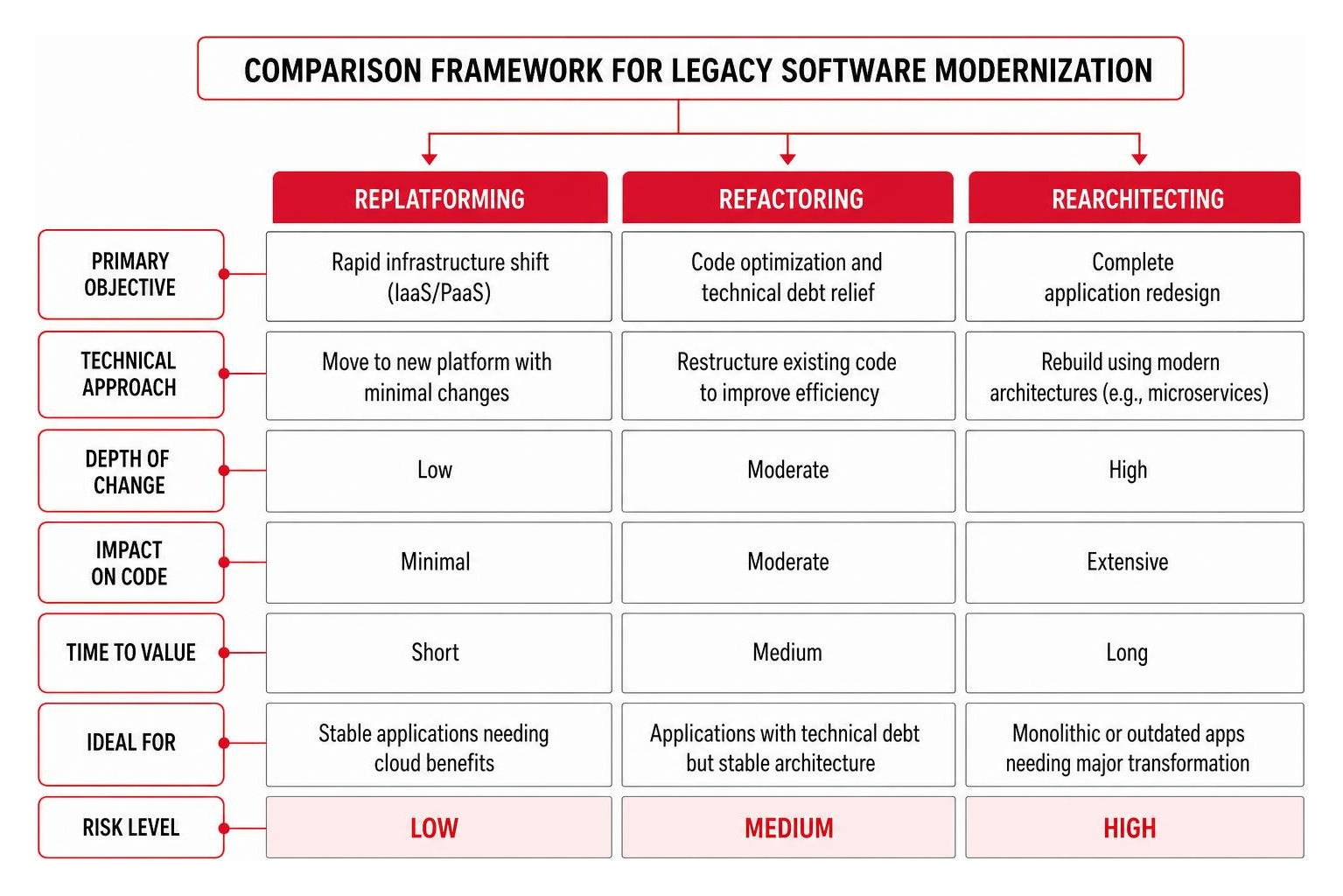
| Strategy Framework | Primary Objective | Technical Impact | Risk Level |
|---|---|---|---|
| Replatforming | Rapid infrastructure shift (IaaS/PaaS) | Upgrades underlying platform with minimal code changes | Low |
| Refactoring | Code optimization and technical debt relief | Restructures existing code to boost efficiency without changing core external behavior | Medium |
| Rearchitecting | Complete application redesign | Shifts monolithic designs into microservices or serverless architecture | High |
Replatforming, often referred to as a lift-and-shift with light optimization, moves an application to managed cloud hosting without changing its underlying business logic. This approach provides immediate operational relief and reduces physical data center costs. Refactoring goes a step further by tuning internal code structure to eliminate stability bottlenecks, while rearchitecting fully breaks apart old applications into scalable microservices and serverless components. Exploring our Cloud Migration Guide and federal insights like the IT Modernization Strategy | U.S. Department of Labor reveals how combining these approaches protects critical business logic while leveraging cloud native agility.
Modular Architecture vs. Monolithic Software
Legacy monolithic applications bundle databases, user interfaces, and operational code into a single interdependent software block. Minor updates to a monolithic application require testing and deploying the entire system, creating severe business risk. In institutional environments where mission-critical systems rely heavily on mainframes, organizations increasingly utilize Mainframe-as-a-Service (MFaaS) or API-first modular integrations to bridge the gap. Building around modular components allows individual functions to be upgraded, secured, and scaled without endangering surrounding operations.
How to Plan and Phase Your IT Modernization Strategy
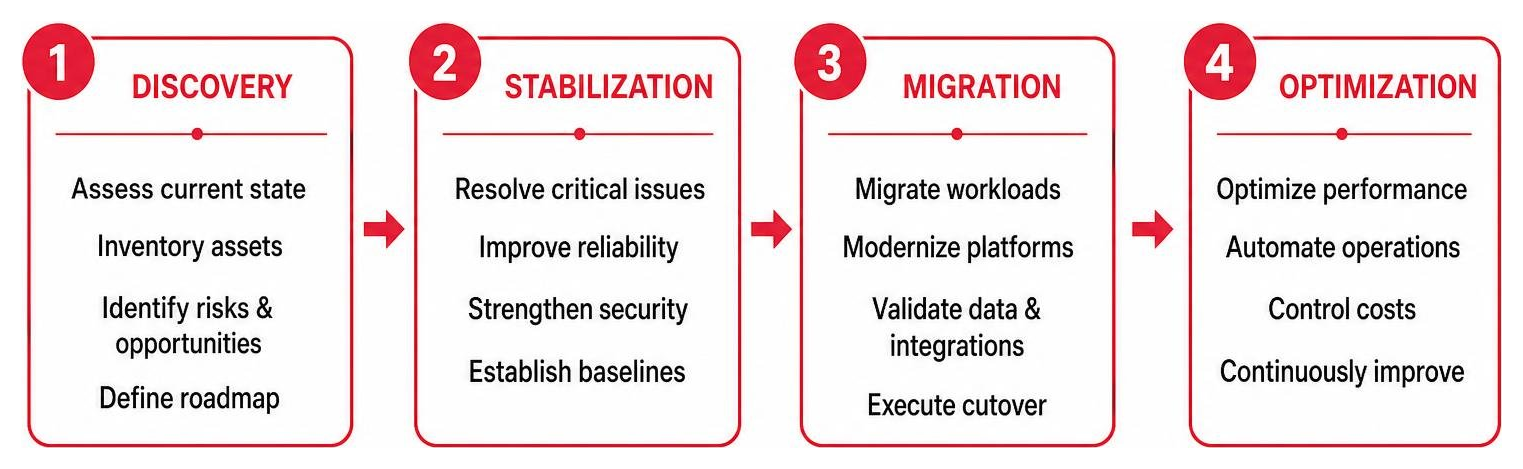
Modernizing enterprise architecture works best as an incremental journey rather than an all-at-once transition. Phased execution allows teams to validate technical performance, limit operational downtime, and demonstrate clear business value early in the initiative.
Planning begins with workload decomposition and a dedicated Phase 0 focused entirely on stabilizing fragile systems in place. Once baseline stability is secured, engineering teams execute parallel deployments—running legacy and modernized environments side by side—to confirm data accuracy before making a final switch cutover. Implementing canary releases, where a minor percentage of live traffic routes to the modernized environment, gives IT managers time to identify performance issues safely.
Adopting structured planning resources like Microsoft’s plan-cloud-modernization guide ensures teams stay focused on sequential 1-to-3-year roadmaps instead of rigid multi-year plans that quickly become obsolete. Real-world journeys detailed in A Multi-State Organization’s Transformation from Fragmented IT to Fully Cloud Enabled demonstrate how clear sequencing transforms fragmented network environments into unified cloud ecosystems.
Governance, Leadership, and Organizational Alignment
Technology modernization is fundamentally a business delivery strategy rather than an isolated IT project. For transformation efforts to succeed, executive sponsorship must originate from business leaders who align technical objectives directly with organizational outcomes. Operating models thrive when organizations transition from project-based teams to persistent product management structures with joint business and IT leadership.
Establishing executive steering committees, enforcing strict change advisory guidelines, and setting formal project scope freezes prevent runaway budget overruns. Strategies outlined in our IT Governance Consulting Whitepaper and the federal Scaling IT Modernization Playbook show that aligning clear purpose with disciplined governance increases transformation success rates by up to 3.5 times.
Mitigating Risk, Ensuring Security, and Integrating AI

Security and risk management must be integrated directly into architectural planning from day one. Modernizing infrastructure without updating access controls or encryption protocols simply exposes legacy vulnerabilities to wider networks. Incorporating zero-trust network concepts ensures that identity verification and access permissions remain tightly enforced across all cloud and hybrid environments.
When modernizing operations, leaders must maintain a clear distinction between IT procurement and AI implementation. Purchasing hardware, cloud storage subscriptions, or network bandwidth involves vendor selection and capacity planning. Implementing emerging technologies like Generative AI and automated workflows involves data governance, compliance validation, and process optimization. Guidance from public sector initiatives, such as the NJ IT Business & Technology Strategic Plan 2025-2026, emphasizes establishing clear risk thresholds before introducing automated capabilities into production environments. Practical examples from Transforming Technology Infrastructure for Growth and Efficiency highlight how combining robust infrastructure with automated operational workflows ensures scalable, long-term stability.
Security Frameworks and Resilience During System Transitions
Maintaining operational resilience during complex transitions requires strict adherence to security frameworks such as NIST 800-53. Centralizing user management through unified Identity and Access Management (IAM) platforms removes credential silos across legacy software and cloud tools. Meanwhile, automated rollback procedures, immutable data backups, and continuous 24/7 Security Operations Center (SOC) monitoring guarantee quick recovery if unexpected service disruptions occur during cutover periods.
Measuring ROI and Success in an IT Modernization Strategy
Evaluating the business value of an IT modernization strategy requires tracking quantitative operational metrics alongside long-term strategic benefits:
- Infrastructure and licensing cost reductions (yielding typical annual operational savings of 20% to 40%).
- Deployment frequency and resolution speed improvements (generating developer productivity gains of 50% to 80%).
- Downtime and security incident avoidance (yielding significant risk mitigation cost savings).
- Market expansion and customer retention gains (accelerating business revenue growth by 10% to 25%).
Frequently Asked Questions About IT Modernization Strategy
What is the main difference between IT modernization and digital transformation?
IT modernization focuses on updating the technical foundation—such as cloud migration, network hardware, application refactoring, and security architecture. Digital transformation builds upon that modernized foundation to change how an organization creates customer value, automates business processes, and delivers services.
How should organizations choose between refactoring and rearchitecting legacy applications?
Organizations should refactor when code exhibits technical debt but the core underlying architecture supports performance needs. Rearchitecting is necessary when monolithic code structures actively prevent horizontal scaling, integration with cloud-native capabilities, or required security updates.
How can executive leaders control scope creep during modernization projects?
Executive sponsors control scope creep by implementing strict change advisory workflows, breaking initiatives into short 1-to-2-month execution phases, and placing non-essential enhancement requests into a formal innovation backlog reserved for future development cycles.
Conclusion

Developing a future-proof IT modernization strategy is a continuous commitment to operational excellence, security, and agility. By establishing deep asset visibility, selecting appropriate refactoring or replatforming frameworks, maintaining strong business governance, and enforcing zero-trust cybersecurity standards, enterprises can eliminate technical debt without risking operational continuity.
As a trusted IT Provider with over two decades of hands-on experience, Alliance InfoSystems helps organizations navigate complex technology transitions with confidence. Whether your enterprise needs advanced managed IT services, comprehensive cloud migration, SOC security monitoring, robust data backup solutions, or specialized IT staffing, our expert teams deliver customized strategies aligned with your business goals. Explore our Cloud & Virtualization Services today to discover how we can help modernize your IT infrastructure.