Is Cloud-Based NAC Right for Your Business? Here’s What You Need to Know
Cloud-based NAC (Network Access Control) is one of the fastest-growing security investments in enterprise IT right now, and for good reason.
Quick answer: What is cloud-based NAC?
A cloud based NAC is a cloud-hosted security system that decides which users and devices can access your network. Instead of relying on on-premises hardware, it authenticates access through a cloud policy engine. It helps organizations manage remote workers, IoT devices, BYOD, and multiple locations while supporting Zero Trust goals without extra hardware to buy, maintain, or patch.
For years, Network Access Control was seen as enterprise-only technology. Too complex. Too expensive. Too much to manage. Small and mid-sized businesses either skipped it entirely or struggled to keep aging on-premises appliances running.
That perception has changed fast.
In 2026, 87% of organizations are actively increasing their NAC investment, up from 83% the year before. The shift to cloud-delivered NAC is a big reason why. It removes the hardware burden and makes enterprise-grade access control accessible to businesses of all sizes.
The core problem NAC solves has not changed. Every device that connects to your network is a potential entry point for attackers. Laptops, smartphones, IP cameras, smart printers, point-of-sale terminals — they all need to be identified, authenticated, and given only the access they actually need. Without that control, you are essentially leaving your front door unlocked.
What has changed is the scale of the problem. Remote work, cloud applications, IoT devices, and bring-your-own-device policies have expanded the network perimeter far beyond the walls of any single office. Around 25% of businesses operate across multiple locations with different networks, technologies, and regulatory requirements. Managing all of that with traditional hardware-based NAC is becoming unsustainable.
Cloud-based NAC addresses this directly. By moving the authentication and policy engine to the cloud, organizations can enforce consistent access rules across every site, device type, and user group — without maintaining physical appliances at each location.
This guide covers everything IT managers and business owners need to understand about cloud NAC: how it works, why modern networks need it, how it supports Zero Trust security, and how to choose the right solution for your environment.
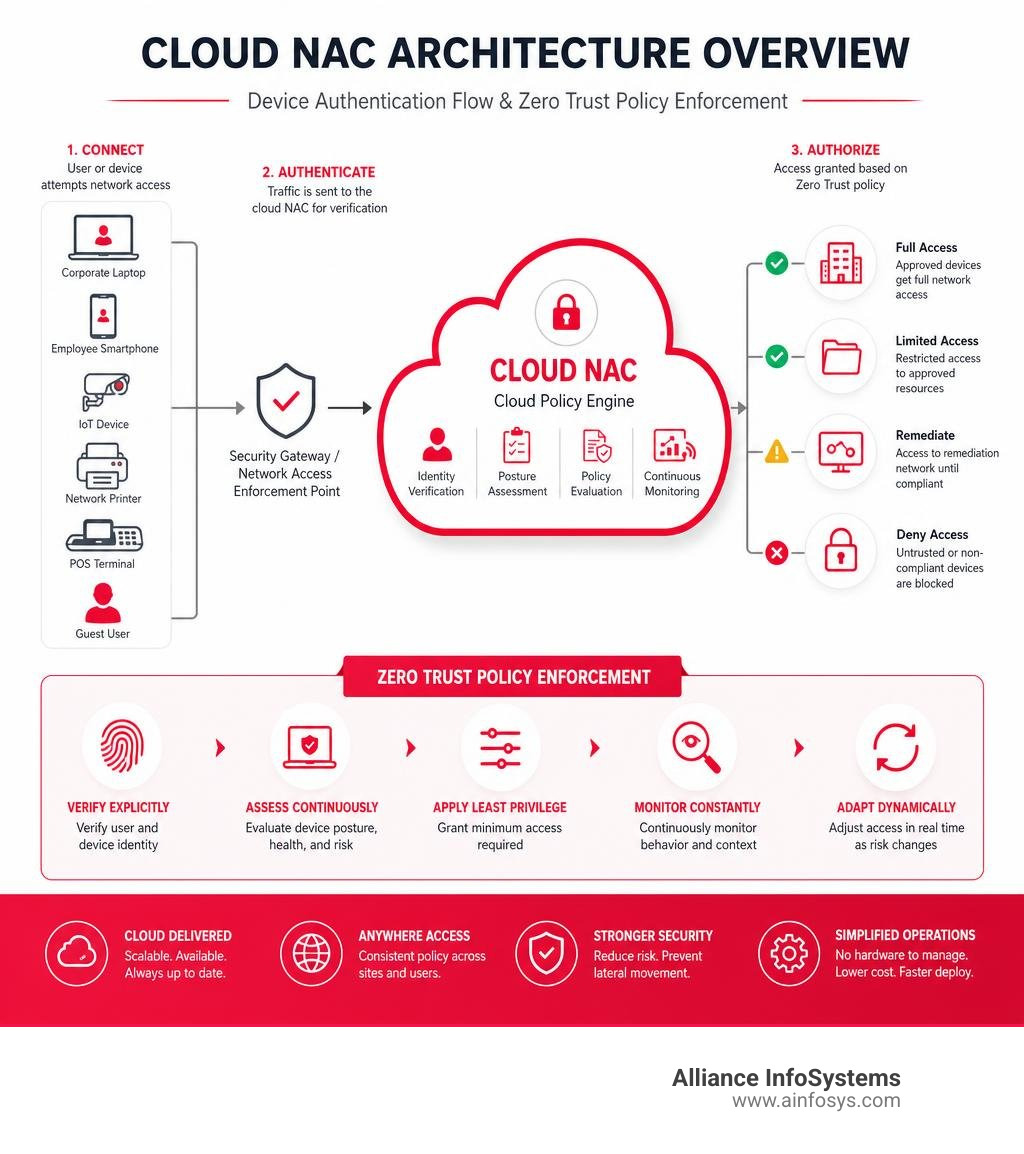
What is a Cloud Based NAC and How Does It Work?
To understand a cloud based nac solution, it helps to look at what came before it. Traditional network access control relied on physical, on-premises appliances sitting in a server rack at your headquarters. If you had ten branch offices, you often needed ten separate appliances (or complex VPN backhauling) to inspect and authorize traffic.
A cloud-based NAC replaces those heavy physical boxes with a lightweight, cloud-native policy engine. Instead of routing local network traffic through a physical server in your closet, your local network switches and wireless access points communicate directly with a cloud-hosted authentication service.
Learn more about network access control to see how these foundational principles protect modern enterprise infrastructure.
At the heart of this system is cloud RADIUS (Remote Authentication Dial-In User Service). When a device attempts to connect to your Wi-Fi or plug into an Ethernet port, the network switch or access point sends an authentication request up to the cloud RADIUS server. The cloud policy engine then evaluates who the user is, what device they are using, and whether that device meets your security standards before granting access.
| Feature | Traditional On-Premises NAC | Cloud-Based NAC |
|---|---|---|
| Infrastructure | Physical appliances, virtual machines, local servers | 100% Cloud-SaaS, zero local hardware |
| Deployment Time | Weeks to months | Days or even hours |
| Maintenance | Manual firmware updates, patches, hardware lifecycles | Automated updates managed by the provider |
| Scalability | Limited by hardware capacity; costly upgrades | Elastic scaling to support unlimited devices |
| Multi-Site Support | Complex VPNs, local collectors at every site | Native global policy enforcement via the cloud |
If you are currently weighing whether to keep your server room humming or migrate your core infrastructure to the cloud, Read our Cloud vs On-Premises Guide for a comprehensive breakdown of these operational shifts.
Why Modern Enterprise Networks Require Cloud-Managed Access Control
The classic “castle-and-moat” security approach—where we assumed anyone inside the physical office was safe—is officially dead. Today’s corporate network is highly distributed, fluid, and constantly changing. With the rise of hybrid work, employees expect to connect securely from a coffee shop in Annapolis, a home office in Baltimore, or the main corporate headquarters.
This shift has created massive gaps in network visibility. If you cannot see what is on your network, you cannot protect it. A cloud-managed NAC solves this by providing a single pane of glass to monitor every connection attempt across your entire organization, regardless of physical location.
To see how these access controls fit into a broader defensive strategy, you can Discover how network security services protect against modern threats.
Securing IoT and BYOD with Cloud Based NAC
One of the biggest security headaches for modern IT departments is the explosion of unmanaged devices. From employee-owned smartphones (BYOD) to smart thermostats, IP security cameras, and connected medical devices, your network is teeming with hardware that cannot run a traditional security agent.
In fact, 67% of IT professionals believe that identifying and authenticating IoT devices accessing the network is absolutely critical to their security strategy.
A cloud based nac tackles this challenge through advanced device profiling. Instead of relying on users to register their devices, the cloud NAC automatically analyzes network traffic patterns, MAC addresses, and device fingerprints to identify exactly what is trying to connect.
- For employee laptops and phones, it facilitates secure BYOD onboarding by verifying device health and compliance before allowing access.
- For headless IoT devices that cannot perform standard 802.1X authentication, the system uses secure MAC authentication bypass rules combined with profiling to ensure a smart printer is actually a printer—and not an attacker masquerading as one.
To explore how these authentication workflows operate in a high-security environment, Explore certificate-based cloud NAC solutions.
Overcoming Multi-Site and Distributed Network Challenges
Operating a multi-site enterprise comes with inherent logistical hurdles. Around 25% of businesses operate from multiple physical locations, meaning IT teams must manage different geolocations, unconnected local networks, and varied network hardware.
Traditional NAC systems struggle in these environments because they lead to inconsistent policies. A security rule updated at the headquarters might take days to replicate to a branch office, leaving a gaping hole in your attack surface.
Cloud-native scalability solves this problem by centralizing policy management. When you update an access rule in your cloud dashboard, it is instantly enforced across every switch, access point, and remote VPN gateway worldwide. Learn how cloud NAC enhances Zero Trust for multi-site enterprises to understand how global organizations maintain airtight security without local IT staff at every branch.
How Cloud NAC Drives Zero Trust Architecture

Zero Trust is no longer just a buzzword; it is the gold standard for modern network defense. The core philosophy is simple: never trust, always verify.
A cloud-based NAC serves as the critical connective tissue of a Zero Trust framework. It ensures that no device is granted access simply because it is plugged into a physical wall jack or connected to the office Wi-Fi. To learn how to build this architecture from the ground up, Check out our Network Security Services Guide 2026.
Aligning Zero Trust Principles with Cloud Based NAC
A robust Zero Trust strategy relies on three main pillars, all of which are directly supported by cloud-managed access control:
- Least-Privilege Access: Users and devices are only given access to the specific resources they need to do their jobs. A cloud NAC uses identity-driven policies to dynamically assign users to isolated network segments (VLANs) based on their role in the company directory.
- Continuous Monitoring: Trust is never static. A cloud NAC continuously monitors connected devices for changes in security posture. If a laptop suddenly disables its firewall or gets flagged by an endpoint detection tool, the NAC dynamically updates its policy to quarantine the device.
- Posture Assessment: Before a device even connects, the cloud NAC performs a comprehensive check to ensure the operating system is up to date, disk encryption is enabled, and anti-malware software is active.
By enforcing these strict checks at the access layer, Read about cloud-based NAC as the path to Zero Trust to see how organizations are accelerating their security transformations.
Implementing Passwordless Authentication and RadSec
Passwords are the weakest link in modern network security. They are easily phished, shared, and stolen. That is why leading cloud NAC platforms are moving toward passwordless authentication using digital certificates.
Through seamless PKI integration (Public Key Infrastructure), managed corporate devices are automatically issued unique cryptographic certificates. When the device attempts to connect to the network, it presents this certificate for instant, phishing-resistant authentication—no user interaction required.
To secure this authentication traffic as it travels over the public internet to the cloud, modern NAC solutions leverage the RadSec protocol. Traditional RADIUS traffic is sent in cleartext, making it vulnerable to interception. RadSec wraps RADIUS packets in a secure TLS tunnel, ensuring that authentication data remains completely private from the local switch all the way to the cloud policy engine.
Evaluating and Deploying Cloud NAC for Your Enterprise
Transitioning to a cloud-managed access control platform is highly efficient, but it requires strategic planning. Unlike legacy deployments that dragged on for months, a cloud NAC can often be configured and running in a matter of days.
The key to a successful deployment lies in integration. Your cloud NAC should seamlessly connect with your existing identity providers (such as Microsoft Entra ID, Okta, or Google Workspace) to perform real-time user lookups. It should also integrate with your Mobile Device Management (MDM) tools via native API connectivity to verify device compliance status instantly.
At Alliance InfoSystems, we help Maryland businesses navigate this evaluation process. Rather than simply purchasing a software license, we work with you to analyze your existing network hardware, map out your user roles, and select a cloud NAC solution that integrates perfectly with your current security stack to ensure your security posture remains resilient as your business grows.
Frequently Asked Questions about Cloud NAC
What is the difference between cloud-based NAC and traditional on-premises NAC?
The primary difference is the complete elimination of local hardware. Traditional NAC requires dedicated physical appliances or local virtual machines that must be manually patched, monitored, and scaled. Cloud-based NAC is a fully managed SaaS platform, offering rapid deployment, lower maintenance overhead, and seamless scaling across multiple locations.
How does cloud NAC handle IoT devices that do not support certificates?
For devices like smart printers or IP cameras that cannot support certificate-based 802.1X authentication, cloud NAC uses MAC Authentication Bypass (MAB) combined with advanced device fingerprinting. The system profiles the device’s behavioral patterns and network footprint to verify its identity before placing it into a securely segmented IoT VLAN.
Can cloud NAC integrate with existing identity providers like Microsoft Entra ID or Okta?
Yes. Modern cloud NAC solutions are designed to integrate natively with cloud-based Identity Providers (IdPs) like Microsoft Entra ID, Okta, and Google Workspace. This allows the policy engine to perform real-time lookups to verify user credentials and group memberships before authorizing network access.
Conclusion
Securing a modern, distributed network does not have to mean managing a complex maze of physical appliances. A cloud based nac provides the visibility, flexibility, and robust security that modern organizations need to protect their digital assets and confidently transition to a Zero Trust architecture.
As a Maryland-based IT services provider with over 20 years of experience, Alliance InfoSystems is dedicated to helping local businesses design, procure, and manage secure IT infrastructures. We specialize in strategic IT procurement and lifecycle management, ensuring your technology investments deliver maximum value and long-term security.
Ready to eliminate network blind spots and secure your distributed workforce? Secure your enterprise with our Managed Security Services and let our team of experts guide your transition to a modern, cloud-managed security framework.