
When the Cloud Goes Dark: Why Business Continuity Matters More Than Ever
Business continuity cloud planning is the practice of using cloud infrastructure to keep your organization running during disruptions. Instead of waiting for disaster to strike and then scrambling to recover, you build systems that automatically replicate data, switch to backup environments, and restore operations with minimal downtime.
Here is a quick summary of what that means in practice:
- What it is: A cloud-based strategy that combines data replication, automated failover, and geographic redundancy to maintain operations during outages, cyberattacks, or natural disasters.
- How it differs from traditional DR: Traditional disaster recovery relies on physical hardware and manual processes. Cloud continuity automates recovery and keeps systems running in real time.
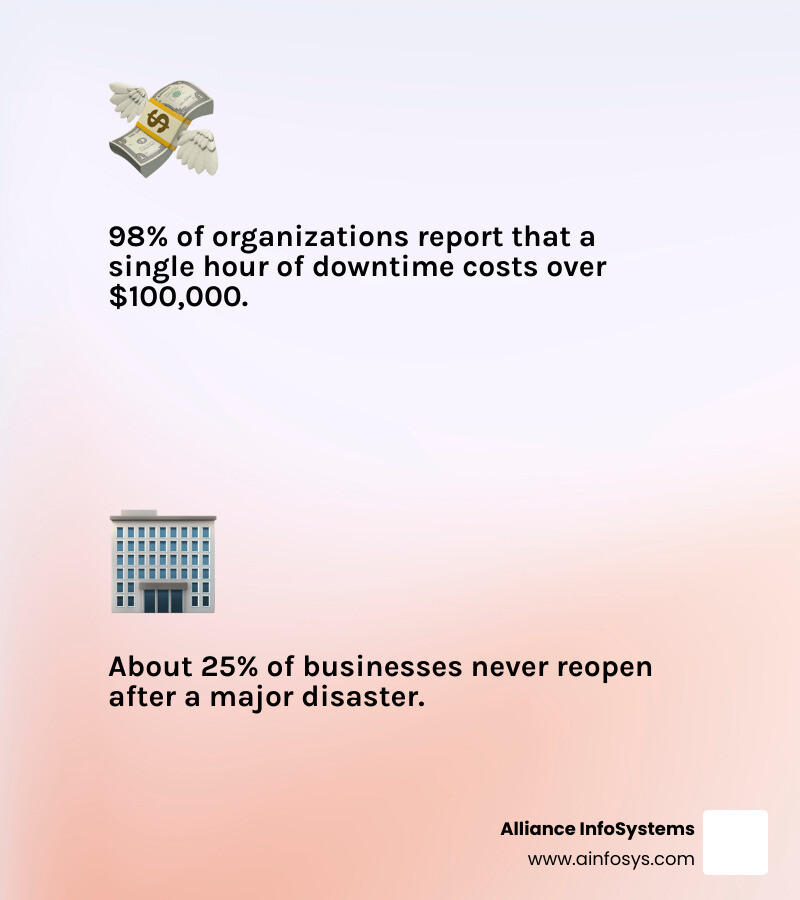
- Why it matters: According to industry data, 98% of organizations report that a single hour of downtime costs over $100,000. About 25% of businesses never reopen after a major disaster.
- Key components: Risk assessment, defined recovery objectives (RTO and RPO), redundant cloud environments, automated backups, and regular testing.
- Who needs it: Any business that relies on digital systems to serve customers, process payments, or manage operations.
The stakes are not abstract. In 2025 alone, Microsoft 365 experienced 16 major outages, accumulating 94 hours of cumulative downtime that affected roughly 850 million users. For a 5,000-person company, a single four-hour outage can cost $3 million in lost productivity. That number does not include reputational damage or customer churn.
The hard truth is that most small and mid-sized businesses treat continuity planning as an afterthought. Plans sit in a shared drive, untested and outdated. When something goes wrong, teams scramble, data is scattered, and recovery takes far longer than it should.
Cloud-based continuity flips that model. Instead of reacting to failure, you build systems that assume failure will happen and keep running anyway.
Key terms for Business continuity cloud:
What is a Business Continuity Cloud Strategy?
A cloud-based business continuity strategy is not just about keeping a spare copy of your files in a digital vault. It is a comprehensive, active operational approach that ensures your critical business processes continue running, even when your primary systems suffer a catastrophic failure.
Unlike traditional setups that require manual intervention, a modern business continuity cloud strategy utilizes automated cloud replication, instant failover mechanisms, and geographic redundancy. If a localized power grid failure or cyberattack strikes your primary site, your workload automatically shifts to virtual machines running in a completely different, unaffected geographic region. This dynamic scaling and instant accessibility are what keep your doors open when your physical or primary digital assets are temporarily compromised.
As an IT Provider with over 20 years of experience, we know that technology is only one part of the equation. To build true operational resilience, your cloud infrastructure must align with a well-documented and holistic Disaster Recovery and Business Continuity Plan.
Traditional Disaster Recovery vs. Business Continuity Cloud Solutions
To understand the value of the cloud, we have to look at how businesses used to handle emergencies. Traditional disaster recovery (DR) was a slow, expensive, and hardware-heavy affair. It often involved copying data to tape drives or physical disks, shipping those backups to an offsite cold storage facility, and maintaining duplicate physical servers that sat idle most of the year. If a disaster occurred, restoring operations could take days of manual rebuilding.
Cloud-based continuity shifts the focus from passive “recovery” to active “resilience.” Because virtual resources are highly flexible, we can replicate your entire operational stack in real time without the massive capital expense of a secondary physical data center.
The differences between these two approaches are stark:
| Feature | Traditional Disaster Recovery | Business Continuity Cloud |
|---|---|---|
| Infrastructure | Costly, idle physical hardware | Scalable, pay-as-you-go virtual resources |
| Recovery Speed | Hours to days (manual rebuilds) | Seconds to minutes (automated failover) |
| Data Loss Risk | High (relying on scheduled nightly backups) | Extremely low (continuous replication) |
| Testing Complexity | High (often disrupts active production) | Low (can run in isolated virtual sandboxes) |
| Cost Model | High upfront capital expenditure (CapEx) | Predictable operational expenditure (OpEx) |
To explore why virtualized infrastructure is so effective at reducing these physical overhead costs, check out our guide on the Benefits of Cloud-Based Storage and Why It Matters.
The Core Pillars of Cloud-Based Operational Resilience
A resilient cloud strategy rests on three primary pillars:
- High Availability and Redundancy: By deploying applications across multiple physically isolated Availability Zones within a cloud region, we ensure that a single data center outage does not bring down your services.
- Secure and Encrypted Access: During a crisis, your team must be able to work from anywhere. Modern cloud frameworks utilize strict data encryption and multi-factor authentication to secure remote connections.
- Proactive Collaboration Environments: Maintaining communication during a localized outage is vital. Utilizing dedicated standby environments, such as About Google Workspace for Business Continuity, ensures that your staff can access alternative, secure communication channels when primary systems go dark.
Why Modern Organizations Need Cloud-Based Continuity Planning
Relying on a “hope for the best” IT strategy is a dangerous gamble. Whether it is a localized natural disaster, a ransomware attack, or a major service provider outage, disruptions are a matter of “when,” not “if.”

The Financial Reality of Unplanned Downtime
The cost of downtime is staggering. Industry research shows that 98% of organizations experience downtime costs exceeding $100,000 per hour. For online-focused businesses, the cost of a down presence ranges from $2,300 to more than $9,000 per minute.
Beyond the immediate financial loss, extended outages cause severe reputational damage, erode customer trust, and can lead to permanent business closure. In fact, the Federal Emergency Management Agency (FEMA) reports that roughly 25% of businesses fail to reopen following a major disaster. By investing in a resilient cloud framework, you protect your bottom line and ensure your business survives the storm.
Mitigating Single-Vendor Concentration Risks
Many organizations assume that because they have migrated to a major SaaS provider, they are automatically safe from outages. However, the multi-hour outages of 2025 proved that even hyperscale platforms have bad days. Standardizing all operations on a single vendor creates a dangerous concentration risk.
To mitigate this, forward-thinking organizations are moving toward multi-cloud “hot standby” strategies. For instance, using tools like Microsoft 365 Business Continuity and Disaster Recovery allows you to mirror critical data to an alternative cloud environment. If your primary productivity suite goes dark, your teams can instantly switch to the standby platform and continue working without missing a beat.
Essential Components of a Business Continuity Cloud Architecture
Designing a resilient cloud architecture requires a deep understanding of your business dependencies. As an IT Provider offering customized Cloud & Virtualization Services, we work with you to map out your infrastructure, identify critical dependencies, and ensure that your technical recovery strategies align with your operational needs.
Defining RTO and RPO in Cloud Environments
Two foundational metrics dictate the design and cost of your cloud continuity plan. Recovery Time Objective (RTO) is the maximum acceptable delay between a service interruption and its restoration, while Recovery Point Objective (RPO) is the maximum acceptable amount of data loss, measured in time since your last successful backup.
If your business cannot tolerate more than five minutes of data loss, you need continuous, near-real-time data replication. If you can tolerate a few hours of downtime, a more cost-effective “pilot light” or “warm standby” deployment may be the perfect fit. Balancing these objectives against your budget ensures you do not overspend on unnecessary redundancy while keeping your critical workloads fully protected.
Hybrid and Multi-Cloud Redundancy Patterns
For highly sensitive operations, a hybrid or multi-cloud approach is key to eliminating single points of failure. However, replicating databases across different environments requires careful planning to avoid the “split-brain” problem—a scenario where two active databases attempt to write conflicting data during a network partition.
By designing clear failover triggers, utilizing short Time to Live (TTL) values for your DNS routing, and carefully managing egress costs, we help you implement seamless Business continuity hybrid and multicloud patterns that keep your data synchronized and secure.
Best Practices for Building and Testing Your Cloud Continuity Plan
A business continuity plan is only as good as your last test. If your plan consists of a static PDF document that has not been updated in a year, you do not have a continuity plan—you have a false sense of security.
Navigating Regulatory Compliance: DORA, ISO 22301, and NIS2
Regulatory bodies are increasingly focusing on digital operational resilience. Frameworks like the European Union’s Digital Operational Resilience Act (DORA), the NIS2 directive, and international standards like ISO 22301 mandate strict continuity and risk-management protocols.
Under these regulations, executives can be held personally liable for resilience failures, and organizations must prove they can restore critical functions within tight windows (such as DORA’s strict two-hour restoration mandate). Integrating your continuity workflows with an enterprise platform like Business Continuity Management helps automate compliance tracking, eliminate data silos, and reduce audit exposure.
Proactive Testing and Continuous Improvement
To ensure your team is ready for any disruption, you must conduct regular testing. This includes tabletop exercises, simulated ransomware attacks, and full failover drills.
Testing allows you to identify hidden dependencies, update outdated playbooks, and measure your Recovery Time Actual (RTA) against your target RTO. For a step-by-step look at how to structure these exercises, refer to our Disaster Recovery Testing: Complete Guide. After all, in places like Annapolis: Where Business Continuity Never Takes a Vacation, keeping your systems resilient year-round is the key to maintaining local economic stability and customer trust.
Future Trends Shaping Cloud-Based Business Continuity
The landscape of cloud resilience is evolving rapidly, with a major shift toward automated, self-healing environments that minimize human intervention during disruptions.
Key trends driving the future of continuity include:
- Proactive Threat Detection: Advanced monitoring tools analyze system performance in real time to identify security anomalies, initiating automated mitigation before an outage occurs.
- Edge Computing Integration: By processing critical data closer to the source, edge computing reduces latency and ensures localized operations can continue even if connectivity to the primary cloud is lost.
- Zero-Trust Architectures: Enforcing continuous authentication and strict access controls ensures that even during a failover scenario, your backup environments remain completely secure from lateral cyber threats.
Frequently Asked Questions about Cloud Business Continuity
What is the difference between cloud backup and a hot standby?
Cloud backup is a reactive “cold storage” solution. It securely saves your data at scheduled intervals, but restoring your systems from a backup during an outage can take hours or days. A hot standby is an active, real-time mirrored environment that is constantly running. If your primary system fails, traffic is automatically rerouted to the hot standby, resulting in near-zero downtime.
How does a multi-cloud strategy improve business continuity?
A multi-cloud strategy distributes your workloads across completely different cloud providers. This eliminates single-vendor concentration risks, ensuring that even if an entire cloud ecosystem experiences a massive outage, your business remains operational by failing over to an independent platform.
How often should cloud business continuity plans be tested?
We recommend conducting tabletop testing and review sessions at least once a year. However, you should also run simulated failover drills whenever there are major changes to your IT infrastructure, application configurations, or key personnel.
Conclusion
Building a robust business continuity cloud strategy is no longer a luxury reserved for global enterprises. It is a fundamental requirement for any modern organization that values its operational uptime, regulatory compliance, and customer trust.
At Alliance InfoSystems, we operate as your dedicated IT Provider, delivering flexible, customized, and cost-efficient solutions backed by over 20 years of experience. From managed IT and cybersecurity to cloud migration, data backup, and network security, we help you build the digital umbrella your business needs to survive any storm.
Are you ready to secure your operations against unplanned downtime? Secure Your Operations with Alliance InfoSystems Cloud & Virtualization Services today, and let us build a resilient foundation for your business.