AI powered business automation is the use of artificial intelligence to run, manage, and improve business processes with minimal human effort. Unlike traditional rule-based automation, AI systems learn from data, adapt to change, and handle complex, unstructured tasks at scale.
Here’s a quick overview of what AI business automation can do for your organization:
- Cut operational costs by replacing repetitive manual work with intelligent, self-improving workflows
- Boost productivity by up to 40%, according to IDC research
- Run 24/7 without the overhead of overtime or shift costs
- Reduce errors in data-heavy tasks like invoice processing, compliance checks, and customer support
- Deliver ROI fast, with many organizations seeing measurable results within 30 days of deployment
If you’re a business owner or IT manager trying to do more with the same resources, the pressure is real. Faster growth, tighter margins, and rising customer expectations are pushing teams to find smarter ways to operate. At Alliance InfoSystems, we help businesses navigate this through strategic IT procurement, ensuring you invest in automation that scales.
The good news? AI automation is no longer just for large enterprises with massive IT budgets. In 2026, accessible platforms and low-code tools have made it practical for small and mid-sized businesses to automate everything from IT helpdesk tickets to HR onboarding to financial fraud detection.
And the momentum is significant. Research from Forrester found that 89% of AI decision-makers say their organization is already expanding, experimenting with, or actively exploring generative AI. Gartner projected that 70% of enterprises would have operationalized AI by 2025, and that trajectory has only accelerated.
The shift is not just about cutting costs. It’s about building a business that can scale without adding proportional headcount, respond to real-time signals automatically, and free up your people for the work that actually requires human judgment.
This guide walks you through everything you need to know: how AI automation works, where it delivers the most value, how to implement it safely, and how to choose the right tools for your situation.
Understanding AI Powered Business Automation vs. Traditional Methods
To understand where we are in 2026, we first need to look at where we came from. Traditional automation, often referred to as Robotic Process Automation (RPA), is like a train on a track. It’s incredibly efficient as long as the track is straight and nothing gets in the way. It follows “if-this-then-that” rules. If a vendor sends an invoice in a format the system doesn’t recognize by even one pixel, the “train” derails, and a human has to fix it.
AI powered business automation is more like a self-driving car. It doesn’t just follow a fixed track; it “sees” the environment, understands context, and navigates obstacles. By utilizing Machine Learning (ML) and Natural Language Processing (NLP), these systems can process unstructured data—like the text in an email or a handwritten note—and make decisions based on patterns rather than just rigid rules.
| Feature | Traditional Automation (RPA) | AI-Driven Automation |
|---|---|---|
| Logic | Rule-based (Static) | Learning-based (Adaptive) |
| Data Type | Structured (Spreadsheets, Databases) | Unstructured (Emails, Images, Voice) |
| Handling Errors | Stops and requires human intervention | Self-heals or suggests intelligent fixes |
| Complexity | Simple, repetitive tasks | Complex, multi-step workflows |
| Setup Time | Months of coding and mapping | Days to weeks via “prompting” or learning |
For businesses in Maryland looking to modernize, moving beyond these brittle legacy systems is essential. Many companies find that their growth is actually inhibited by “IT debt”—old systems that don’t talk to each other. Integrating AI into your Managed IT Services helps bridge these gaps, turning disconnected tools into a cohesive, intelligent engine.
The Evolution of Intelligent Orchestration
We have entered the era of “Agentic AI.” This isn’t just a chatbot that answers questions; it’s an agent that performs actions. Using Large Work Models (LWM), these agents can navigate software interfaces just like a human would—logging into a CRM, extracting data, and updating an ERP system—without needing a custom API for every single connection. This creates a “closed-loop” system where the AI acts, observes the result, and optimizes the next action. Our IT Managed Services Complete Guide explores how this orchestration is becoming the new backbone of enterprise integration.
Automation vs. Augmentation Strategies
One common fear is that AI will replace humans entirely. In reality, the most successful 2026 business models focus on a “Human-in-the-loop” approach.
- Automation is for high-frequency, low-value tasks (like routing IT tickets or data entry).
- Augmentation is for high-value tasks where AI provides “decision support.”
For example, an AI might screen 1,000 resumes to find the top five candidates, but a human still conducts the interview. This strategic differentiation allows your team to focus on empathy, ethics, and complex relationships while the AI handles the heavy lifting.
The Strategic Benefits of AI in Modern Operations

The move toward AI powered business automation isn’t just a trend; it’s a survival strategy. Organizations that embrace these tools are seeing a massive shift in their operational DNA.
The most immediate benefit is 24/7 availability. Unlike a human team, an AI agent doesn’t need sleep, coffee breaks, or holiday pay. It can process loan applications or resolve customer inquiries at 3 AM just as accurately as it does at 10 AM. This lead to significant error reduction, especially in fields like finance and compliance where manual data entry is notoriously prone to “human slips.” For a deeper look at how this fits into your support structure, check out our guide on Managed IT Support.
Measurable ROI and Time-to-Value
In the past, enterprise software took years to show a return. Today, the “GenAI” effect has slashed implementation timelines. Many platforms now boast a 90% pilot-to-deployment conversion rate. Because these systems can be “prompted” into existence rather than hard-coded, most enterprises achieve measurable ROI within 30 days. Whether it’s through cutting resolution times in half or increasing employee productivity by 40%, the value is realized almost immediately. You can learn more about these efficiencies in The Beginners Guide to Managed IT Services.
Industry-Specific Use Cases
AI powered business automation shows up differently in each department, but the pattern is the same: faster work, fewer manual steps, and better decisions at scale.
In finance, AI can spot unusual transaction behavior in real time and flag potential fraud that a person might miss. It works by finding patterns across huge volumes of activity, which makes it especially useful in fast-moving environments.
In HR, automation helps remove repetitive admin from onboarding. That can include generating documents, routing approvals, setting up accounts, and triggering hardware or access requests so new hires are productive sooner.
In customer service, AI tools can answer common message-based questions before an agent ever gets involved. That reduces ticket volume, shortens response times, and lets human teams focus on more complex issues that need judgment or empathy.
In IT operations, AI is often used to resolve routine support requests such as password resets, account unlocks, and access questions. The result is fewer help desk tickets, faster resolution, and more time for IT teams to work on higher-value projects.
For organizations needing specialized talent to build these systems, IT Augmentation provides the necessary expertise to scale without long-term hiring risks.
Key Types of AI Driving Business Automation
Not all AI is created equal. To build a robust automation strategy, we have to look at the three main pillars:
Generative AI: This handles creation and transformation. It can summarize long documents, draft emails or code, and turn messy, unstructured data into something teams can actually use.
Predictive AI: This is about forecasting what comes next. It learns from past data to spot patterns, estimate demand, flag risks, and help businesses act before small issues become expensive problems.
Adaptive AI: This focuses on adjustment in real time. Instead of following the same logic forever, it responds to changing conditions, improves with new data, and helps automation stay useful as workflows evolve.
When you combine these with transformer-based RPA, you get agents that can “reason” through a task. If you’re struggling to find the right developers to implement these, our Software Development Staff Augmentation services can help fill those gaps.
Generative AI for Content and Code
Generative AI has solved the “unstructured data” problem. In the past, if a customer sent a messy, five-paragraph email, a machine couldn’t understand it. Now, GenAI can summarize that email, extract the key complaint, and draft a brand-aligned response in seconds. This is a game-changer for IT Staff Augmentation, where speed is the primary currency.
Predictive and Adaptive Systems
Predictive systems are particularly valuable for strategic IT procurement. By forecasting when hardware will reach its end-of-life or when server capacity will peak, businesses can buy smarter. We focus on ensuring your hardware is “AI-ready,” meaning it has the processing power to handle the local LLMs and data pipelines that modern automation requires.
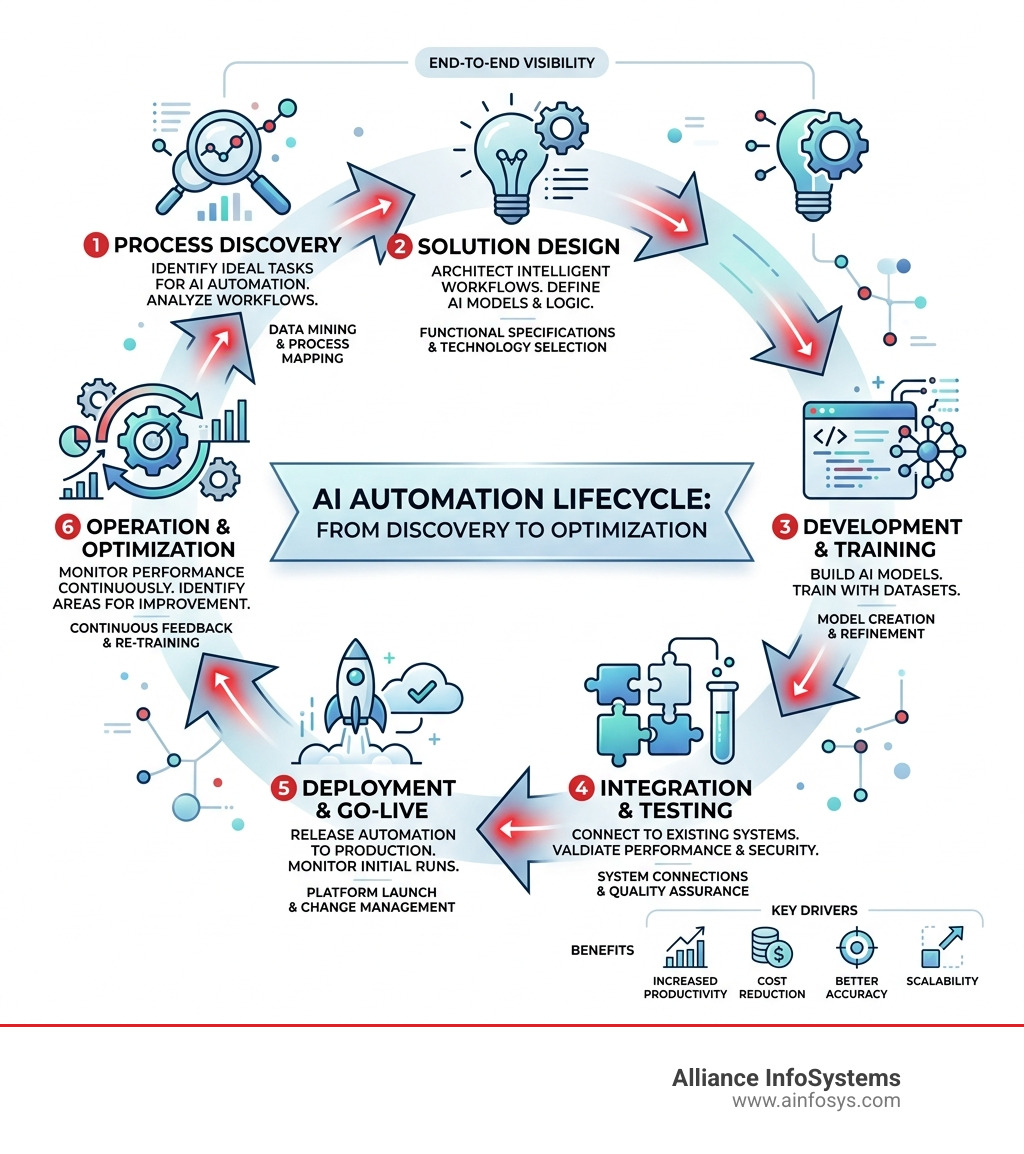
Implementing AI Powered Business Automation: A Step-by-Step Guide
Ready to start? Don’t try to automate everything at once. We recommend a phased approach:
- Process Discovery: Inventory your tasks. Look for “The Rule of One”—if you have to type a customer’s name more than once across different systems, that’s a candidate for automation.
- Tool Selection: Choose platforms that offer low-code interfaces. This empowers “citizen automators” (your non-technical staff) to build their own workflows.
- Pilot Projects: Start with a “bite-sized” activity, like automating IT ticket routing or invoice classification.
- Employee Training: AI is a tool for optimizing human labor, not replacing it. Invest in training so your team knows how to supervise their new “digital twins.”
- Scaling: Once the pilot succeeds, move toward full-process autonomous workflows.
Identifying Processes for AI Powered Business Automation
Focus on data-heavy workflows and manual bottlenecks. High-value judgment tasks should remain with humans, but the “data gathering” part of those tasks is perfect for AI. If your CFO is spending three days a month manually reconciling spreadsheets, that is a massive waste of high-value time.
Scaling Your AI Powered Business Automation Strategy
As you scale, you’ll face “integration sprawl.” This is where you have too many AI agents running around without oversight. We recommend using a centralized orchestration platform and standardizing on the Model Context Protocol (MCP). This allows IT to maintain guardrails, ensuring that AI agents only access the data they are supposed to. Strategic lifecycle management ensures that as your business changes, your AI models are updated and retrained to stay relevant.
Security, Compliance, and Governance in the AI Era
This is the “make-or-break” part of AI. You cannot have automation without world-class security. In 2026, the standard is Zero Trust architecture. Every action taken by an AI agent must be authenticated, authorized, and logged.
In regulated industries such as healthcare and finance, AI automation has to do more than work well. It has to meet strict security and compliance requirements. That usually starts with PII masking, which keeps sensitive personal information hidden or restricted while data is being processed. It also requires strong audit trails so teams can trace what the system did, why it did it, and how decisions were made. Just as important, the platforms behind your automation should align with recognized standards and regulations, including SOC 2 and frameworks like GDPR. These guardrails help reduce risk, support accountability, and build trust with customers, employees, and regulators.
Our Managed IT Services are designed with these guardrails in mind, providing the governance you need to sleep soundly while your AI works through the night.
Frequently Asked Questions about AI Automation
What is the difference between AI and RPA?
RPA follows fixed rules and breaks when something changes. AI learns from data, handles unstructured information (like emails), and adapts to new situations without needing a human to rewrite the code.
How long does it take to see ROI from AI automation?
While traditional IT projects took months, most modern AI automation initiatives show measurable ROI within 30 to 60 days. Some organizations see results in as little as 30 days by focusing on high-impact, low-complexity tasks like ticket deflection.
Is AI automation secure for regulated industries?
Yes, provided you use enterprise-grade platforms with built-in “human-in-the-loop” controls, PII masking, and adherence to standards like SOC 2, HIPAA, and GDPR.
Conclusion
Alliance InfoSystems helps Maryland businesses move from outdated systems to smarter, more efficient operations. The goal is not to chase hype. It is to make AI powered business automation practical, secure, and aligned with real business needs. With deep expertise in technology and strategic lifecycle management, Alliance InfoSystems supports organizations as they evaluate tools, modernize infrastructure, and build a clear path to long-term operational efficiency.
Whether you are looking to augment your current team or completely overhaul your operations, we provide the flexible, cost-efficient solutions you need to thrive in the 2026 landscape. Let us help you turn AI from a buzzword into a competitive advantage.
Ready to automate? Explore our Managed IT Services and let’s build something intelligent together.