How to Choose Managed IT Services Consulting
When sourcing managed IT services consulting, start with the work your team cannot reliably cover. Then compare IT Providers on their ability to protect your systems, meet clear service targets, and support future changes. Ask who will handle day-to-day issues, how security and backups are tested, and what stays under your control. The lowest price is not always the best value.
This matters most when a small team is asked to manage growing systems and rising cyber risk. Alliance InfoSystems is an IT Provider with expertise in managed IT, cybersecurity, cloud migration, SOC services, data backup, network security, and IT staffing. This guide explains how to evaluate those services and choose a partner based on outcomes, not just tasks. For a broader industry perspective, the National Institute of Standards and Technology offers guidance on cybersecurity frameworks that can inform your evaluation criteria.
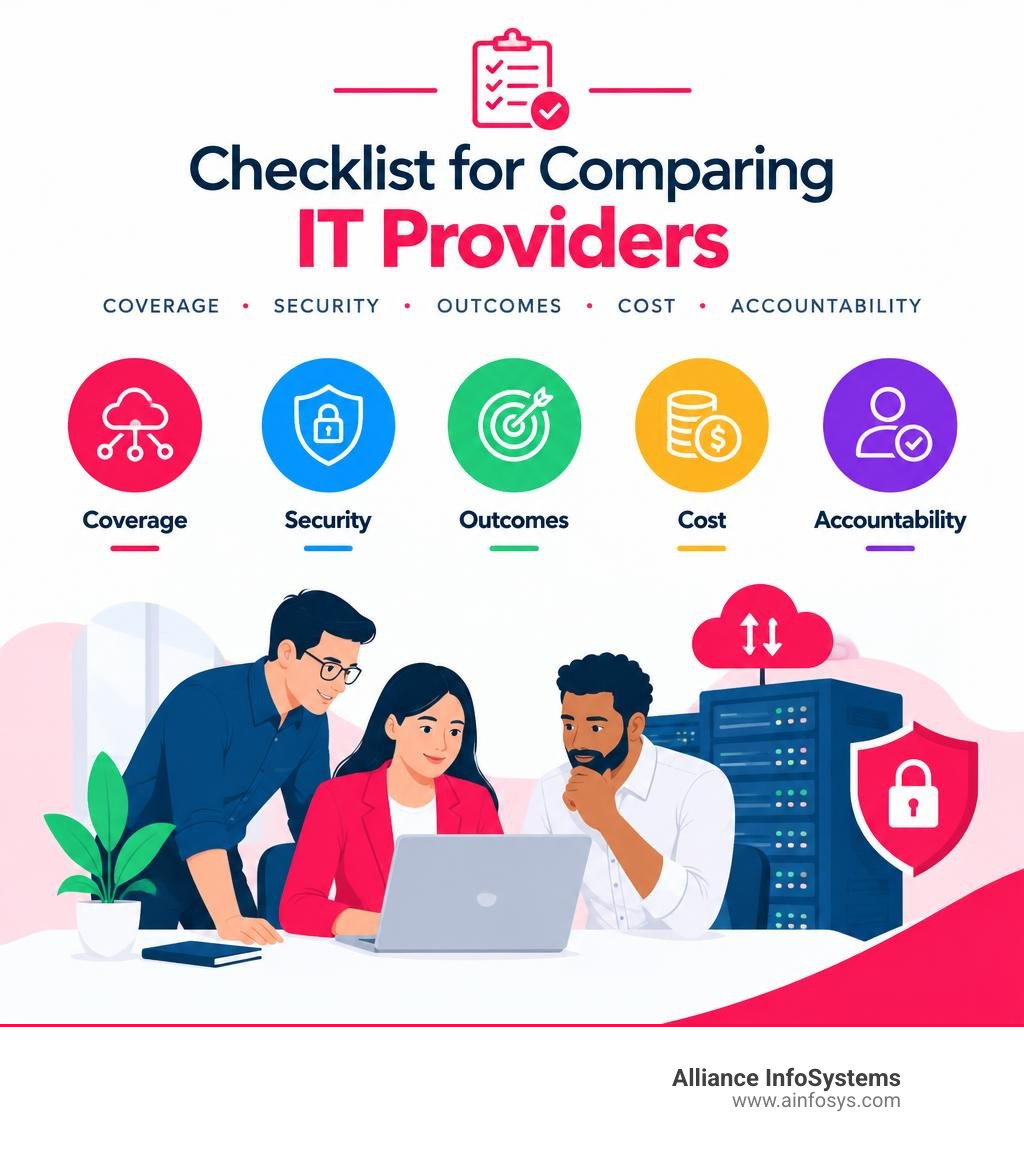
Must-know managed it services consulting terms:
The Strategic Shift: Rethinking the Build vs Buy Model in Managed IT Services Consulting
Organizations in nearly every sector are re-evaluating long-held assumptions regarding internal builds versus external sourcing. For decades, standard wisdom dictated building internal teams for core functions while outsourcing only repetitive administrative tasks. As of October 2026, relentless digitization, talent scarcity, and escalating cybersecurity threats have fundamentally broken that formula. Building every technical competency in-house is no longer practical or cost-effective for growing enterprises.
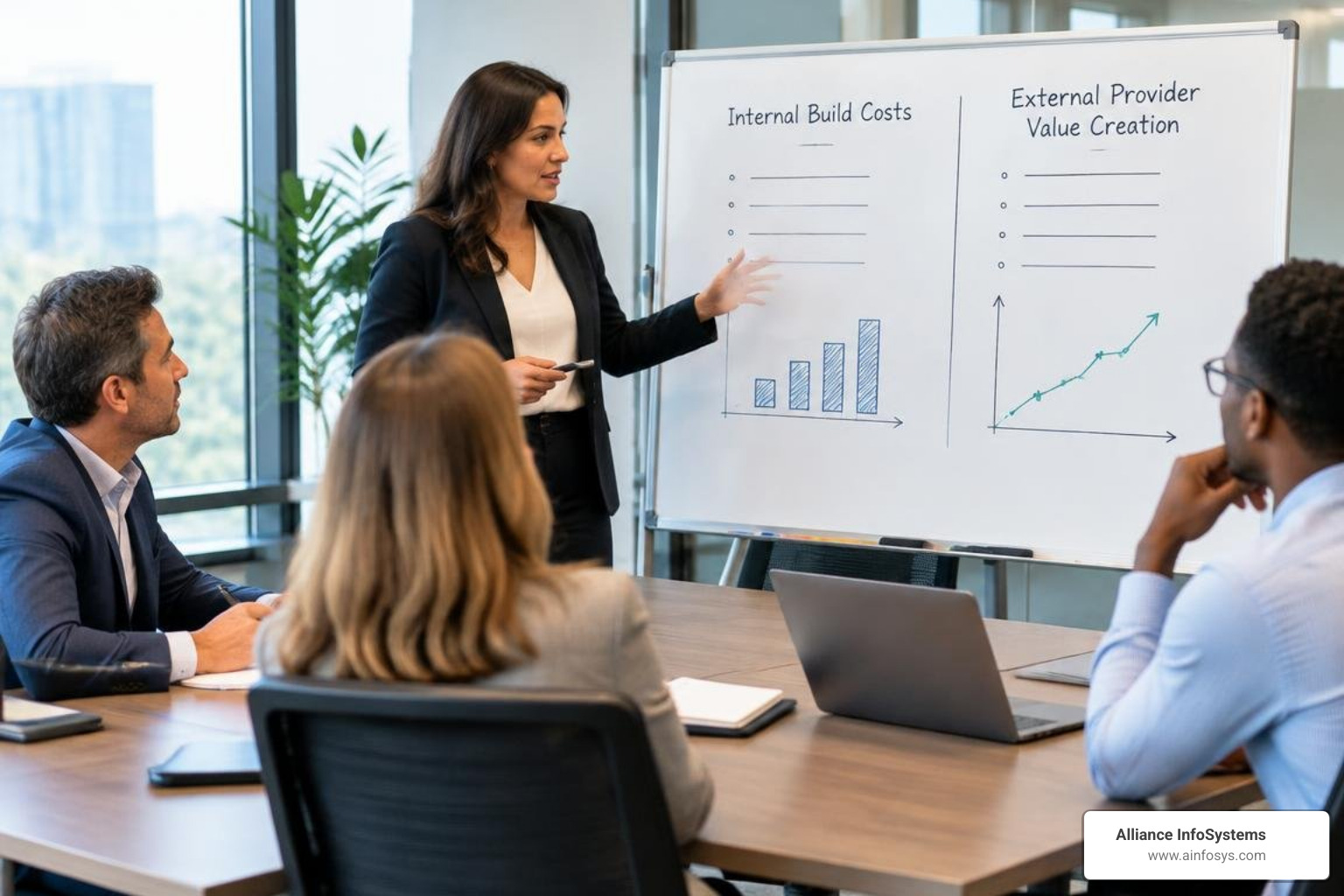
Leadership teams now recognize that selecting an external technology partner is not an admission of operational defeat; it is an exercise in operational resilience. The goal has shifted from offloading low-level operational noise to gaining direct access to elite technical capabilities. Following a comprehensive IT managed services guide helps enterprises navigate modern infrastructure demands, such as continuous monitoring, advanced cloud integration, and proactive defense mechanisms that single internal hires cannot sustain alone without significant tooling expenses and overhead.
Traditional Outsourcing vs Next-Generation Operate Models
Traditional IT outsourcing focused heavily on cost containment through labor arbitrage and strict, ticket-based service level agreements (SLAs). If a server crashed, the vendor restarted it; if a ticket arrived, they processed it. However, modern Operate models prioritize value creation, systems resilience, and continuous optimization. This shift mirrors broader industry guidance on aligning technology investments with business outcomes, as outlined in resources like the ITIL service management framework.
| Feature | Legacy Outsourcing | Next-Generation Operate Services |
|---|---|---|
| Primary Goal | Direct labor cost reduction | Business agility and value creation |
| Engagement Model | Transactional, ticket-based tasks | Collaborative, outcome-oriented delivery |
| Talent Strategy | Low-cost generic staffing | Shared pools of elite technical specialists |
| Operational Focus | Reactive maintenance and patching | Proactive optimization and modernization |
| Innovation Role | Minimal scope; rigidly governed | Built-in continuous improvement roadmaps |
Modern organizations require technology partners that drive agility rather than merely logging incident resolutions. This proactive orientation ensures infrastructure anticipates market demands instead of lagging behind operational growth.
Driving Value Creation in Managed IT Services Consulting Engagements
Evaluating enterprise infrastructure requires separating tactical hardware and software procurement from broader technology enablement initiatives. When evaluating what to look for in a business technology partner, leadership should focus on how an external team frees internal staff to concentrate on core, revenue-generating projects.
Engaging an experienced IT Provider protects mission-critical systems and scales operations seamlessly. Rather than sinking capital into recruitment overhead, continuous training certifications, and redundant software licenses, leadership can leverage pre-built enterprise frameworks. This structure transforms routine maintenance into a predictable engine for operational stability, while also creating room for digital innovation that directly supports long-term business goals and measurable organizational agility.
Mitigating Mission-Critical Risks Through Shared Specialist Expertise
Niche operational disciplines like cloud architecture, SOC operations, and regulatory audit management carry severe operational risk when understaffed. Recruiting dedicated in-house engineers for every emerging domain creates untenable financial drag and introduces operational single points of failure.
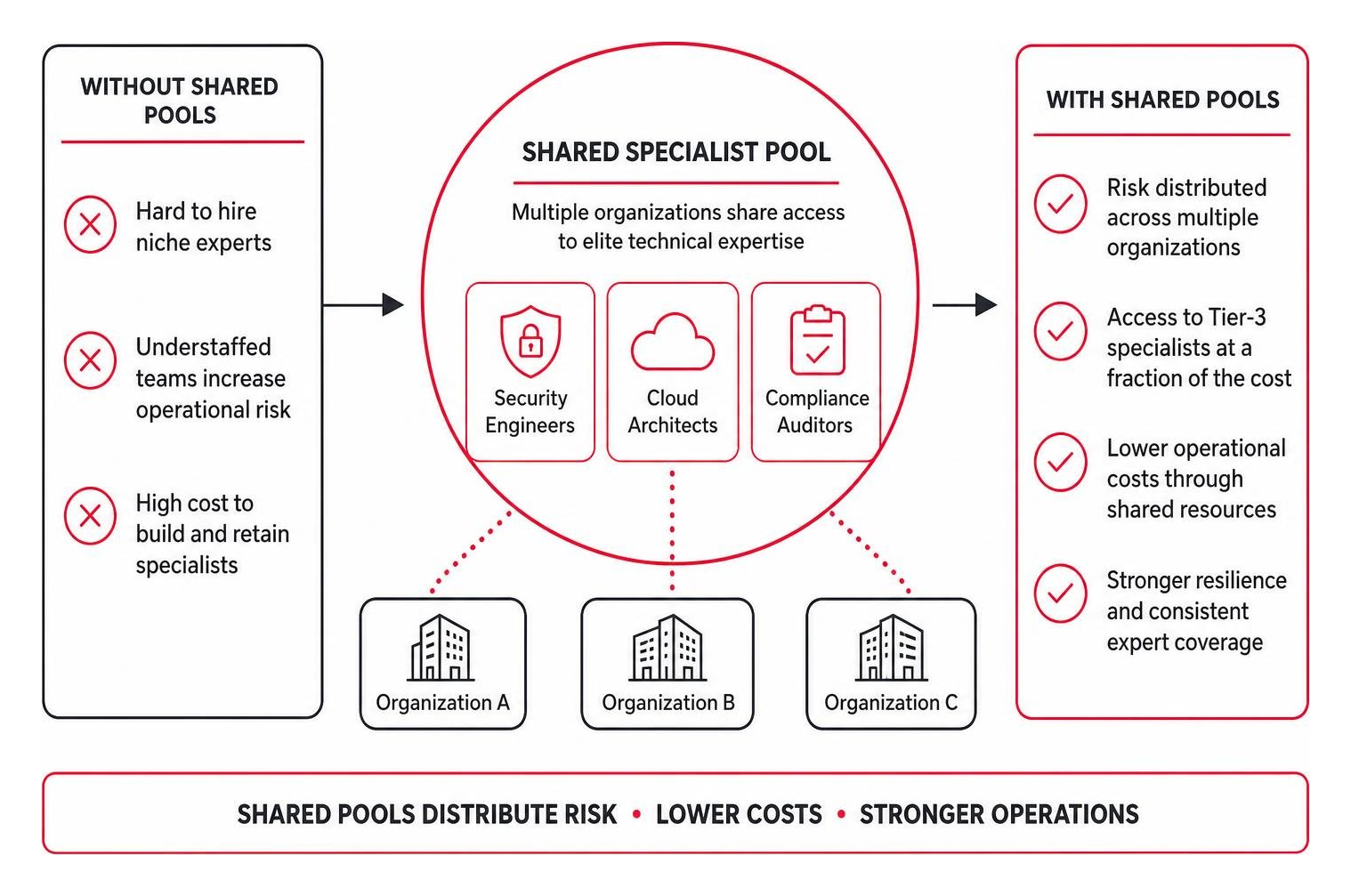
Next-generation delivery frameworks solve this dilemma through shared-cost economics. Multiple enterprises effectively share fractional access to Tier-3 security engineers, compliance auditors, and cloud architects. This structure gives mid-market enterprises access to enterprise-grade defenses and round-the-clock monitoring that would otherwise be cost-prohibitive. Organizations seeking robust baseline protections often anchor their journey with tailored managed IT support to establish resilient operational baselines.
Overcoming Talent Scarcity with Managed IT Services Consulting Partnerships
The global shortage of certified technical personnel makes finding, vetting, and retaining specialized engineers difficult. High turnover leaves critical gaps in network defense, automated patch management, and infrastructure maintenance.
Organizations frequently turn to IT staff augmentation to bridge capability gaps without lengthy recruitment cycles or costly onboarding programs. By blending internal institutional knowledge with specialized outside engineering, organizations rapidly scale their capacity for cloud migrations, platform modernizations, and continuous infrastructure monitoring. This approach also reduces the burden of maintaining niche certifications in-house, allowing internal teams to focus on business-specific priorities and day-to-day strategic user support.
Governance, Compliance, and Management Independence
Outsourcing execution does not mean outsourcing governance. Executive leadership remains ultimately responsible for data integrity, financial reporting standards, customer privacy mandates, and regulatory oversight. When structuring partnerships, clear operational boundaries must separate strategic decision-making authority from technical execution.
Technology partners manage internal controls, maintain rigorous audit logs, and enforce network security configurations according to agreed benchmarks. However, core operational decisions, budget authority, risk tolerance thresholds, and policy approvals must remain strictly within enterprise leadership. Establishing this governance framework ensures strict compliance with regulatory standards while insulating the organization from unauthorized operational drift. For additional context on governance expectations, the ISACA COBIT framework provides widely recognized guidance for aligning IT governance with enterprise objectives.
Framework for Evaluating and Sourcing Next-Generation IT Providers
Selecting the right partner requires a structured evaluation framework that moves beyond standard pricing sheets and surface-level feature checklists. A comprehensive evaluation analyzes how prospective providers govern uptime, handle high-severity incidents, and integrate with existing enterprise tools.
Establishing a clear managed IT services baseline helps leadership construct rigorous vendor assessment rubrics and define objective performance standards across all technology operations.
Key Selection Criteria for Strategic Alignment
A partner must provide transparent, measurable insights into operational health and long-term infrastructure vitality across four core dimensions:
- Operational Transparency: Real-time visibility into infrastructure health, security events, patch compliance, and automated backup verification status.
- Security Capabilities: Dedicated 24/7/365 Security Operations Center (SOC) monitoring, active threat hunting, vulnerability management, and rapid incident containment protocols.
- Architectural Scalability: Capability to migrate workloads to hybrid cloud environments without disrupting core daily workflows or compromising regulatory compliance.
- Service Integration: Cohesive alignment across managed IT services, data backup, disaster recovery, and business continuity systems.
Phased Onboarding and Pilot Roadmaps
Avoid moving entire enterprise operations overnight. Successful sourcing strategies rely on structured, phased onboarding roadmaps that validate operational alignment:
- Discovery and Baseline Assessment: Conduct a comprehensive audit of existing network assets, security vulnerabilities, backup states, and software licensing.
- Pilot Implementation: Transition a single, bounded workload—such as offsite data backups or helpdesk triage—to evaluate operational communication and technical responsiveness.
- Core Migration: Systematically migrate primary systems, cloud environments, identity management systems, and proactive network security monitoring.
- Optimization and Review: Establish recurring operational reviews to analyze infrastructure trends, patch schedules, and strategic roadmaps.
This phased approach reduces disruption, protects daily business continuity, and gives leadership measurable checkpoints before committing to broader transformation initiatives.
Frequently Asked Questions About Sourcing IT Services
What distinguishes traditional managed services from modern Operate models?
Traditional managed services focus primarily on tactical task execution, incident response, and labor-based cost reduction. Modern Operate models emphasize value creation, continuous business modernization, and shared access to specialized technical experts who proactively improve system resilience.
How do shared specialist models reduce operational overhead?
Shared specialist models allow organizations to distribute the high cost of recruiting and retaining specialized engineers across a broader client ecosystem. This fractional access delivers enterprise-grade expertise in cybersecurity, compliance, and cloud architecture at a fraction of full-time hiring costs.
How can enterprises maintain governance when partnering with an external IT provider?
Enterprises maintain governance by retaining all strategic decision-making authority, policy approvals, and risk tolerances internally. External partners execute maintenance, monitoring, and administrative controls within strict boundaries, supported by audit logging and transparent reporting. For a deeper look at governance practices, the ISACA COBIT framework offers practical guidance on aligning IT oversight with business goals.
Conclusion
Sourcing managed technology services is a strategic decision that shapes an organization’s agility, security posture, and growth trajectory. By moving away from transactional, reactive outsourcing and embracing outcome-focused partnerships, enterprises protect their operations while unlocking sustainable long-term value.
At Alliance InfoSystems, we serve as a premier IT Provider delivering tailored IT management, cloud migration, data backup, network security, and enterprise managed security solutions. Leveraging over two decades of engineering excellence, we help leadership teams build resilient, future-ready infrastructure that supports continuous innovation and operational resilience.