
Why Baltimore Businesses Can’t Afford Downtime
Business continuity Baltimore services help local companies protect their operations from disasters, cyberattacks, and unexpected disruptions. Here’s what you need to know:
Quick Guide to Baltimore Business Continuity Services:
- What They Do: Assess risks, create recovery plans, implement data backup solutions, and ensure your business can operate during emergencies
- Who Needs Them: Healthcare providers, tech companies, manufacturers, logistics firms, and any business that can’t afford extended downtime
- Key Services: Data backup and recovery, disaster recovery planning, cybersecurity protection, and 24/7 IT support
- Local Providers: Look for Maryland-based partners who understand regional risks like flooding, power outages, and proximity to D.C.
- Cost of Inaction: 43% of businesses hit by disaster never reopen, and 29% close within two years
The stakes couldn’t be higher for Baltimore businesses. Data is your most critical asset – lose it and your business faces permanent closure.
Research from Gartner shows that 94% of businesses that suffer data loss are put out of business permanently. That’s not a risk, it’s a near certainty.
Baltimore’s economy spans healthcare, cybersecurity, tech, and logistics. The city’s position near Washington D.C. and its 52 miles of shoreline create unique vulnerabilities. From the 2019 ransomware attack that crippled city systems to flooding on Frederick Avenue in 2018, Baltimore businesses face real, documented threats.
Your tolerance for downtime determines your survival strategy. When asked, most companies say they “cannot afford to be down at all.” But without proper planning, that’s exactly where they’ll end up during a crisis.
The solution starts with understanding your risks, protecting your data across all platforms, and having a tested plan ready before disaster strikes.
The Unseen Threats: Assessing Baltimore-Specific Business Risks
Baltimore, often called Charm City, is a vibrant hub of innovation, culture, and commerce. However, its unique geography and economic landscape also expose businesses to a distinct set of risks that demand robust business continuity Baltimore strategies. We understand these local nuances because we’re part of this community.
When we talk about business continuity, we’re not just talking about abstract concepts; we’re talking about real threats that have impacted our city. Natural disasters, for instance, are a perennial concern. Baltimore’s coastal location means that hurricanes and severe storms can bring devastating flooding, particularly to areas along its 52 miles of shoreline and around its seven square miles of deep-water harbor. The flooding on Frederick Avenue in 2018 is a stark reminder of how quickly water can disrupt operations. Beyond weather, technological failures pose a constant threat. The infamous ransomware attack on Baltimore City systems in 2019 demonstrated the crippling impact cyber incidents can have, bringing essential services to a halt.
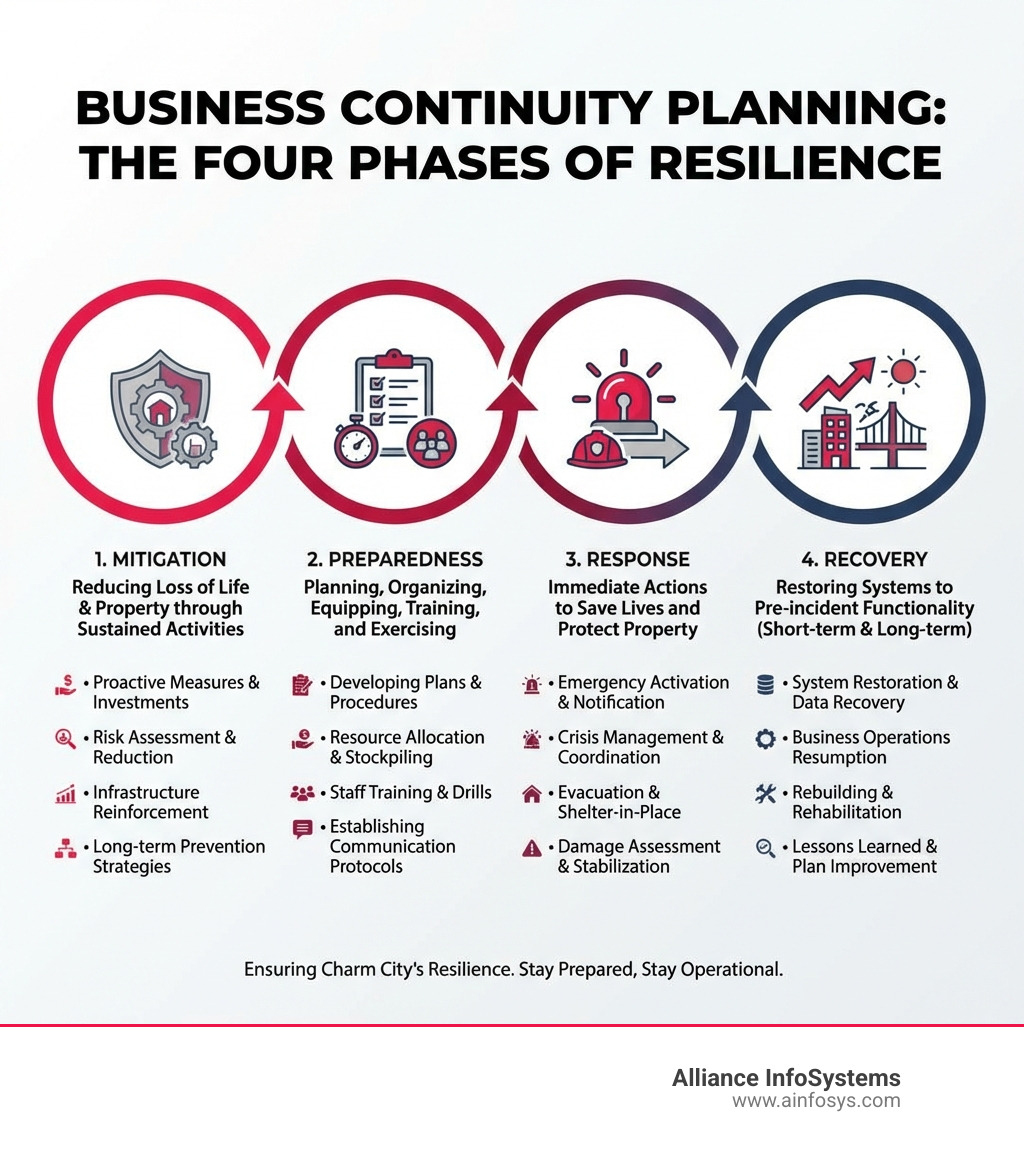
Human-caused disruptions, such as civil unrest (like those experienced in 2015 and 2020), power outages, and even supply chain issues, can further compound these challenges. These events can stifle communications, prevent employees from reaching their workplaces, and render normal systems unreliable. For a comprehensive overview of how our city plans for these events, we often refer to resources like The City of Baltimore’s Emergency Operations Plan, which outlines the policies and procedures under which Baltimore operates during an incident. This plan addresses mitigation, preparedness, response, and recovery, emphasizing a “whole-community approach.”
Calculating Your Downtime Tolerance
Understanding your business’s tolerance for downtime isn’t just an academic exercise; it’s a critical step in crafting an effective business continuity Baltimore plan. When we ask clients how much downtime they can afford, the common initial response is often, “We cannot afford to be down at all!” While understandable, this highlights the need for a deeper analysis.
Downtime translates directly into lost revenue, decreased productivity, damaged reputation, and potential regulatory fines. A Business Impact Analysis (BIA) helps us quantify these costs. It involves identifying your mission-critical applications, systems, and processes, and then assessing the financial and operational impact if they become unavailable. This analysis helps define your Recovery Time Objective (RTO) – how quickly you need to restore operations – and your Recovery Point Objective (RPO) – how much data loss you can tolerate. For instance, a small retail business might have a higher tolerance for a few hours of downtime than a healthcare provider whose systems support patient care.
As an example, if a company’s e-commerce platform is down for an hour, what is the direct revenue loss? What about the indirect cost of customer dissatisfaction? These are the questions we help Baltimore businesses answer to tailor their continuity strategies effectively.
The Crucial Role of Cybersecurity in Your Continuity Strategy
In today’s digital landscape, cybersecurity is not merely an IT concern; it’s a fundamental pillar of any robust business continuity Baltimore strategy. The rise of sophisticated cyber threats means that data breaches, ransomware attacks, and phishing scams are no longer “if” but “when.” For Baltimore businesses, especially those in sectors like healthcare or finance, the integrity and availability of data are paramount.
The 2019 ransomware attack on Baltimore City servers showcased how a single cyber incident can paralyze an entire municipality. It underscored the need for proactive cybersecurity measures that go beyond simple antivirus software. Our approach integrates robust defenses to mitigate these risks before they escalate into full-blown disasters. This includes implementing strong access controls, adhering to the principle of least privilege (giving employees only the access they need to perform their jobs), and deploying advanced threat detection systems.
Beyond technical solutions, employee security training is vital. Phishing attacks, for example, often exploit human error. Educating your team about identifying and avoiding these threats creates a stronger human firewall. We also emphasize regular data backups, which are your last line of defense against data loss from cyberattacks. To learn more about how we help protect your critical information, you can explore our Data Backup and Recovery Services. After all, having secure, restorable backups is the only way to truly recover from a ransomware event without paying the ransom.
Building Your Blueprint: Key Components of a Business Continuity Plan
A well-crafted business continuity plan (BCP) is more than just a document; it’s your organization’s survival guide. For businesses in Baltimore, developing this blueprint involves a systematic approach that identifies potential pitfalls and outlines clear steps for recovery.

Our process typically begins with a comprehensive risk assessment to identify the specific threats your Baltimore business faces, from localized power outages to regional emergencies. This is followed by a gap analysis, where we evaluate your current preparedness against industry best practices and your defined downtime tolerance. This helps us pinpoint weaknesses and vulnerabilities that need addressing. Finally, we move into plan development, creating a custom strategy that ensures your operations can continue, even when faced with significant disruption. This methodical approach ensures your plan is not just theoretical but actionable. You can learn more about how we approach this planning by visiting our page on Business Continuity Plan.
BCP vs. DRP: Understanding the Difference for Baltimore Businesses
While often used interchangeably, Business Continuity Plans (BCPs) and Disaster Recovery Plans (DRPs) serve distinct, albeit complementary, purposes. Understanding their differences is crucial for any Baltimore business aiming for comprehensive resilience.
| Feature | Business Continuity Plan (BCP) | Disaster Recovery Plan (DRP) |
|---|---|---|
| Scope | Holistic, covers entire business operations, processes, and people. | Specific to IT systems, applications, and data. |
| Objective | Ensure the continued operation of critical business functions during and after a disruption, maintaining service levels. | Restore IT infrastructure and data to an operational state after a disaster. |
| Focus | “How do we keep the business running?” Addresses operational resilience, alternative work arrangements, supply chain, communication. | “How do we get our IT systems back online?” Focuses on backups, replication, recovery sites, and technical restoration procedures. |
| Triggers | Any event threatening business operations (e.g., pandemic, civil unrest, major facility damage, extended power outage). | IT-specific disasters (e.g., server failure, cyberattack, data center outage, major software corruption). |
| Key Question | How do we continue providing essential services to customers? | How do we recover our data and IT systems? |
A DRP is a subset of a BCP. The BCP looks at the “big picture” – how your entire organization continues to function, including how employees provide services, where they work, and how they communicate. A DRP, on the other hand, zeroes in on the IT aspects, detailing the steps to recover your technology infrastructure. Many IT compliance frameworks, including HIPAA, specifically require a Business Continuity Plan, not just a Disaster Recovery Plan, because they understand the broader operational implications. For a deeper dive into disaster recovery specifics, explore our insights on Disaster Recovery.
Core Elements of a Robust Plan for business continuity Baltimore
A robust business continuity Baltimore plan isn’t just a thick binder gathering dust on a shelf. It’s a living document, custom to your organization’s unique needs and the specific risks prevalent in our region. Here are the core elements we ensure are part of every plan we help develop:
- Risk Assessment and Business Impact Analysis (BIA): As discussed, identifying potential hazards (like Baltimore’s flood risks or cyber threats) and understanding their impact on your essential functions is foundational.
- Emergency Contact Lists: Up-to-date contact information for employees, key vendors, emergency services, and insurance providers. This should be accessible even if your primary systems are down.
- Communication Plan: How will you communicate with employees, customers, and stakeholders during a crisis? This includes internal alerts, public statements, and using redundant communication channels (e.g., satellite phones, backup email systems).
- Employee Roles and Responsibilities: Clearly defined roles for key personnel during an incident, including an order of succession for critical leadership positions. Cross-training employees for essential functions is also vital.
- Vital Records Protection: Identifying and protecting essential records, systems, and equipment. This includes ensuring off-site backups and secure access to critical documents. This is where robust Data Backup solutions become indispensable.
- Alternate Facilities/Work Locations: Plans for where employees will work if your primary location is inaccessible. This could involve remote work capabilities, shared office spaces, or temporary sites.
- Vendor and Supply Chain Coordination: Strategies for managing disruptions to your supply chain and coordinating with essential vendors to ensure continued service delivery.
- Resource Inventory: A list of critical hardware, software, and physical resources needed to sustain operations.
- Testing and Training Schedule: A commitment to regularly test the plan and train employees on their roles, ensuring it remains effective.
Think of it as a comprehensive playbook for navigating the unexpected, ensuring your Baltimore business can weather any storm.
Testing and Maintenance: Keeping Your Plan Ready for Action
Developing a business continuity Baltimore plan is an accomplishment, but it’s only half the battle. A plan that isn’t regularly tested and maintained is, to put it mildly, just a hopeful guess. We often say, “The condition of any backup is unknown until a restore is attempted.” The same applies to your entire continuity strategy.
Regular testing ensures that your plan is viable and that your team knows how to execute it under pressure. We recommend a multi-faceted approach to testing:
- Tabletop Exercises: These are scenario-based discussions where your team walks through a hypothetical disaster. It’s a low-cost, low-risk way to identify gaps in your plan, clarify roles, and improve communication strategies. What would happen if a major flood hit the Inner Harbor, impacting your office? How would your team respond?
- Failover Testing: For your IT systems, this involves actively switching from primary systems to backup systems to ensure they work as expected. This tests your Recovery Time Objective (RTO) and confirms data integrity.
- Scheduled Reviews and Updates: Your business evolves, technology changes, and new threats emerge. Your BCP must evolve too. We advocate for annual reviews, or whenever there are significant changes to your staff, systems, or facilities.
- Post-Incident Reports: Every real-world disruption, no matter how small, is an opportunity to learn. Document what went well, what didn’t, and update your plan accordingly.
For a complete guide on ensuring your recovery systems are always ready, refer to our Disaster Recovery Testing Complete Guide. Consistent testing and maintenance transform your plan from a static document into a dynamic, reliable tool that protects your Baltimore business.
Leveraging Technology for Uninterrupted Operations in Baltimore
Technology is both a source of vulnerability and the most powerful tool for achieving uninterrupted operations. For businesses in Baltimore, leveraging the right technological solutions is paramount for effective business continuity Baltimore.
We empower Baltimore businesses with state-of-the-art solutions designed for resilience. Cloud services, for instance, offer unparalleled flexibility and scalability, allowing your critical applications and data to reside in secure, redundant environments. This means that even if your physical location is compromised, your operations can continue seamlessly from virtually anywhere. Our managed services ensure that these complex systems are continuously monitored, maintained, and updated, minimizing the risk of downtime from technical glitches or cyber threats. You can learn more about how our proactive approach boosts efficiency for businesses across Maryland by visiting our Managed IT Services Maryland page.
Additionally, Baltimore boasts robust data center infrastructure, with facilities offering secure colocation options and high-speed network access necessary to support critical operations and disaster recovery efforts. Automation plays a key role, streamlining backup processes, system monitoring, and even recovery procedures, significantly reducing human error and recovery times. Furthermore, the rise of remote work capabilities, supported by secure cloud infrastructure and reliable connectivity, means that employee productivity can be maintained even if physical offices are inaccessible. Our goal is to make sure your business can leverage these technologies to stay agile and resilient. You can also explore general business continuity information through resources like this YouTube video.
The Power of Data Backup and Disaster Recovery
For any Baltimore business, the mantra should be clear: “Data is the most critical asset you own. Lose it and your business will be wiped out.” This isn’t hyperbole; nearly 70% of businesses that suffer data loss quickly go out of business. Furthermore, two out of every five companies struck with a major disaster are unable to recover, and of the survivors, one third go out of business within the next two years. These grim statistics underscore the absolute necessity of robust data backup and disaster recovery (BDR) solutions.
Effective BDR is the bedrock of business continuity Baltimore. It ensures data integrity, meaning your information is accurate and uncorrupted. This is achieved through redundant backups, where copies of your data are stored in multiple locations, often both on-site and securely off-site. Off-site storage, whether in the cloud or at a remote data center, protects your data from localized disasters that might affect your primary location.
Virtualization technology allows for rapid restoration by creating virtual copies of your servers and systems. In the event of a disaster, these virtual machines can be quickly spun up, significantly minimizing downtime and helping you meet your RTOs. Imagine recovering a 4TB+ virtual machine in just 1-2 minutes – that’s the power of modern BDR. This proactive approach to data protection is vital because, as we’ve seen, businesses that lose their data rarely survive. For more critical insights into why these measures matter, check out our 4 Important Disaster Recovery Statistics and Why They Matter.
Navigating Compliance and Regulations in Maryland
Baltimore businesses operate within a complex web of compliance and regulatory requirements, many of which have direct implications for business continuity Baltimore. Failing to adhere to these standards can result in hefty fines, legal repercussions, and severe reputational damage.
For instance, healthcare providers in Baltimore must comply with HIPAA (Health Insurance Portability and Accountability Act) regulations, which mandate strict controls over the privacy and security of Protected Health Information (PHI). This includes requirements for data encryption, access controls, and comprehensive disaster recovery plans to ensure patient data remains confidential and available. Similarly, businesses handling credit card information must adhere to PCI DSS (Payment Card Industry Data Security Standard), while financial institutions are often subject to GLBA (Gramm-Leach-Bliley Act) requirements.
Maryland’s state agencies also have their own continuity mandates. The Maryland Department of Emergency Management and the Maryland Department of Information Technology (DoIT) Emergency Support & Business Continuity outline state-level efforts to ensure essential functions can be reestablished within 12 hours and maintained for up to 30 days after an event. Baltimore City also has its own Business Continuity Policy. These regulations often require not just data backup, but a full BCP that addresses operational continuity.
Navigating these compliance landscapes can be daunting. Our IT Support services include expertise in understanding and implementing solutions that meet these stringent requirements, helping your Baltimore business stay compliant and secure. For general information on business continuity, you can also refer to resources like UMBC HR’s business continuity page.
The Local Advantage: Partnering for business continuity Baltimore
When it comes to something as critical as business continuity Baltimore, partnering with a local IT and business continuity service provider offers distinct advantages that national chains simply can’t match. We are Maryland-based, and our roots in the community give us a unique perspective and commitment.
Our local expertise means we have an intimate understanding of the specific risks and challenges faced by businesses in Baltimore, from the nuances of local infrastructure to the prevalent types of cyber threats impacting our region. This local knowledge allows us to tailor solutions that are genuinely relevant and effective, rather than applying generic, one-size-fits-all approaches.
Furthermore, being local means faster on-site response times when you need us most. During a crisis, every minute counts. Our proximity ensures that our team can be on the ground quickly, providing hands-on support and accelerating your recovery efforts. We’re not just a remote helpdesk; we’re your neighbors. This local presence also fosters a deeper, more strategic partnership. We invest in the community, and our success is tied to the success of Baltimore businesses. We understand the local economy, the regulatory environment, and the particular needs of industries thriving here, from the tech sector to healthcare. You can read more about our commitment to local businesses on our Maryland page.
Choosing a local provider means you’re working with a team that truly cares about your business’s resilience and contributes to the economic vitality of our shared community. It’s about more than just services; it’s about building a trusted relationship. For strategic advice on aligning your IT with your business goals, our IT Consulting Services are always available.
Conclusion: Secure Your Baltimore Business’s Future Today
In a world filled with uncertainties, from natural disasters to sophisticated cyber threats, proactive planning for business continuity Baltimore is no longer optional—it’s essential for survival. We’ve seen the devastating statistics: businesses that suffer data loss or major disruptions often face permanent closure. But with the right strategy and a trusted partner, your Baltimore business can not only survive but thrive through adversity.
By understanding your unique risks, carefully crafting a comprehensive business continuity plan, and leveraging cutting-edge technology for data backup and disaster recovery, you gain a significant competitive advantage. More importantly, you gain peace of mind, knowing that your operations, your data, and your reputation are protected.
At Alliance InfoSystems, we’re dedicated to helping Baltimore businesses build operational resilience. With over 20 years of experience, we offer flexible, customized, and cost-efficient services designed to meet the specific needs of our community. Don’t wait for a crisis to expose your vulnerabilities. Secure your Baltimore business’s future today by taking the proactive steps toward robust business continuity.
To build a resilient framework custom to Baltimore’s unique landscape, explore expert Data Backup and Recovery services.