Why SOC-as-a-Service for CMMC Is Now a Business-Critical Decision
SOC-as-a-Service for CMMC compliance has quickly become one of the most important decisions a defense contractor can make. If you handle Controlled Unclassified Information (CUI) and need to meet CMMC Level 2 or Level 3 requirements, here is what you need to know upfront:
What SOCaaS must deliver for CMMC compliance:
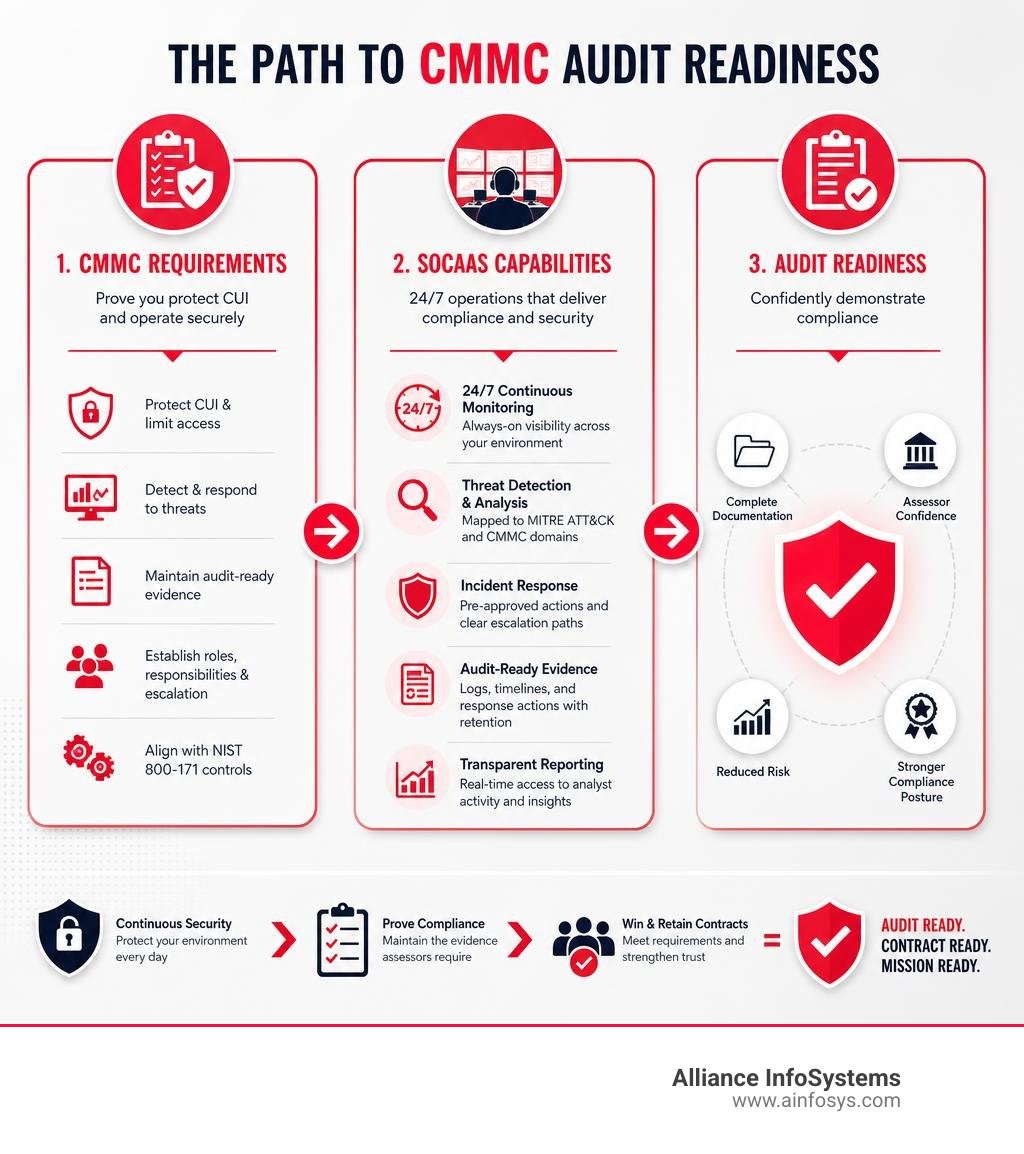
- 24/7 continuous monitoring of your IT environment and CUI systems
- Audit-ready evidence including documented incident timelines, log retention, and traceable response actions aligned to NIST 800-171 controls
- Defined response ownership with pre-approved containment actions and clear escalation paths
- Threat detection mapped to MITRE ATT&CK and CMMC practice domains
- Transparent reporting with real-time access to analyst activity, not just black-box summaries
If your current security setup cannot check all five of those boxes, you likely have a compliance gap that puts your contracts at risk.
The defense industrial base (DIB) is under relentless pressure. The Department of Defense has made CMMC certification a hard requirement for contractors seeking to work on federal contracts. That means the days of a basic firewall and a quarterly vulnerability scan being “good enough” are over. CMMC now demands that organizations prove they can detect threats, respond to them, and document everything in a way that holds up under third-party assessment.
The challenge for most small to mid-sized defense contractors is simple: building an internal Security Operations Center (SOC) is expensive. Staffing a 24/7 team of trained analysts, maintaining a SIEM, engineering detections, and generating compliance-grade reporting requires resources that most SMBs do not have. That is exactly where SOC-as-a-Service (SOCaaS) steps in as a practical, cost-effective alternative.
But not every SOCaaS provider is built with CMMC in mind. Many are designed for general commercial use. They may alert you to threats, but they do not necessarily generate the structured, traceable evidence that a CMMC assessor needs to see. The gap between “we monitor your environment” and “we help you prove compliance” is significant, and it is a gap that too many organizations discover only when it is too late.
Alliance InfoSystems is a Maryland-based IT Provider with over 20 years of experience helping organizations in regulated industries navigate exactly this kind of challenge. This guide breaks down what CMMC actually requires from a security operations standpoint, where common outsourcing models fall short, and what to look for in a SOCaaS provider that is genuinely built for compliance-heavy environments.
Understanding CMMC 2.0 and the Role of Security Operations
The Cybersecurity Maturity Model Certification (CMMC) framework is built to safeguard sensitive defense information across the supply chain. If your organization handles Controlled Unclassified Information (CUI), you must align with CMMC Level 2, which mirrors the 110 security controls of NIST SP 800-171.
Achieving compliance is not a “one-and-done” checklist. When an auditor reviews your environment, they will not just ask if you have security tools installed—they will demand proof of active, continuous monitoring. This is where security operations become the heart of your compliance strategy. You must demonstrate that you can identify, analyze, and respond to security anomalies in real time.
For a deeper look into the official framework, you can read more About CMMC – DoW CIO – Department of War.
To successfully defend your network, you must establish a strong foundation. This begins with answering: What Should Be the First Principle of Cybersecurity Within Any Organization?—namely, identifying and understanding what assets and data you are trying to protect. Without this continuous operational visibility, maintaining a true CMMC-compliant posture is impossible.
Why Traditional MDR and MSSP Models Fall Short for Defense Contractors
Many defense contractors assume that hiring a traditional Managed Security Service Provider (MSSP) or Managed Detection and Response (MDR) vendor will automatically satisfy CMMC requirements. Unfortunately, this is a costly misconception.
Traditional MSSPs generally focus on managing tools, configuring firewalls, and monitoring infrastructure logs. If an alert triggers, they pass it to your team to deal with. They do not dive deep into hands-on threat investigation or compliance reporting. On the other hand, standard MDR services offer threat detection and response, but they often operate as a “black box.” They alert you when something goes wrong, but they rarely provide the transparent, structured audit logs and policy documentation required by CMMC assessors.
For those looking to understand advanced defense structures, exploring how a Cybersecurity Service Provider operates can be highly beneficial; see our CSSP Explained: Cyber Defense Strategy Guide.
Here is how these models compare when mapped to CMMC requirements:
| Capability | Traditional MSSP | Standard MDR | CMMC-Compliant SOCaaS |
|---|---|---|---|
| 24/7 Monitoring & Triage | Yes (often basic alerts) | Yes | Yes (with deep contextual analysis) |
| Active Threat Containment | No | Limited (host-only isolation) | Yes (pre-approved host, network, and identity actions) |
| Audit-Ready NIST Logs | No | No | Yes (full audit trail and historical retention) |
| Workflow Transparency | Low (ticketing portals only) | Medium (black-box dashboard) | High (direct co-managed visibility) |
Key Capabilities of SOC-as-a-Service for CMMC Compliance
A dedicated soc-as-a-service for cmmc bridges the gap between raw threat detection and rigorous regulatory proof. It delivers a comprehensive security operations team that acts as an extension of your business. To understand the fundamental architecture of these services, explore What is SOC as a Service (SOCaaS)? and how a fully Managed SOC Security Operations Center functions to protect modern enterprises.
Continuous Monitoring and Threat Detection in SOC-as-a-Service for CMMC
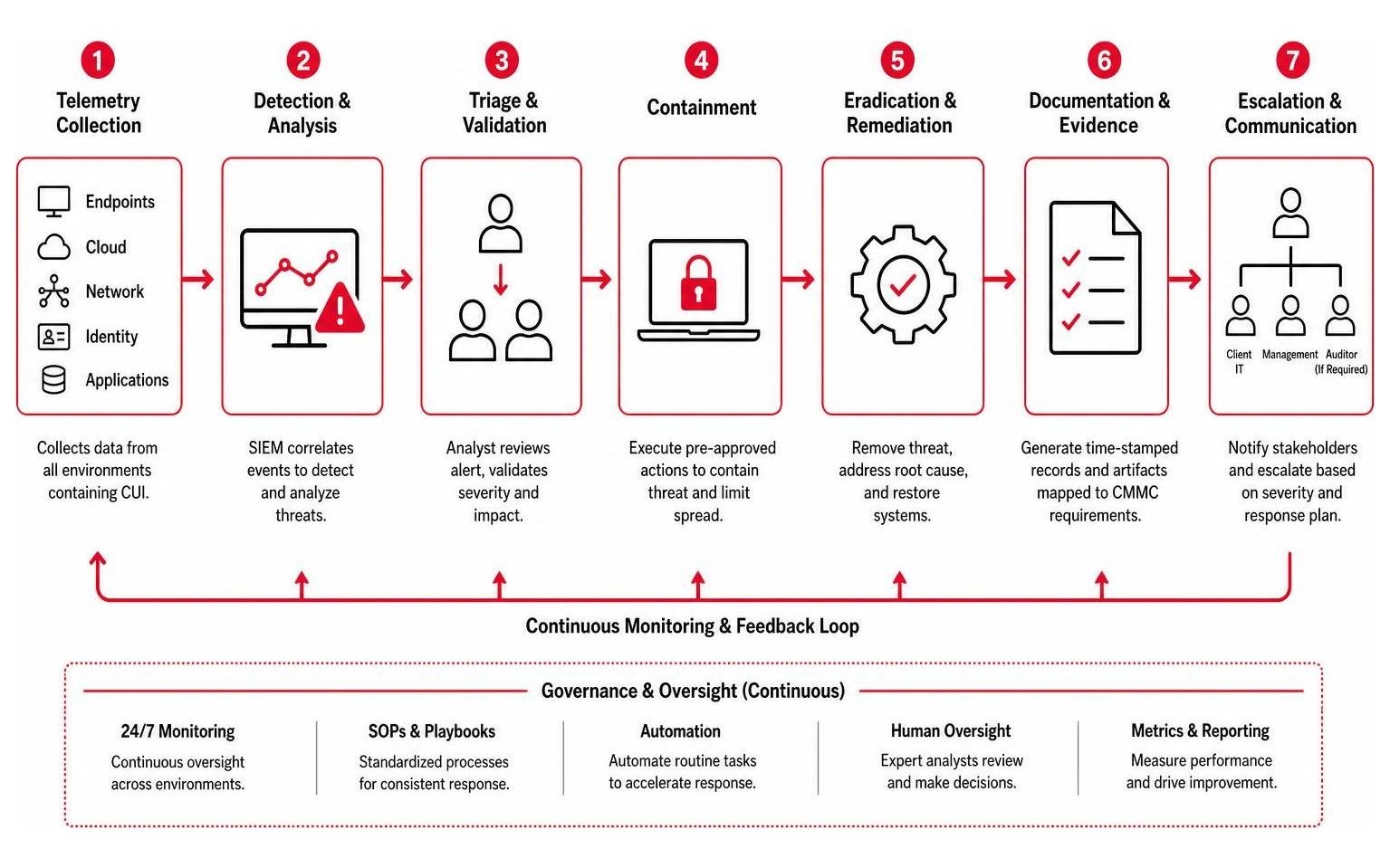
CMMC requires continuous 24/7 monitoring across all environments where CUI resides. A compliant SOCaaS model achieves this by aggregating telemetry from your endpoints, cloud environments, networks, and identity providers into a centralized Security Information and Event Management (SIEM) system.
By analyzing these diverse data streams, the SOC can identify sophisticated threat patterns. To learn how these layers work together to stop active breaches, read about How Network Security Services Protect Against Modern Cyber Threats.
Audit-Ready Evidence and Incident Reporting
When assessment day arrives, your auditor will not take your word for it—they need hard evidence. A compliance-native SOCaaS provider generates structured, time-stamped artifacts of every alert, investigation, and remediation step taken.
Just as financial audits require rigorous accounting, cybersecurity compliance demands certified operational standards. Working with a provider that maintains verified internal controls ensures your data is handled securely; for example, see why partnering with a SOC 2 Certified MSP 2025 is critical for regulated industries.
Operationalizing SOCaaS: Ownership, Automation, and MSP Integration
Successfully deploying a SOC is not just about buying the right software; it is about defining clear operational workflows. To build a resilient foundation, organizations must implement How to Secure IT Infrastructure Best Practices alongside the Top 10 Cyber Security Practices to ensure no security gaps are left unaddressed.
Defining Response Ownership and Accountability
A common failure point in outsourced security is the “bystander effect,” where an alert is detected, but both the internal IT team and the SOC provider assume the other is handling it.
To prevent this, we establish a strict responsibility matrix. This defines pre-approved containment actions—such as isolating an infected workstation or disabling a compromised user account—that our analysts can execute immediately. This keeps response times down to minutes rather than hours.
Balancing Automation with Human Oversight in SOC-as-a-Service for CMMC
Modern security operations leverage advanced automation and agentic AI to parse through millions of daily events, filtering out the noise. However, fully autonomous systems lack the context required to make critical business decisions.
A CMMC-compliant SOCaaS balances this by pairing high-speed automation with human validation. Experienced analysts review flagged anomalies, mapping threat behaviors directly to the MITRE ATT&CK framework to ensure precise, context-aware containment.
Integrating SOCaaS with Existing IT and MSP Workflows
Your SOC should not operate in a silo. It must integrate seamlessly with your existing IT staff or Managed Service Provider (MSP). When a threat is validated, the SOC provider should inject actionable remediation steps directly into your team’s ticketing system, establishing a co-managed workflow.
By combining 24/7 security oversight with daily IT operations, we ensure your business remains both secure and compliant. You can learn more about how we structure these hybrid relationships by visiting our dedicated page on Managed Security.
Selecting and Budgeting for a CMMC-Compliant SOC Provider

When evaluating a soc-as-a-service for cmmc provider, pricing models and scope are critical considerations. Some providers charge based on data ingestion volume, which can lead to unpredictable monthly bills and “scope creep” as your business grows. Look for predictable, flat-rate pricing models based on endpoint or user counts.
Additionally, verify that your partner has documented credentials in security excellence. For example, Alliance Infosystems Achieves a New Milestone in Security Excellence, demonstrating our commitment to maintaining the highest security standards for our clients in Maryland and beyond.
Frequently Asked Questions about SOCaaS and CMMC
What is the difference between a SOC and a SOC 2 audit report?
A Security Operations Center (SOC) is an operational team responsible for monitoring, detecting, and responding to cyber threats in real time. A SOC 2 audit report, on the other hand, is an independent compliance assessment that evaluates whether a service organization’s internal controls meet specific security, availability, and confidentiality standards.
How much does SOC-as-a-Service cost for CMMC compliance?
The cost of SOCaaS varies depending on the size of your environment, the number of monitored endpoints, and log ingestion requirements. For small to mid-sized defense contractors, outsourcing to a managed SOC is significantly more cost-efficient than building an in-house team, which can easily cost hundreds of thousands of dollars annually in staffing and licensing.
Can my existing MSP handle CMMC SOC requirements?
Most standard MSPs excel at IT maintenance, helpdesk support, and basic backup management, but they lack the dedicated, round-the-clock security analysts and specialized compliance tools required for CMMC Level 2 continuous monitoring. A co-managed model, where a specialized SOCaaS integrates directly with your existing MSP, is often the most effective approach.
Conclusion
Navigating the complexities of CMMC compliance does not have to be an overwhelming or cost-prohibitive journey. By partnering with a specialized IT Provider, you can achieve 24/7 threat monitoring, rapid response, and audit-ready reporting without the massive overhead of building an internal security team.
At Alliance InfoSystems, we bring over 20 years of experience as a trusted Maryland-based IT Provider. We deliver flexible, customized, and cost-efficient managed security solutions designed to protect your sensitive data and keep your federal contracts secure.
Ready to simplify your compliance journey? Secure your defense contract with Alliance InfoSystems’ Managed Security Services today.