
Why Network Security Remediation is Critical for Your Business
Network security remediation services are specialized processes that identify, fix, and eliminate cybersecurity vulnerabilities in your IT infrastructure. The goal is to prevent future attacks and strengthen your overall security posture.
Quick Answer:
Network security remediation services help businesses by:
- Identifying vulnerabilities through comprehensive assessments.
- Fixing security weaknesses by patching, hardening configurations, and adjusting access.
- Eliminating root causes of security issues, not just symptoms.
- Preventing future breaches through proactive defense.
- Strengthening long-term resilience by systematically improving security.
Why This Matters Now
The numbers tell a stark story. The average cost of a data breach reached $4.35 million in 2022. It takes an average of 207 days to identify a breach and another 77 days to contain it. For small and medium-sized businesses, downtime from cyber incidents can cost up to $225,000 per day. A major security incident is a matter of when, not if.
The Proactive Difference
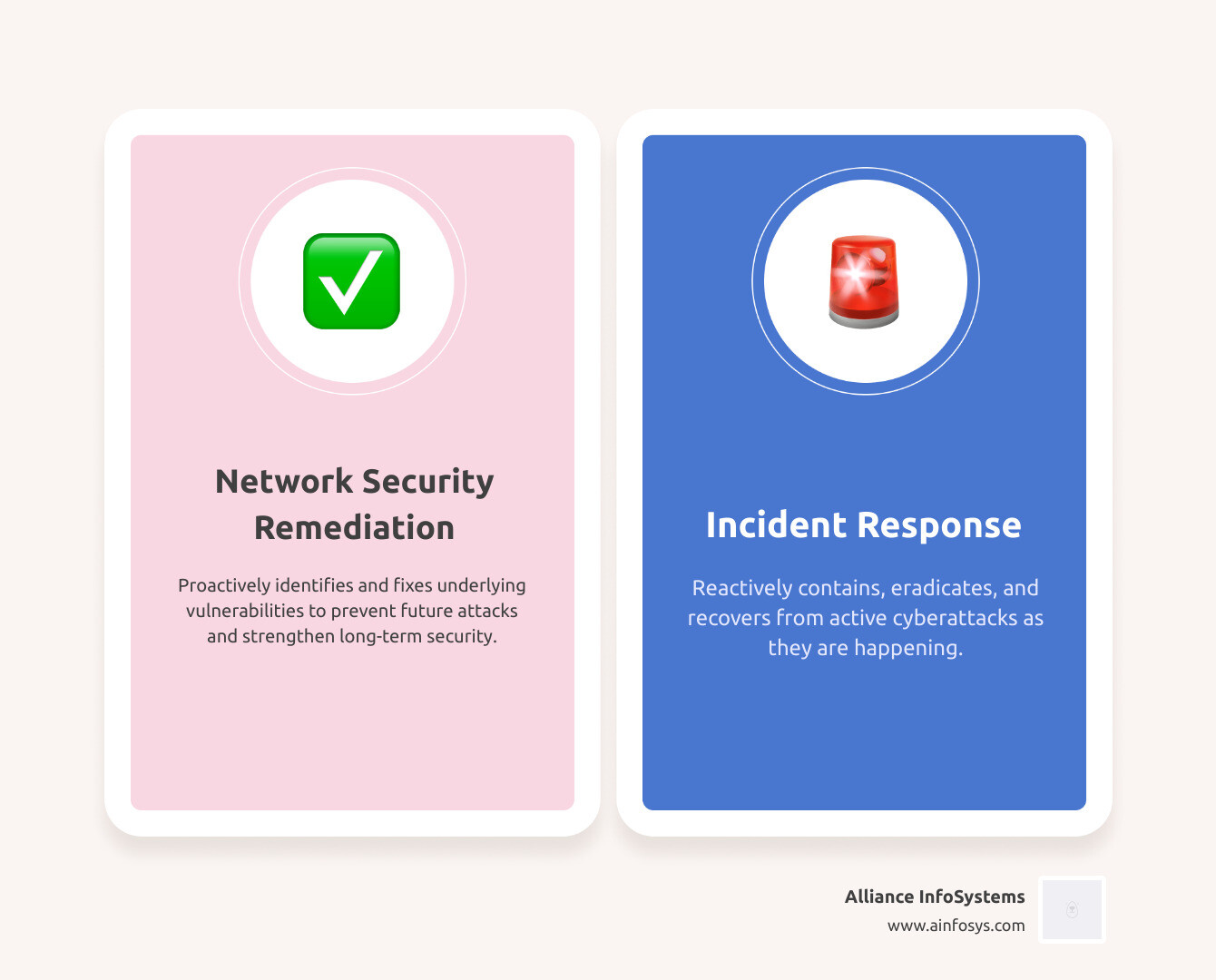
Remediation is different from incident response. Incident response deals with active attacks, like calling the fire department. Remediation is proactive; it focuses on fixing the underlying problems to prevent attacks, like fireproofing your building. Organizations with a continuous exposure management program are three times less likely to suffer a breach by 2026. This highlights the power of proactive remediation.
Understanding Network Security Remediation
Network security remediation services are a systematic approach to finding and fixing weak spots in your digital defenses before they become expensive problems. It’s about strengthening your security posture, reducing your attack surface, and building long-term resilience. The goal is to ensure fewer things go wrong in the first place.
So, what is network security remediation?
In plain English, network security remediation is the process of identifying vulnerabilities, fixing the underlying problems, and implementing safeguards to prevent them from recurring. It’s an ongoing commitment, not a one-time fix.
Unlike simply patching software, remediation addresses root causes. This includes hardening system configurations, adjusting access controls, updating security policies, and training your team to recognize threats. It eliminates the conditions that allow threats to emerge, creating long-term resilience instead of temporary fixes.
Not sure if your business is vulnerable? We’ve put together a helpful guide: Are You at Risk of a Cyberattack?
How do network security remediation services differ from incident response?
Remediation and incident response are both crucial but serve different purposes at different stages.
Incident response is your emergency team. During an active cyberattack, it works to contain the damage, stop the attack, and restore systems. It’s immediate, intense, and focused on mitigation—minimizing harm while the fire is still burning.
Network security remediation is the proactive work that happens after an incident is contained, or ideally, before one ever starts. It involves figuring out how the breach occurred, fixing the vulnerability, and strengthening defenses to prevent it from happening again.
In short, incident response contains active threats, while remediation eliminates root causes to prevent future incidents.
| Feature | Incident Response | Network Security Remediation |
|---|---|---|
| Timing | During and immediately after an active security event | After an incident is contained, or proactively |
| Primary Goal | Contain, eradicate, and recover from an active attack | Eliminate root causes, fix vulnerabilities, strengthen defenses |
| Key Activities | Detection, analysis, containment, eradication, recovery, evidence preservation | Patching, configuration changes, policy updates, security control deployment, training |
| Outcome | Minimize immediate damage, restore operations | Improve long-term security posture, prevent recurrence |
Both are essential. Incident response gets you back on your feet, while remediation keeps you standing strong. Learn more about our approach in our Managed Security services.
The Remediation Lifecycle: From Detection to Defense
Network security remediation services are a continuous, cyclical process, much like maintaining your health. It’s an ongoing commitment to keeping your organization secure as new threats emerge.
At Alliance InfoSystems, we’ve guided Maryland businesses through this lifecycle for over 20 years. We know effective remediation isn’t a one-time event.

Phase 1: Identification and Risk Assessment
You can’t fix what you can’t see. This phase is about finding and understanding every vulnerability.
- Vulnerability Scanning: We use automated tools to sweep your network, systems, and applications for known weaknesses like unpatched software or misconfigurations.
- Penetration Testing: Our ethical hackers simulate real-world attacks to find subtle weaknesses that automated tools might miss.
- Threat Modeling: We analyze your specific business processes and assets to understand your unique risk landscape.
After gathering this data, we perform a risk assessment and prioritization. Not every vulnerability is critical. Using scoring systems like CVSS (Common Vulnerability Scoring System) and business impact analysis, we rank vulnerabilities to focus our energy where it matters most.
Maryland organizations can find additional guidance from resources like the Vulnerability Scanning, Assessment and Testing guide from DoIT.maryland.gov.
Phase 2: Remediation Planning and Implementation
With a clear understanding of the risks, we create a structured roadmap for action. This plan outlines specific steps, assigns responsibilities, sets timelines, and defines success.
Implementation can take many forms:
- Patch Management: Applying software updates and security patches to operating systems, applications, and firmware.
- Configuration Hardening: Adjusting default settings on systems and applications for security, not just convenience. This includes disabling unneeded services and removing default passwords.
- Access Control Adjustments: Enforcing the principle of least privilege, ensuring users only have access to resources essential for their jobs.
- Architectural Changes: Implementing network segmentation to isolate zones and limit an attacker’s movement, or deploying new security controls like firewalls and multi-factor authentication.
Our IT Consulting Services guide Maryland businesses in developing and implementing these customized remediation plans.
Phase 3: Verification and Monitoring
Fixing a vulnerability is not the final step. We must verify the fix and monitor for new threats.
- Testing Fixes: We conduct follow-up scans and tests to confirm vulnerabilities are closed and that our fixes haven’t created new issues.
- Continuous Monitoring: We deploy tools like Security Information and Event Management (SIEM) systems to analyze security logs in real-time. These systems provide 24/7 monitoring and alert our team to potential threats.
- Documentation and Lessons Learned: We document all actions and capture insights to inform future security decisions. This feedback makes the entire process cyclical and continuously improving.
This level of monitoring is often best handled by specialized services. Learn more: What is SOC as a Service (SOCaaS)?.
Common Threats and Corresponding Remediation Techniques
At Alliance InfoSystems, we’ve learned that cyber threats target organizations of all sizes. Network security remediation services are designed to address these threats head-on.

What types of cyber threats do network security remediation services address?
Remediation must be comprehensive, tackling a wide range of vulnerabilities.
- Malware (Viruses, Worms, Trojans): We don’t just remove the malicious code; we clean infected systems and identify the entry point to prevent reinfection.
- Ransomware: Remediation focuses on isolating infected systems, restoring data from secure backups, and fixing the initial infiltration point.
- Phishing Attacks: Beyond resetting compromised accounts, we implement user awareness training to turn your team into a strong first line of defense.
- Insider Threats: We implement the principle of least privilege and monitor user behavior to mitigate both malicious and accidental threats.
- DDoS Attacks: Remediation involves deploying mitigation services, rate limiting, and Web Application Firewalls (WAFs) to filter malicious traffic.
- Unpatched Software: This common vulnerability is fixed with a straightforward, consistent patch management program across all systems and devices.
- Cloud Misconfigurations: We audit your cloud configurations against security best practices, correcting deviations like publicly accessible storage buckets.
For a deeper dive, see our post on How Network Security Services Protect Against Modern Cyber Threats.
What is the difference between manual and automated network security remediation?
The best approach uses both human expertise and machine efficiency.
Manual remediation is essential for complex vulnerabilities, unique system configurations, or highly sensitive environments. A skilled cybersecurity professional can analyze context, consider business impact, and craft custom solutions that automated tools cannot handle. This human judgment is invaluable for your most critical systems.
Automated remediation provides speed and scale for common, high-volume vulnerabilities like missing patches. Security Orchestration, Automation, and Response (SOAR) platforms and other tools can fix thousands of issues faster than any human team, ensuring consistent security across a large infrastructure.
The most effective strategy is a hybrid approach. We use automation for routine tasks, freeing our security experts to focus on complex issues that require careful analysis. This gives you the speed of automation combined with the wisdom of human experience.
The Business Case for What is Network Security Remediation Services
When it comes to network security remediation services, the financial case is crystal clear. This is a strategic investment that protects your bottom line and keeps your business running. As the Cloud Security Alliance’s 2024 report on The State of Security Remediation highlights, proactive security management is business-critical.
What are the benefits of engaging specialized network security remediation services?
Partnering with a dedicated team like Alliance InfoSystems provides a strategic advantage.
- Access to Specialized Expertise: Our team has years of experience dealing with the full spectrum of cyber threats. This deep knowledge is difficult and expensive to hire and retain in-house.
- Faster Resolution Times: Our specialized tools and proven methods mean we identify and fix issues quickly, reducing the window of opportunity for attackers.
- Reduced Downtime: By proactively fixing weaknesses, we dramatically lower the risk of attacks that could shut down your operations.
- Cost-Effectiveness: Investing in remediation is almost always cheaper than the multi-million dollar cost of recovering from a major breach.
- Improved Compliance: We help you meet requirements for regulations like HIPAA, PCI DSS, and CMMC, avoiding steep penalties and reputational damage.
- Focus on Core Business: Trusting us with cybersecurity allows your team to focus on innovation, customer service, and growth.
Our guide on 7 Factors for Choosing IT Cybersecurity Services can help you evaluate your options.
How does remediation impact business continuity and disaster recovery?
Remediation and your business continuity/disaster recovery (BC/DR) plans are two sides of the same coin, both focused on keeping your business operational.
Remediation reduces incident severity by eliminating the vulnerabilities attackers would exploit. This makes it less likely your BC/DR plan will be needed for a cyberattack. If an incident does occur, a well-maintained environment allows for faster recovery times, improving your Recovery Time Objective (RTO) and Recovery Point Objective (RPO). The insights gained during remediation also help strengthen your DR plans by identifying and addressing weaknesses.
How are remediation costs justified?
The return on investment for remediation becomes undeniable when you consider the alternatives.
- The Cost of a Breach: The average data breach costs $4.35 million, a figure that includes forensic investigations, legal fees, fines, and lost business.
- Downtime Costs: For small and medium-sized businesses, downtime can cost up to $225,000 per day. Every hour offline is lost revenue and an opportunity for your competitors.
- Regulatory Fines: Non-compliance with regulations like HIPAA or GDPR can result in fines reaching millions of dollars. For many Maryland businesses, CMMC non-compliance means losing the ability to bid on DoD contracts.
- Reputational Damage: Customer trust, once broken, is incredibly difficult to rebuild. 60% of small businesses that suffer a cyberattack go out of business within six months, often due to lost customer confidence.
- Cyber Insurance Premiums: Insurers are scrutinizing cybersecurity postures. A robust remediation program can lead to better rates and coverage, while a poor posture can make you uninsurable.
Investing in remediation is insurance, risk management, and business enablement rolled into one. Our Beginner’s Guide to Managed IT Services explores how these services can protect your business and reduce total IT costs.
Ensuring Effective and Continuous Remediation
Network security remediation services are never truly “done.” The threat landscape shifts constantly, and your defenses must evolve with it. Effective remediation is a continuous process, not a one-time project.
How frequently should network security remediation be performed?
Remediation should be woven into your daily operations. Organizations that adopt continuous exposure management are three times less likely to suffer a breach.
Remediation should occur:
- After every vulnerability scan or penetration test.
- Following any security incident, as part of the “lessons learned” phase.
- Proactively, when new threats or zero-day vulnerabilities are announced.
We also recommend regular reviews (e.g., quarterly) of your remediation backlog to ensure fixes are holding and your security posture remains strong.
How can organizations ensure the effectiveness of their efforts?
Going through the motions isn’t enough. You need to verify that your efforts are making a real difference.
- Set Clear Metrics: Track key performance indicators, such as the average time to fix critical vulnerabilities or the number of open high-severity issues.
- Conduct Post-Incident Reviews: A thorough analysis after any security event provides valuable insights to prevent it from happening again.
- Use Independent Security Audits: An unbiased assessment can highlight overlooked gaps and validate the effectiveness of your remediation work.
- Train Your People: Regular cybersecurity awareness training addresses the human element. A well-trained employee who can spot a phishing email is a powerful defense.
- Break Down Silos: Effective remediation requires collaboration across IT, security, operations, and leadership to ensure efforts align with business objectives.
At Alliance InfoSystems, we believe continuous improvement is the foundation of cybersecurity. Learn more: What Should Be the First Principle of Cybersecurity Within Any Organization?
Conclusion
Understanding what is network security remediation services is the foundation of a resilient cybersecurity strategy. It’s about building defenses that don’t just respond to attacks, but actively prevent them.
This guide has shown how remediation differs from incident response, walked through its lifecycle, and explored the threats it addresses. Most importantly, we’ve made the business case: investing in remediation protects your bottom line, ensures business continuity, and preserves customer trust. The cost of prevention is always less than the cost of recovery.
For over 20 years, Alliance InfoSystems has helped Maryland businesses steer the complex cybersecurity landscape. We’re not just an IT provider; we’re your local partner. We take the time to understand your unique challenges and goals, creating customized security solutions that fit your needs and budget.
The threat landscape is constantly evolving, but you don’t have to face it alone. With the right partner and a proactive approach, you can turn cybersecurity from a source of anxiety into a strategic advantage.
Don’t wait for a breach to reveal your vulnerabilities. Take the proactive step today. Strengthen your defenses with our Managed Security services and let us help you build a secure, resilient future for your business.