
Why IT Staff Augmentation Matters for Growing Businesses
IT staff augmentation is a flexible hiring strategy that lets you temporarily add skilled IT professionals to your existing team without the commitment of full-time employment. Instead of going through lengthy recruitment cycles, you bring in pre-vetted experts who integrate directly into your workflows and work under your management.
Quick Answer: What You Need to Know
- What it is: A staffing model where external IT professionals join your team temporarily
- How it works: A provider sources, vets, and manages HR/payroll while you direct the work
- When to use it: For skill gaps, project spikes, urgent deadlines, or specialized expertise
- Key benefit: Fast access to talent (1-2 weeks vs. 2-3 months for traditional hiring)
- Cost impact: Potential savings of 30-50% compared to full-time employees
- Your role: You maintain full control over tasks, quality, and project direction
The numbers tell a compelling story. IT staff augmentation is projected to become an $82 billion industry in 2025, growing at 3.5% annually. This growth isn’t random—it’s driven by a real problem.
64% of IT executives find it difficult to adopt new technologies due to talent gaps. The shortage is hitting hard across major economies including the United States, Japan, Germany, China, and Spain.
Traditional hiring takes months. Projects can’t wait that long.
This is where staff augmentation changes the game. You get the expertise you need, when you need it, without the overhead of permanent hires. No recruitment fees. No benefits packages. No long-term commitments.
For small to medium-sized businesses, this flexibility is crucial. You might need a cybersecurity specialist for three months to implement new protocols. Or a cloud architect to migrate your systems. Or developers to build a custom application.
Staff augmentation gives you access to a global talent pool of specialists who can start in days, not months.
Why and When to Choose Staff Augmentation
In today’s digital landscape, businesses in Maryland and across the US are constantly challenged to innovate and scale. Even talented teams can face skill gaps or capacity limitations. This is precisely where IT staff augmentation shines, offering a strategic advantage that can propel your projects forward.

One of the primary drivers for IT staff augmentation is accessing specialized skills. The IT landscape is vast and ever-changing. Finding in-house talent for niche areas like AI, advanced cybersecurity, or specific cloud platforms (AWS, Azure, GCP) can be a lengthy and expensive endeavor. Staff augmentation allows you to tap into a broad pool of experts, getting the precise skills required without the burden of long-term recruitment.
Beyond skills, IT staff augmentation offers significant cost savings. Traditional hiring involves substantial costs for recruitment, onboarding, benefits, and administrative overhead. With staff augmentation, you bypass many of these expenses. Some reports indicate 30-50% savings over hiring full-time staff. This efficiency allows you to allocate your budget to project delivery rather than HR processes.
Meeting urgent deadlines and scaling for project-based work are other critical scenarios where this model proves invaluable. When a sudden project arises or an existing one faces challenges, the ability to quickly onboard skilled professionals makes all the difference. You can rapidly scale your team up or down based on project demands, ensuring milestones are met. This agility is a game-changer for businesses needing to be responsive and competitive.
The model also significantly reduces recruitment overhead. IT continues to top the list of in-demand roles, and competition is fierce. Instead of spending months on a hiring process, a staff augmentation partner provides pre-vetted professionals quickly.
Industries that commonly benefit from IT staff augmentation include:
- Technology: For rapid development cycles, new product launches, or tackling technical debt.
- Finance: For implementing new fintech solutions, ensuring regulatory compliance, or strengthening cybersecurity.
- Healthcare: For developing telemedicine platforms, managing patient data systems, or enhancing data security.
- Retail & E-commerce: For optimizing online platforms, implementing AI-driven customer experiences, or managing seasonal spikes.
- Manufacturing & CPG: For IoT integration, supply chain optimization, or digital change initiatives.
- Media & Gaming: For accelerating development, adding specialized graphics or engine expertise, or handling peak demand.
- SaaS: For faster feature development, scaling infrastructure, or specialized integrations.
Here are some scenarios where IT staff augmentation is ideal:
- Short-term projects with specific skill needs and a controlled budget.
- When you need to scale up fast for big launches, tight deadlines, or seasonal peaks.
- When you need specialized expertise for legacy systems, new tech trials, or innovation projects.
- To fill temporary gaps due to employee leave or unexpected departures.
- When you have clear project requirements and want to maintain direct management.
The Key Benefits of IT Staff Augmentation
The advantages of integrating augmented staff into your operations are numerous and impactful:
- Flexibility to Scale: Easily adjust team size to match project demands, scaling up for peak periods and down as needs change, avoiding the complexities of traditional hiring and firing.
- Cost-Effectiveness: By avoiding recruitment fees, benefits, and long-term salaries, IT staff augmentation often results in significant cost savings. You pay only for the expertise you need, when you need it.
- Access to a Global Talent Pool: Your local talent market in Maryland is competitive. Staff augmentation allows you to tap into a worldwide network of professionals, ensuring you find the exact skills required.
- Maintaining Project Control: Unlike full outsourcing, with IT staff augmentation, you retain full control over project direction and quality. Augmented staff become an extension of your team, working under your management.
- Reduced Time-to-Hire: The lengthy traditional hiring process (often 2-3 months) is cut down drastically. Partners can provide vetted candidates in days, allowing onboarding within 1-2 weeks.
- Bridging the Talent Gap: With an estimated 1 million computer programming jobs projected to go unfilled, the talent gap is a real challenge. Staff augmentation provides a practical solution to quickly fill these critical skill shortages.
For deeper insights into strategic IT guidance, you might find our resources on IT Consulting Services beneficial.
Is Staff Augmentation Right for Your Business?
Deciding whether IT staff augmentation is the right move involves evaluating your current needs and long-term goals. It’s not a one-size-fits-all solution, but for many, it offers unparalleled agility.

Consider these questions as a checklist:
- Do you have short-term projects or initiatives? If you have a project with a clear beginning and end, staff augmentation can be a perfect fit.
- Is niche expertise required that your current team lacks? For specialized tasks, bringing in an expert temporarily is more efficient than training existing staff.
- Are you operating under tight budget constraints? If avoiding the full costs of permanent employment is a priority, staff augmentation offers a financially savvy alternative.
- Do you need to scale rapidly for a big launch or project? When speed is essential, staff augmentation allows for swift onboarding of qualified professionals.
- Are you looking to fill temporary leave or unexpected vacancies? Augmented staff can step in to keep projects on track without interruption. As highlighted, short-term projects with specific skill needs are a prime example where this model excels.
If you answered yes to several of these, IT staff augmentation is likely a strong contender for your strategic planning.
Understanding IT Staff Augmentation Models and Alternatives
When we talk about IT staff augmentation, it’s important to understand how it fits into the broader landscape of IT service delivery. It’s distinct from traditional hiring and also from other external service models like managed services or project-based outsourcing.
Here’s a comparison to help clarify where IT staff augmentation stands, especially when considering our own Managed IT Services:
| Feature | IT Staff Augmentation | Alliance InfoSystems’ Managed IT Services |
|---|---|---|
| Control Level | High – You maintain direct control over daily tasks, project direction, and methodologies. | Medium to High – We manage the services, but you set the strategic direction and receive regular reports. |
| Management Responsibility | Your internal project managers oversee augmented staff daily. | Alliance InfoSystems manages the IT functions, systems, and personnel involved. |
| Integration | Augmented staff integrate seamlessly into your existing in-house team. | We operate as an external partner, often remotely, managing specific IT functions or infrastructure. |
| Cost Structure | Typically hourly or monthly rates per augmented professional. | Often a fixed monthly fee for a defined scope of services, providing predictable budgeting. |
| Best Use Cases | Filling skill gaps, scaling for projects, urgent deadlines, niche expertise. | Ongoing IT support, network management, cybersecurity, cloud services, proactive maintenance, strategic IT planning. |
While IT staff augmentation provides flexible human resources, our Managed IT Services offer comprehensive, proactive management of your IT infrastructure and operations, allowing you to focus on your core business.
Common IT Staff Augmentation Models
The beauty of IT staff augmentation lies in its versatility. Providers offer different models to suit various needs:
- Commodity Augmentation: This is for straightforward, often repetitive tasks that require less specialized skills. Think data entry, basic testing, or administrative support. It’s about adding hands to get routine work done efficiently.
- Skill-Based Augmentation: This model brings in professionals with specific technical skills for intermediate-level tasks. For example, a front-end developer for a website redesign or a QA engineer for software testing.
- Specialist Augmentation: This is for high-stakes projects requiring advanced technical knowledge or certifications. This might involve a senior cloud architect, a cybersecurity expert, or a data scientist for complex AI initiatives. These are the folks who bring deep, niche expertise to the table.
- Onshore Model: Hiring augmented staff located within your own country (e.g., in Maryland or elsewhere in the US). This offers seamless communication, cultural alignment, and often real-time collaboration with shared time zones.
- Nearshore Model: Engaging talent from neighboring countries or regions with minimal time zone differences (ee.g., Canada or Latin America for US companies). This provides a good balance of cost-effectiveness and collaborative convenience.
- Offshore Model: Sourcing talent from distant countries (e.g., Eastern Europe, Asia). This can offer significant cost savings and access to vast talent pools, though it may require careful management of time zone differences.
- Hybrid Models: A combination of the above, perhaps mixing onshore project leads with offshore development teams, or a blend of remote and on-site augmented staff. This allows for maximum flexibility and optimization.
Staff Augmentation vs. Traditional Hiring
Let’s face it, traditional hiring in the IT sector can be a bit of a marathon. IT staff augmentation is more like a sprint.
- Recruitment Time: Traditional hiring can take 2-3 months, sometimes longer, for a full-time employee. With IT staff augmentation, we can often have qualified candidates presented within days and onboarded in 1-2 weeks. This speed is crucial for project continuity and market responsiveness.
- Onboarding Costs: Beyond salary, traditional hires come with costs for training, equipment, and administrative setup. Augmented staff usually arrive ready to go, often with their own equipment, minimizing our onboarding expenses.
- Long-Term Commitment: A full-time hire implies a long-term commitment. IT staff augmentation is inherently flexible, allowing us to engage talent for the precise duration of a project or need, without the commitment of permanent employment.
- Employee Benefits: Providing comprehensive benefits packages (health insurance, 401K, paid time off) is a significant cost for full-time employees. With IT staff augmentation, the provider typically handles these, reducing our financial burden.
- Administrative Burden: HR, payroll, compliance, and other administrative tasks are managed by the staff augmentation provider. This frees up our internal HR and management teams to focus on core business operations.
- Flexibility: This is perhaps the biggest differentiator. We can scale our team up or down as project demands dictate, bringing in specialized skills for a temporary period and releasing them when the need passes. This agility is challenging to achieve with traditional full-time employment models.
The Process: Finding and Integrating Your Augmented Team
Starting on an IT staff augmentation journey can seem daunting, but a clear process makes it straightforward and effective. At Alliance InfoSystems, we understand the importance of a structured approach, from initial needs analysis to seamless integration.
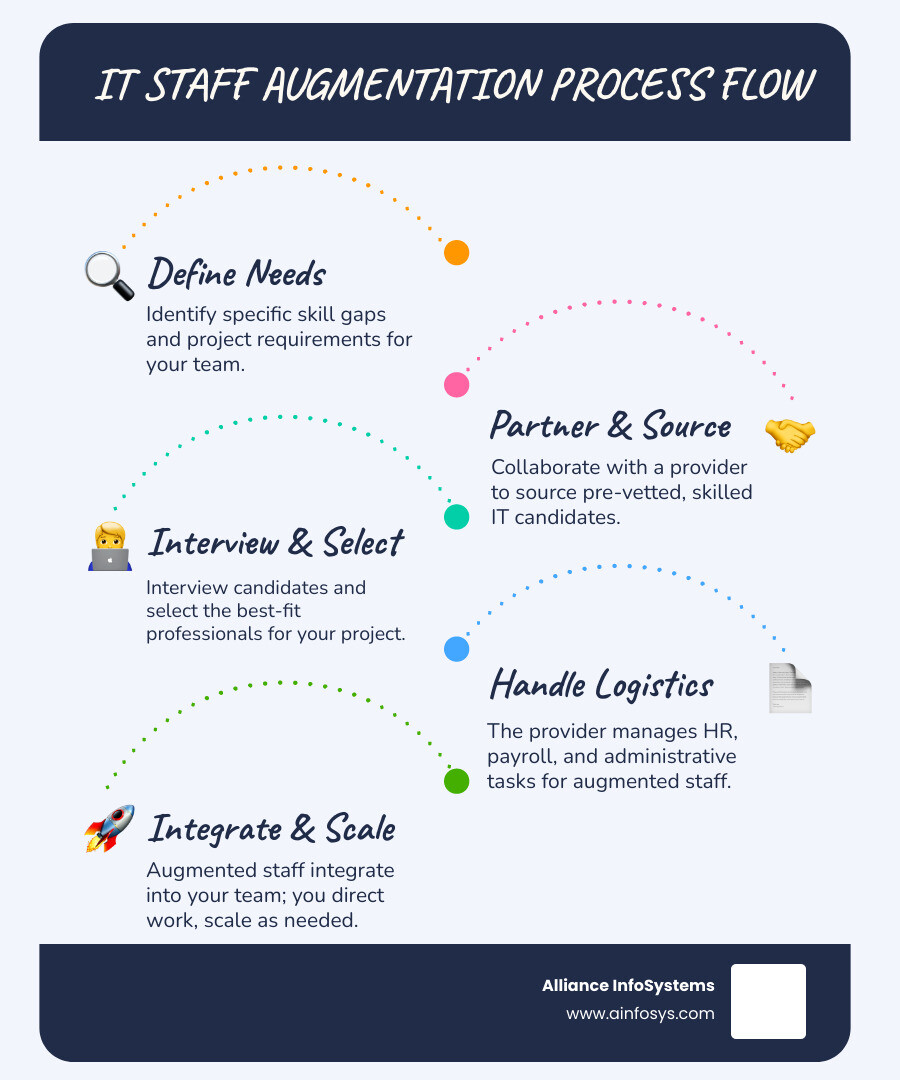
The typical process flows as follows:
- Define Requirements: Clearly articulate the roles, skills, experience, and duration needed.
- Partner Selection: Choose a reliable IT staff augmentation provider.
- Candidate Vetting & Selection: The provider presents pre-vetted candidates; you interview and select the best fit.
- Contracting: Agreements are finalized with the provider, covering terms, scope, and service levels.
- Onboarding & Integration: Augmented staff join your team and begin work.
- Ongoing Management: You manage their daily tasks and project contributions.
- Scaling & Offboarding: Adjust team size as needed and ensure smooth transitions when projects conclude.
Collaboration is key at every step. A structured process ensures that augmented team members feel like an integral part of the organization from day one.
Step 1: Choosing the Right Partner
Selecting an IT staff augmentation partner is one of the most critical decisions. It’s about finding a strategic ally who understands your business and can deliver top-tier talent.
- Defining Requirements: Before approaching providers, carefully define your needs. This includes specific technical skills (e.g., Python, Java), soft skills, experience level, cultural fit, and project duration.
- Vetting Providers: Look for partners with a proven track record.
- Technical Expertise: Do they specialize in the technologies you need?
- Industry Experience: Have they worked with businesses in your sector (e.g., finance, healthcare, government contracting in Maryland)?
- Client Testimonials & Case Studies: What do their previous clients say?
- Communication Standards: How do they ensure clear and consistent communication?
- Vetting Process: How rigorously do they screen candidates for technical proficiency and cultural fit? Do they use assessment tools like Codility, CodeSignal, or TestGorilla?
- Flexibility: Can they scale resources quickly?
- Support: What kind of ongoing support do they offer?
To ensure you’re getting the best value and partnership, it’s wise to understand What You Should Be Getting When You Hire a Professional Service Provider.
Here’s a list of questions we recommend asking any potential IT staff augmentation partner:
- What is your vetting process for technical skills and cultural fit?
- How quickly can you source and onboard candidates for our specific needs?
- Can you provide case studies or references relevant to our industry?
- How do you manage communication, time zones, and ongoing support?
- What are your contract terms, pricing models, and replacement policies?
- How do you ensure data security and protect intellectual property?
Step 2: Seamless Integration and Management
Once you’ve selected your augmented team members, the next crucial step is ensuring their seamless integration and effective management. This phase dictates the success of the entire initiative.
- Onboarding Plan: A structured onboarding plan is essential. It should include access to necessary resources, tools, and documentation, plus introductions to the team, company culture, and project vision.
- Cultural Alignment: While technical skills are paramount, cultural alignment is equally important. Treat augmented staff as integral team members, including them in meetings and discussions to foster a sense of belonging and improve collaboration.
- Providing Tools and Access: Augmented staff need access to your communication platforms (like Google Workspace, Slack, Microsoft Teams), project management tools (Jira, Asana, Trello), and development environments. Secure access protocols are crucial.
- Communication Protocols: Clear communication is the bedrock of successful hybrid teams. Establish consistent channels, define meeting schedules, and encourage regular check-ins. For instance, daily stand-up meetings are excellent for staying updated.
- Project Management Tools: Utilizing shared project management tools helps everyone track tasks, progress, and deadlines. This transparency ensures augmented staff are always aligned with project goals.
- Setting Clear Goals and KPIs: Define clear expectations, roles, and responsibilities from the outset. Establishing measurable key performance indicators (KPIs) allows you to monitor performance and provide constructive feedback.
Navigating Challenges and Ensuring Success
While IT staff augmentation offers immense benefits, it’s not without potential challenges. Being aware of these and having mitigation strategies in place is key to ensuring success.
Common challenges we might encounter include:
- Communication Barriers: Differences in language, culture, or time zones can lead to miscommunications.
- Security Risks: Granting external personnel access to internal systems and sensitive data carries inherent risk.
- Lack of Loyalty/Integration: Augmented staff might not feel fully invested if not properly integrated.
- Knowledge Transfer: Ensuring knowledge is transferred back to the in-house team before departure can be tricky.
Our approach to mitigation focuses on proactive measures:
- For Communication Barriers: Establish clear communication guidelines, use video calls to build rapport, and ensure overlapping work hours for real-time collaboration. Assigning a dedicated internal contact also streamlines communication.
- For Lack of Loyalty/Integration: Involve augmented staff in team-building activities and recognize their contributions. Treating them as true team members, not temporary contractors, helps build engagement.
- For Knowledge Transfer: Prioritize thorough documentation throughout the project. Use shared knowledge bases and ensure ample handover time before an augmented staff member departs.
Mitigating Security Risks with Augmented Staff
Data protection is paramount when working with external teams. As research by Weforum indicates, 95% of cybersecurity issues are caused by human error. Therefore, robust security measures are non-negotiable.
- Data Protection Policies: Establish strict data protection rules and educate all staff on best practices for handling sensitive information.
- Non-Disclosure Agreements (NDAs): All augmented staff must sign comprehensive NDAs to protect confidential and proprietary information.
- Role-Based Access Control: Grant access to systems and data on a “need-to-know” basis, limiting potential exposure.
- Encrypted Connections: Ensure all data sharing and communication occur over secure, encrypted channels like SSH for file transfers.
- Using a virtual private network (VPN): For remote access to internal networks, a VPN provides an encrypted tunnel, safeguarding data in transit.
- Regular Audits and Monitoring: Continuously monitor access logs and conduct security audits to identify and address vulnerabilities.
- Incident Response Plans: Have a clear plan for how to respond to a security breach, should one occur.
For comprehensive strategies on safeguarding your digital assets, you can explore our resources on how to Find Best IT Security Service Providers.
Frequently Asked Questions about IT Staff Augmentation
We often get asked similar questions about IT staff augmentation. Here are some of the most common ones:
How is staff augmentation different from other service models?
IT staff augmentation integrates external talent directly into your existing team, where you (the client) maintain full project control and direct the day-to-day work. The augmented staff work under your management, using your processes and tools. Other models, such as managed services, involve a provider taking on more responsibility for specific IT functions or even entire projects, with less direct client involvement in daily operations. In outsourcing, an external company takes on an entire project, managing their own team and processes, delivering a final product. With staff augmentation, you retain the steering wheel.
How quickly can I onboard an augmented staff member?
The timeline for onboarding an augmented staff member is significantly faster than traditional hiring. While traditional recruitment can take months, many IT staff augmentation partners can present qualified candidates within days of understanding your requirements. Once a selection is made, you can often have them onboarded and contributing to your team in as little as one to two weeks. This rapid deployment is a key advantage for urgent projects or immediate skill gaps.
Who is responsible for managing the augmented staff?
You are. One of the core tenets of IT staff augmentation is that you maintain direct control and management over the augmented staff. Your internal project managers or team leads assign tasks, monitor progress, provide feedback, and manage the daily work of these team members, ensuring they integrate seamlessly with your existing workflows and team structure. The staff augmentation provider handles the administrative aspects, such as HR, payroll, benefits, and compliance for their employees, freeing you from these burdens.
Conclusion
In an era defined by rapid technological change and persistent talent shortages, IT staff augmentation has emerged as a powerful, flexible, and cost-effective strategy for businesses in Maryland and beyond. It allows us to access specialized skills, scale our teams with agility, and meet urgent deadlines without the overheads and commitments of traditional hiring. From bridging critical talent gaps to driving efficiency and innovation, IT staff augmentation offers a clear strategic advantage.
At Alliance InfoSystems, with over 20 years of experience since our founding in 2004, we pride ourselves on offering flexible, customized, and cost-efficient IT solutions. We understand the unique challenges faced by Maryland-based businesses and are committed to being your trusted IT partner. Our expertise ensures that when you choose to augment your team, you’re not just getting temporary staff; you’re gaining access to vetted professionals who seamlessly integrate into your operations, helping you achieve your goals.
Take the next step towards building a more agile and capable IT team.