Why Healthcare Compliance Technology Is Essential for Modern Healthcare Organizations
Healthcare compliance technology is changing how organizations meet regulatory requirements while protecting patient data and avoiding costly penalties. If you’re looking for technology solutions to streamline compliance, here’s what you need to know:
Top Healthcare Compliance Technology Solutions:
- Automated Tracking Software – Manages risk assessments, policy reviews, workforce training, and incident response
- Cloud-Based Platforms – Centralizes documentation, enables real-time collaboration, and provides secure data storage
- AI-Powered Analytics – Predicts compliance risks, automates auditing, and monitors regulatory changes
- Integrated Reporting Systems – Tracks breach notifications, corrective actions, and audit trails
- Training Management Tools – Delivers engaging content and tracks completion in real-time
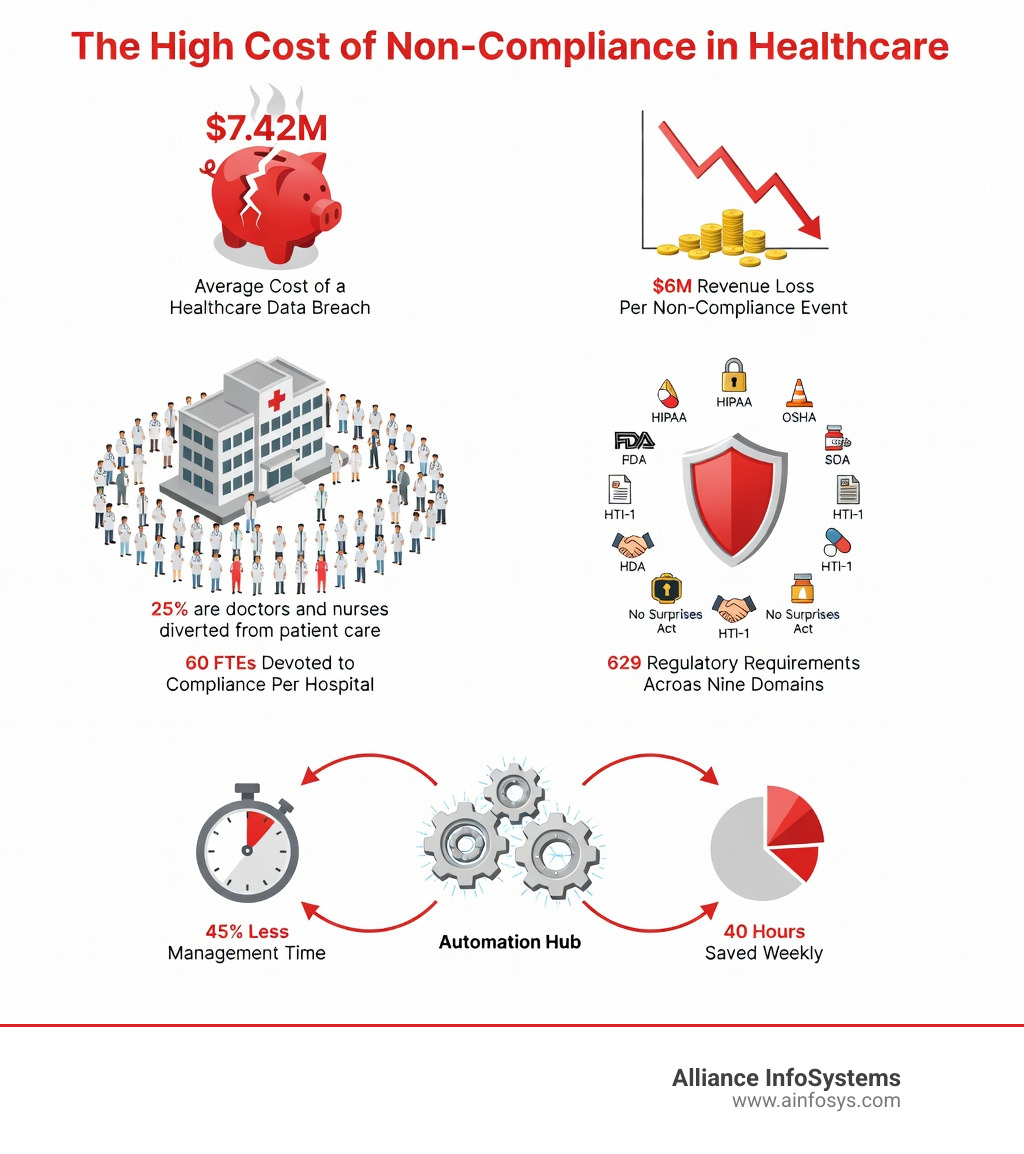
Healthcare organizations face an overwhelming compliance burden. The average hospital devotes nearly 60 full-time employees to regulatory compliance efforts, with 25% of them being doctors and nurses who should be caring for patients instead. Organizations must comply with 629 discrete regulatory requirements across nine domains, including HIPAA, OSHA, FDA regulations, and emerging rules like the HTI-1 Final Rule and No Surprises Act.
The financial stakes are severe. A single non-compliance event can cost an organization nearly $6 million in revenue. Healthcare breaches are the costliest in any industry, averaging $7.42 million per breach. In 2023 alone, 553 large-scale breaches were reported on the OCR breach portal, with individual HIPAA violations carrying penalties up to $68,928.
Manual compliance management is no longer sustainable. Staff shortages and burnout are pushing organizations to adopt technology solutions, with 88% of healthcare leaders saying automation is critical for addressing workforce challenges. Organizations using compliance platforms report saving 40 hours of extra work each week and spending 45% less time managing and tracking compliance issues.
As President of Alliance InfoSystems, I’ve spent years helping healthcare organizations implement healthcare compliance technology that reduces administrative burden while strengthening security and regulatory adherence. The right technology doesn’t just prevent penalties—it frees clinical staff to focus on patient care while building a culture of proactive compliance.
Defining Healthcare Compliance Technology and Its Core Functions
When we talk about healthcare compliance technology, we’re describing a robust ecosystem of software and hardware designed to automate the heavy lifting of regulatory adherence. Think of it as a digital “safety net” that catches human errors before they turn into expensive legal headaches. At its heart, this technology is about moving away from dusty binders and scattered spreadsheets into a centralized, “single source of truth.”
Modern compliance platforms handle everything from checking if your business associates have signed their agreements to ensuring every staff member has completed their annual HIPAA training. It’s not just about “checking boxes”—it’s about operationalizing integrity.
One of the most critical functions is managing incident responses. For instance, if a laptop containing patient data goes missing, the HIPAA Breach Notification Rule sets a very strict clock on when and how you must notify affected individuals and the government. Compliance software automates these timelines, ensuring you don’t miss a deadline that could lead to a secondary fine.
For those just starting to explore this landscape, we’ve put together a deeper dive into compliance for healthcare to help you understand the foundational pillars.

Automating Risk Assessments and Incident Tracking
In the old days (which, let’s be honest, was about five years ago for many), a “risk assessment” involved a consultant with a clipboard and a lot of manual data entry. Today, healthcare compliance technology allows for real-time monitoring.
- Audit Trails: Every time a record is accessed or a policy is changed, the software creates a permanent, tamper-proof digital fingerprint.
- Corrective Actions: If a vulnerability is found—say, a server room door left open uped or an unencrypted database—the system automatically assigns a “corrective action” to the relevant staff member and tracks it until completion.
- Documentation Retention: Regulations often require you to keep records for years. Digital platforms ensure these files are backed up, encrypted, and easily searchable during a surprise audit.
Streamlining Workforce Training and Policy Management
Staff burnout is a massive issue in Maryland’s healthcare facilities. When we ask nurses to spend hours hunting for the latest version of a “Patient Safety” policy, we are contributing to that burnout.
Compliance technology solves this by:
- Policy Versioning: Ensuring everyone is looking at the 2024 version of a document, not a draft from 2019.
- Automated Reminders: Instead of a compliance officer sending 500 individual emails, the system pings employees who haven’t finished their training.
- Specialized Content: This is especially vital in niche areas. For example, behavioral health IT requires specific privacy considerations that a general platform might miss.
The Strategic Benefits of Modernizing Compliance Programs
Upgrading your healthcare compliance technology isn’t just a “tech project”—it’s a strategic move for your organization’s financial health. When you look at the numbers, the “cost of doing nothing” is significantly higher than the investment in modern tools.
| Feature | Manual Compliance | Automated Technology |
|---|---|---|
| Audit Readiness | Weeks of frantic preparation | Always ready with real-time reports |
| Staff Focus | Doctors/Nurses doing paperwork | Clinical staff focused on patients |
| Human Error | High (missed deadlines, lost files) | Minimal (automated alerts & logs) |
| Revenue Protection | High risk of $6M+ losses | Proactive mitigation of fines |
The Office for Civil Rights (OCR) has received nearly 750,000 HIPAA complaints since the Privacy Rule was implemented. Many of these weren’t malicious; they happened because people were simply unaware they were breaking the rules. Technology acts as a constant coach, keeping your team on the right side of the law.
Maximizing ROI with Healthcare Compliance Technology
Return on Investment (ROI) in compliance is often measured by what doesn’t happen (fines, lawsuits, and data breaches). However, there are also very real “hard” savings.
We see organizations achieve a 45% increase in management efficiency. By automating repetitive tasks, a compliance officer who used to spend 40 hours a week on paperwork can now spend that time on high-level risk strategy. For a detailed look at the technical side of these requirements, check out our guide on HIPAA IT requirements.
Improving Patient Outcomes Through Regulatory Integrity
At the end of the day, we are in the business of saving lives and improving health. When compliance is handled efficiently, it fosters a culture of trust. Patients are more likely to share sensitive information if they know their data is protected by state-of-the-art security.
Furthermore, efficient data sharing between providers—done safely and compliantly—leads to better diagnoses and fewer medical errors. This is a core reason why it is important to manage behavioral health services with the same technological rigor as any other medical specialty.
Navigating the Regulatory Landscape: HIPAA, HTI-1, and Beyond
The regulatory landscape is moving faster than ever. It’s no longer just about HIPAA. We now have to contend with OSHA safety standards, FDA oversight on medical devices, and the “No Surprises Act” regarding billing transparency.
One of the biggest shifts recently is the Health Data, Technology, and Interoperability (HTI-1) Final Rule. This rule is a game-changer for how health information flows (and doesn’t flow) across the industry.
Understanding the ONC HTI-1 Final Rule
The HTI-1 rule, issued by the Office of the National Coordinator for Health IT (ONC), focuses on three main pillars:
- USCDI v3: This is the new baseline for data classes. It includes more detailed information on social determinants of health, which helps providers treat the “whole patient.”
- Information Blocking: The rule cracks down on practices that unreasonably interfere with the access, exchange, or use of electronic health info.
- Algorithm Transparency: As AI becomes more common in clinical settings, the HTI-1 rule requires developers to be transparent about how their predictive models work. No more “black boxes.”
Enforcement Trends and Agency Oversight
We are seeing a trend of “creative enforcement.” Federal agencies like the FTC are now stepping in to fine health apps that share data with advertisers, even if those apps aren’t traditionally covered by HIPAA.
The OCR breach portal is a sobering reminder of the risks; with over 550 large-scale breaches in a single year, the government is looking closer than ever at how Maryland facilities protect their data. For those in the behavioral health space, keeping up with these changes is a full-time job, which is why we offer a behavioral health IT services complete guide to help steer these specific waters.
Emerging Trends: AI, Blockchain, and Automation
The future of healthcare compliance technology is incredibly exciting. We are moving from reactive systems (telling you what went wrong) to predictive systems (telling you what might go wrong).
The Role of AI in Healthcare Compliance Technology
Artificial Intelligence isn’t just for robots; it’s a powerful tool for compliance officers.
- Predictive Monitoring: AI can scan your network for unusual patterns that might indicate a data breach or an internal bad actor before they do damage.
- Automated Auditing: Instead of auditing 5% of your charts, AI can audit 100% of them in seconds, flagging inconsistencies in billing or documentation.
- Decision Support: AI helps ensure that clinical decisions align with the latest evidence-based guidelines, which is a key part of regulatory quality standards.
This level of support is becoming standard for remote hybrid therapy IT support, where providers need to maintain compliance across multiple locations and digital platforms.
Blockchain for Credentialing and Transparency
While often associated with cryptocurrency, Blockchain Technology Applications in Healthcare are focused on security.
- Tamper-Proof Records: Once a record is added to a blockchain, it cannot be altered without leaving a trace. This is perfect for credentialing doctors and nurses.
- Fraud Prevention: Because the ledger is distributed, it’s nearly impossible for a single point of failure to result in a fraudulent record.
- Credentialing Automation: Blockchain can create a “digital passport” for providers, making it much faster to verify their licenses and education across different state lines.
Overcoming Implementation Challenges for Long-Term Success
We won’t sugarcoat it: implementing new healthcare compliance technology can be a challenge. The most common problems we see in Maryland facilities are:
- Legacy Systems: Trying to get a brand-new cloud platform to talk to a 15-year-old on-premise server.
- Costs: The upfront investment can be daunting, though it’s much lower than the $7.42 million average breach cost.
- Staff Training: Change is hard! People are used to their old ways of doing things.
Best Practices for Adopting Healthcare Compliance Technology
To ensure a smooth transition, we recommend these steps:
- Start Small and Scalable: Don’t try to automate everything on day one. Start with your highest-risk area (like HIPAA training or BAA management) and build from there.
- Cross-Department Collaboration: Get your IT team, your clinical leads, and your legal counsel in the same room. Compliance is everyone’s business.
- Vendor Consolidation: If you can get one platform that handles six different compliance tasks, you’ll save money and reduce the “app fatigue” your staff feels.
- Invest in Cybersecurity: Compliance and security are two sides of the same coin. Ensure your new tools include robust encryption and multi-factor authentication.
Frequently Asked Questions about Healthcare Compliance
How does technology reduce the cost of healthcare compliance?
Technology reduces costs primarily through automation and risk mitigation. By automating repetitive tasks, you reduce the need for a massive administrative staff (the average hospital uses 60 FTEs!). More importantly, it prevents the multi-million dollar fines and revenue losses associated with non-compliance events.
What are the most common HIPAA violations prevented by software?
Software is excellent at preventing “unintentional” violations. This includes things like:
- Sending PHI to the wrong email address (prevented by DLP tools).
- Forgetting to update a Business Associate Agreement (prevented by automated tracking).
- Failing to terminate a former employee’s access to records (prevented by integrated identity management).
- Losing unencrypted devices (prevented by mandatory encryption software).
How does the HTI-1 rule impact data sharing between providers?
The HTI-1 rule makes data sharing the “default” rather than the exception. It mandates the use of USCDI v3 standards, ensuring that when data is shared, it is in a format the receiving system can actually understand. It also creates strict penalties for “information blocking,” meaning providers and IT vendors can no longer hoard data to keep patients within their own network.
Conclusion
Navigating healthcare compliance technology doesn’t have to be a solo journey. At Alliance InfoSystems, we’ve spent over 20 years serving as a trusted partner for Maryland-based healthcare organizations. We understand that your focus should be on your patients, not on worrying if your server is 100% HIPAA compliant or if you’ve met the latest HTI-1 transparency requirements.
Our Maryland-based team provides flexible, customized, and cost-efficient IT management and security solutions designed specifically for the high-stakes world of healthcare. Whether you are a small behavioral health clinic or a large medical group, we can help you build a technology stack that turns compliance from a burden into a competitive advantage.
Ready to protect your organization and your patients? Start your compliance journey with our comprehensive healthcare guide and see how we can help you modernize your operations today.