What is Healthcare Compliance?
Healthcare compliance is the practice of following the laws, regulations, and ethical standards that govern the healthcare industry — covering everything from patient data privacy to billing practices to fraud prevention.
Here is a quick overview of what it involves:
- What it is: Following federal and state laws to prevent fraud, waste, and abuse in healthcare
- Who it applies to: All healthcare organizations — hospitals, clinics, private practices, and vendors
- Key laws involved: HIPAA, Anti-Kickback Statute, Stark Law, False Claims Act, and more
- Who oversees it: Agencies like HHS, CMS, OIG, FDA, and OCR
- What happens without it: Fines, lawsuits, exclusion from Medicare/Medicaid, and even criminal charges
Healthcare is one of the most heavily regulated industries in the United States — and for good reason. Lives are on the line. Regulations exist to protect patients from harm, keep sensitive data private, and make sure public healthcare dollars are spent honestly.
But for many small and mid-sized healthcare organizations, keeping up with compliance feels like a moving target. The rules are complex, frequently updated, and carry serious consequences when missed.
I’m Sara Szot, President of Alliance InfoSystems, and my background in IT management and business operations has given me a front-row seat to the real challenges healthcare organizations face around healthcare compliance — particularly when it comes to data protection and secure systems. In the sections below, we’ll break it all down in plain language so you know exactly where you stand.
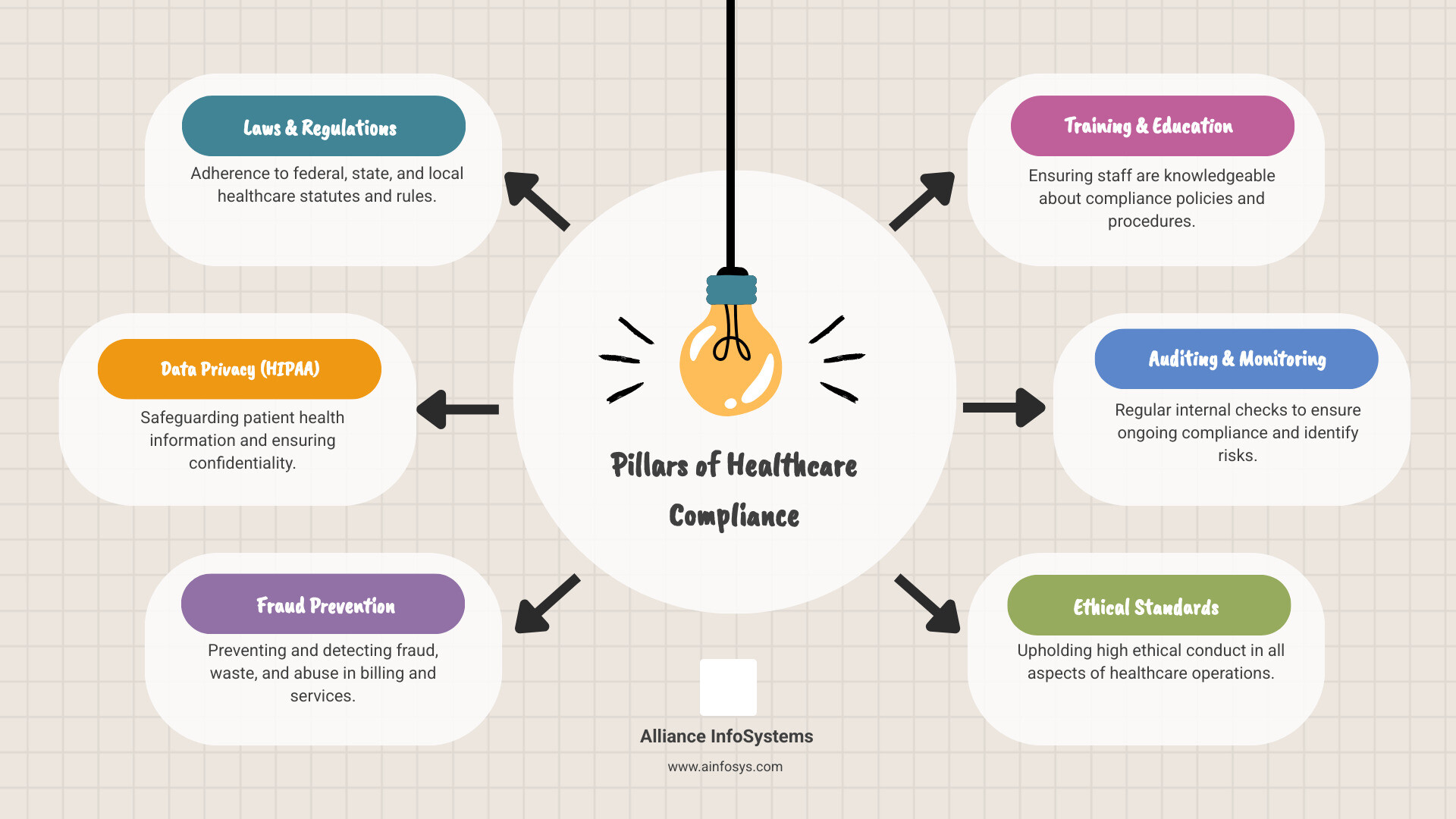
What is Healthcare Compliance and Why Does It Matter?
At its heart, healthcare compliance is about doing the right thing for the right reasons. While it often feels like a mountain of paperwork, the primary purpose is to ensure the safety, integrity, and security of the entire healthcare system. By adhering to local, state, and federal laws, organizations can effectively prevent fraud, waste, and abuse.
Fraud involves intentional deception (like billing for services never rendered), while waste and abuse involve practices that result in unnecessary costs to programs like Medicare and Medicaid. Beyond just saving money, compliance for healthcare is what builds and maintains patient trust. When a patient walks into a clinic in Maryland, they need to know their medical records are private and their treatment is based on medical necessity, not a financial kickback.

The Consequences of Non-Compliance
If you think a compliance program is expensive, try the alternative. The government doesn’t take kindly to “accidental” violations of federal law. For instance, a violation of the Federal Anti-Kickback Statute is a felony. This can lead to a maximum fine of $100,000, imprisonment for up to 10 years, or both.
Under the False Claims Act, the stakes are even higher. Liability can include up to three times the program’s loss, plus an additional penalty for every single false claim filed. Furthermore, if your organization identifies an overpayment from Medicare or Medicaid, you have exactly 60 days to report and repay it. Failure to do so can trigger False Claims Act liability. Beyond the direct fines, there is also the hidden compliance cost of poor records retention, which can lead to massive ediscovery costs and legal headaches during Department of Justice (DOJ) investigations.
The Core Federal Laws Governing Healthcare Compliance
Navigating the legal landscape of healthcare requires an understanding of several “heavy hitter” laws. These aren’t just suggestions; they are the foundation of federal enforcement.
- The Anti-Kickback Statute (AKS): This law prohibits offering, paying, soliciting, or receiving anything of value to induce or reward referrals for items or services reimbursable by federal healthcare programs.
- The Stark Law (Physician Self-Referral Law): This is a “strict liability” law, meaning the government doesn’t have to prove you intended to break the law. It prohibits physicians from referring Medicare patients for “designated health services” to an entity with which the physician (or an immediate family member) has a financial relationship, unless an exception applies.
- The False Claims Act (FCA): This protects the government from being overcharged. It includes a qui tam provision, which allows “whistleblowers” to file lawsuits on behalf of the government and share in any recovered funds.
- The Social Security Act: This is the massive piece of legislation that governs the funding and requirements for Medicare and Medicaid.
To understand how we got here, it’s helpful to look at the history of privacy legislation, which shows how public demand for protection has shaped these modern rules.
HIPAA and Data Privacy in Healthcare Compliance
The Health Insurance Portability and Accountability Act (HIPAA) is perhaps the most famous healthcare law. It was created to protect Protected Health Information (PHI)—which is essentially any “individually identifiable health information” held or transmitted by a covered entity.
HIPAA is split into several rules:
- The Privacy Rule: Sets standards for when PHI can be used or disclosed.
- The Security Rule: Specifically addresses HIPAA IT requirements, requiring administrative, physical, and technical safeguards for electronic PHI (ePHI).
- The Breach Notification Rule: Requires entities to notify patients and the government when data is compromised.
In 2009, the HITECH Act expanded HIPAA by increasing penalties and promoting the adoption of Electronic Health Records (EHRs), making digital security a mandatory part of any modern practice.
Transparency and Patient Rights
Recent years have brought a wave of new regulations focused on transparency and patient empowerment. The No Surprises Act now protects patients from unexpected medical bills, particularly from out-of-network providers at in-network facilities.
We also have the Emergency Medical Treatment and Labor Act (EMTALA), which prevents “patient dumping” by requiring hospitals to stabilize anyone coming to the emergency room regardless of their ability to pay. Additionally, the Affordable Care Act (ACA) and the Interoperability and Patient Access Final Rule have pushed the industry toward giving patients more control over their own digital health data, ensuring that information flows smoothly between different doctors and systems.
The Seven Elements of an Effective Compliance Program
The Office of Inspector General (OIG) provides a “gold standard” roadmap for what an effective compliance program should look like. Whether you are a small practice in Maryland or a large hospital system, your program should be built on these seven pillars:
- Written Policies and Procedures: A clear Code of Conduct and specific policies for high-risk areas like billing and referrals.
- Compliance Leadership and Oversight: Designating a compliance officer and a compliance committee.
- Effective Training and Education: Regular, mandatory sessions for all staff.
- Effective Lines of Communication: A way for employees to report issues (like a hotline) without fear of retaliation.
- Enforcing Standards: Clear disciplinary guidelines for those who violate the rules.
- Auditing and Monitoring: Regular internal reviews to catch mistakes before the government does.
- Responding to Offenses: Taking immediate corrective action when a problem is found.
Implementing the Seven Elements of Healthcare Compliance
Implementation looks different depending on the size of your organization. A large hospital might have a full-time Compliance Officer with a dedicated staff, while a small physician group might designate an office manager to spend a portion of their time on compliance.
Regardless of size, the Compliance Officer must have the authority and independence to do their job. They should report directly to the CEO or the Board, not to the legal or financial departments, to avoid conflicts of interest. Interestingly, some organizations are finding that neurodiversity can be a compliance asset, as individuals with different cognitive styles may be exceptionally skilled at the detailed pattern recognition required for auditing and monitoring.
| Feature | Small Entity (e.g., Private Practice) | Large Organization (e.g., Hospital) |
|---|---|---|
| Compliance Officer | May be part-time or shared role | Dedicated full-time executive |
| Training | Informal but documented sessions | Robust, automated LMS modules |
| Auditing | Periodic manual spot-checks | Continuous software-based monitoring |
| Hotline | Simple “open door” or suggestion box | 24/7 third-party anonymous hotline |
Auditing, Monitoring, and Response
You can’t just “set it and forget it.” A healthy healthcare compliance program requires constant vigilance. This includes conducting annual risk assessments to identify where your organization is most vulnerable. The OIG even provides free resources like RAT-STATS, a statistical software tool that helps providers select random samples for claims reviews.
If an audit reveals that you’ve received an overpayment, remember the 60-day rule. If the violation is more serious—such as a potential AKS or Stark Law breach—organizations should consider using the OIG’s Health Care Fraud Self-Disclosure Protocol. Coming forward voluntarily often results in lower penalties and avoids the “death penalty” of being excluded from federal programs.
Navigating Modern Risks: From Exclusions to Shadow AI
Compliance risks are constantly evolving. One of the most basic but often overlooked tasks is screening for excluded individuals. The OIG maintains the List of Excluded Individuals/Entities (LEIE). If you hire someone on this list—or even buy supplies from an excluded vendor—you can face massive civil monetary penalties.
Common billing risks also remain a top priority. This includes “upcoding” (billing for a more expensive service than performed) and “unbundling” (billing separately for services that should be grouped under one code). Maintaining a clean behavioral health IT infrastructure is critical for ensuring these billing codes are captured accurately and securely.
Emerging Technology and AI Risks
As we move into the era of Artificial Intelligence, new challenges are emerging. Many healthcare workers are using “generative AI” tools to help with notes or scheduling. However, if these tools aren’t properly vetted, they become “Shadow AI”—technology used within an organization without the IT department’s knowledge.
The risks of Shadow AI in healthcare are significant. If an employee pastes PHI into a public AI tool to summarize a patient’s history, that data is no longer secure, creating a major HIPAA violation. Proper data governance and clear policies on AI use are now essential components of a modern compliance strategy.
Mergers, Acquisitions, and Due Diligence
In the business of healthcare, growth often happens through mergers and acquisitions. However, when you buy another practice, you might also be buying their compliance liabilities. Performing due diligence during mergers and acquisitions is vital. You need to know if the entity you are acquiring has a history of improper referrals or “sloppy” billing practices, as these can come back to haunt the new parent company.
Frequently Asked Questions about Healthcare Compliance
What are the seven elements of a compliance program?
The seven elements defined by the OIG are: written policies/procedures, compliance leadership, effective training, open lines of communication, disciplinary standards, auditing/monitoring, and rapid response to detected offenses.
How does the Anti-Kickback Statute differ from the Stark Law?
The Anti-Kickback Statute is a criminal law that requires “intent” and applies to anyone (not just doctors) and any federal healthcare program. The Stark Law is a civil “strict liability” law that only applies to physicians, specifically regarding Medicare/Medicaid referrals for designated health services.
What is the role of the OIG in healthcare?
The Office of Inspector General (OIG) for the Department of Health and Human Services is the largest civilian inspector general’s office. Its job is to fight fraud, waste, and abuse. They perform audits, investigate crimes, and provide the guidance that helps healthcare providers stay on the right side of the law.
Conclusion
Healthcare compliance is a journey, not a destination. It requires a culture of ethics, a commitment from leadership, and a robust technical foundation to protect the data that patients entrust to us.
At Alliance InfoSystems, we’ve spent over 20 years helping Maryland-based healthcare organizations navigate these complex waters. We understand that you want to focus on patient care, not worrying about whether your servers meet the latest HIPAA Security Rule standards. Our flexible, customized, and cost-efficient IT management and security solutions are designed to take the technical burden of compliance off your shoulders.
Don’t wait for an audit to find out where your gaps are. Learn more about our healthcare compliance solutions and let us help you build a proactive risk management strategy that protects your practice, your reputation, and your patients.