
Why Maryland Businesses Can’t Afford to Skip Penetration Testing
Maryland penetration testing services help businesses find and fix security weaknesses before attackers can exploit them. Here’s what you need to know at a glance:
| Question | Quick Answer |
|---|---|
| What is it? | A simulated cyberattack run by ethical hackers to expose real vulnerabilities |
| Who needs it? | Any MD business handling sensitive data, especially in healthcare, finance, or government |
| Why now? | Ransomware and data breaches are rising — the median breach cost hit $4.24M in 2021 |
| Is it required? | Yes, for many — HIPAA, PCI-DSS, CMMC, FISMA, and others mandate it |
| How often? | At minimum annually, or after major system changes |
Cyber threats don’t discriminate by business size. Small and mid-sized businesses are often the easiest targets because attackers know they have fewer defenses in place. A single unpatched vulnerability — like the Apache Struts flaw that exposed data on 143 million people in the Equifax breach — can be all it takes.
Penetration testing goes further than automated scans. It puts a skilled human on the other side, thinking like a hacker, finding the gaps that tools miss.
Understanding Maryland Penetration Testing Services
When we talk about maryland penetration testing services, we aren’t just talking about running a piece of software and printing out a colorful graph. We are talking about a rigorous, authorized, and simulated attack on your own network. Think of it like hiring a professional locksmith to see if they can pick the locks on your front door, bypass the alarm, and get into the safe—all so you can fix the hardware before a real burglar shows up.

What is Penetration Testing?
At its core, a penetration test (or “pen test”) is the process of identifying, testing, and exploiting vulnerabilities in an organization’s IT infrastructure. While a vulnerability scan might tell you that a door is unlocked, a pen test actually walks through that door, sees where the hallways lead, and determines if they can reach your “crown jewels”—your customer data, intellectual property, or financial records.
In Maryland, where we have a high concentration of government contractors, healthcare providers, and financial institutions, the stakes are incredibly high. We use these tests to proactively defend your business by uncovering flaws in application boundaries, system configurations, and even employee behavior.
Core Objectives of a Pen Test
The goal isn’t just to “break in.” The goal is to provide a roadmap for system hardening. By the end of a professional engagement, we aim to achieve:
- Risk Identification: Pinpointing exactly where your digital armor is thin.
- Security Control Validation: Making sure those expensive firewalls and antivirus tools you bought are actually doing their jobs.
- Remediation Guidance: Providing a prioritized list of what to fix first based on real-world impact.
- System Hardening: Strengthening your overall cybersecurity posture so you are a much harder target for the “bad guys.”
The Growing Demand for Ethical Hacking in MD
The demand for maryland penetration testing services has skyrocketed recently. Why? Because the “bad guys” are getting better. We’ve seen a massive surge in sophisticated ransomware attacks across Baltimore and the wider Maryland region. These aren’t just “script kiddies” anymore; they are organized criminal enterprises that exfiltrate data and threaten to leak it on the dark web if a ransom isn’t paid.
Businesses in our state are realizing that being “too small to target” is a myth. In fact, many attackers view small and mid-sized businesses (SMBs) as “low-hanging fruit” because they often lack the robust security resources of a Fortune 500 company. As one of Maryland’s largest cyber security companies, we’ve seen how a proactive defense can save a business from total operational collapse.
Key Types of Security Testing for MD Businesses
Not every business needs the same type of test. Depending on whether you store data in the cloud, run a local warehouse, or host a complex web portal, we tailor our approach to where your specific risks lie.
Network Security Testing (Internal and External)
This is the “bread and butter” of security testing.
- External Testing: We look at your business from the outside in. We try to breach your perimeter by attacking your firewalls, email servers, and any other “public-facing” assets.
- Internal Testing: We simulate what happens if an attacker gets past the front door—perhaps through a malicious email or a compromised guest Wi-Fi. We see how far they can move laterally through your network to find sensitive files.
Social Engineering
Sometimes the weakest link isn’t a computer; it’s a person. Social engineering tests involve simulating phishing attacks or even physical “walk-ins” to see if employees will hand over passwords or grant access to restricted areas. It’s an eye-opening way to test your staff’s awareness and training.
Intelligence-Led Red Teaming
For organizations with high security maturity, we might suggest intelligence-led red teaming. This is a full-scale, multi-layered attack simulation that uses real-world adversary tactics to test your team’s ability to detect and respond to a breach in real-time.
Web Application and API Security
If your business runs a customer portal or an e-commerce site, web application testing is non-negotiable. We look for classic flaws like SQL injection (where an attacker “talks” to your database) and Cross-Site Scripting (XSS). Complexity is often the enemy of security, and modern web apps are incredibly complex. We ensure your application boundaries are secure and that your network security services protect against modern cyber threats effectively.
Cloud and Mobile Maryland Penetration Testing Services
As Maryland businesses move to AWS, Azure, or Google Cloud, new risks emerge. Misconfigured cloud storage is a leading cause of data breaches today. We assess your IaaS, SaaS, and PaaS configurations to ensure your data isn’t sitting in an “open” bucket for the world to see. We also test mobile applications for vulnerabilities that could leak user data from smartphones.
Penetration Testing vs. Vulnerability Scanning
We often hear from business owners who say, “Oh, we already do that—our IT guy runs a scan every month.” While that’s a great start, it’s not a penetration test. It’s important to understand the difference so you don’t have a false sense of security.
| Feature | Vulnerability Scanning | Penetration Testing |
|---|---|---|
| Nature | Automated & Passive | Manual & Active |
| Frequency | High (Weekly/Monthly) | Periodic (Annual/After Changes) |
| Goal | Identify known vulnerabilities | Exploit weaknesses to see impact |
| Effort | Low (Software-driven) | High (Human-led creativity) |
| Results | List of potential flaws | Proof of concept & remediation roadmap |
Why Manual Maryland Penetration Testing Services Matter
Automated tools are great for catching “low-hanging fruit,” but they lack human intuition. A tool might see two minor configuration errors and report them as “low risk.” A human pen tester, however, might realize that by combining those two “minor” errors, they can gain full administrative control of your server.
This “creative exploitation” is what real hackers do. They look for logic flaws that a scanner simply cannot see. By hiring professional vulnerability scanning and testing services, you get the benefit of both automated efficiency and human ingenuity. As we always say, knowing what should be the first principle of cybersecurity is key: you must assume that a determined human will try to find a way in.
Sequential Security Assessments
Ideally, these assessments should happen in order. You start with a Vulnerability Assessment to find the easy stuff. Then, you move to Security Control Validation to make sure your defenses are working. Finally, you perform a Penetration Test to see if a skilled attacker can still get through. This sequential approach is a core part of a modern network security services guide for businesses looking to manage risk holistically.
Compliance and Regulatory Requirements in Maryland
For many of our clients, maryland penetration testing services aren’t just a “nice to have”—they are a legal requirement. Maryland’s diverse economy means our local businesses fall under several different sets of rules.
The Legal “Must-Haves”
If you handle sensitive data, you are likely required to conduct penetration testing for regulations. Key frameworks include:
- HIPAA: Protecting patient health information in our world-class Maryland healthcare systems.
- PCI-DSS: Essential for any business (retail, logistics, or services) that processes credit card payments.
- GLBA: For financial institutions managing consumer data.
- FISMA: For organizations working with federal agencies.
Meeting CMMC Standards for Defense Contractors
Maryland is home to a massive Defense Industrial Base (DIB). If you are a defense contractor, you are likely facing the Cybersecurity Maturity Model Certification (CMMC). This requires strict adherence to NIST 800-171 standards. We’ve even participated in events like the Alliance InfoSystems Howard County Cyber 6.0 conference to help local contractors navigate these complex DoD requirements. Getting a C3PAO-level assessment is often the difference between winning a contract and being left out in the cold.
Industry-Specific Security Mandates
Whether it’s ensuring the integrity of financial transactions or maintaining government transparency, the pressure is on. Many organizations are now seeking out a SOC 2 certified MSP to ensure their service providers are meeting the same high standards they are. Good security naturally leads to compliance, but more importantly, it protects your brand’s reputation.
The Professional Pen Testing Methodology
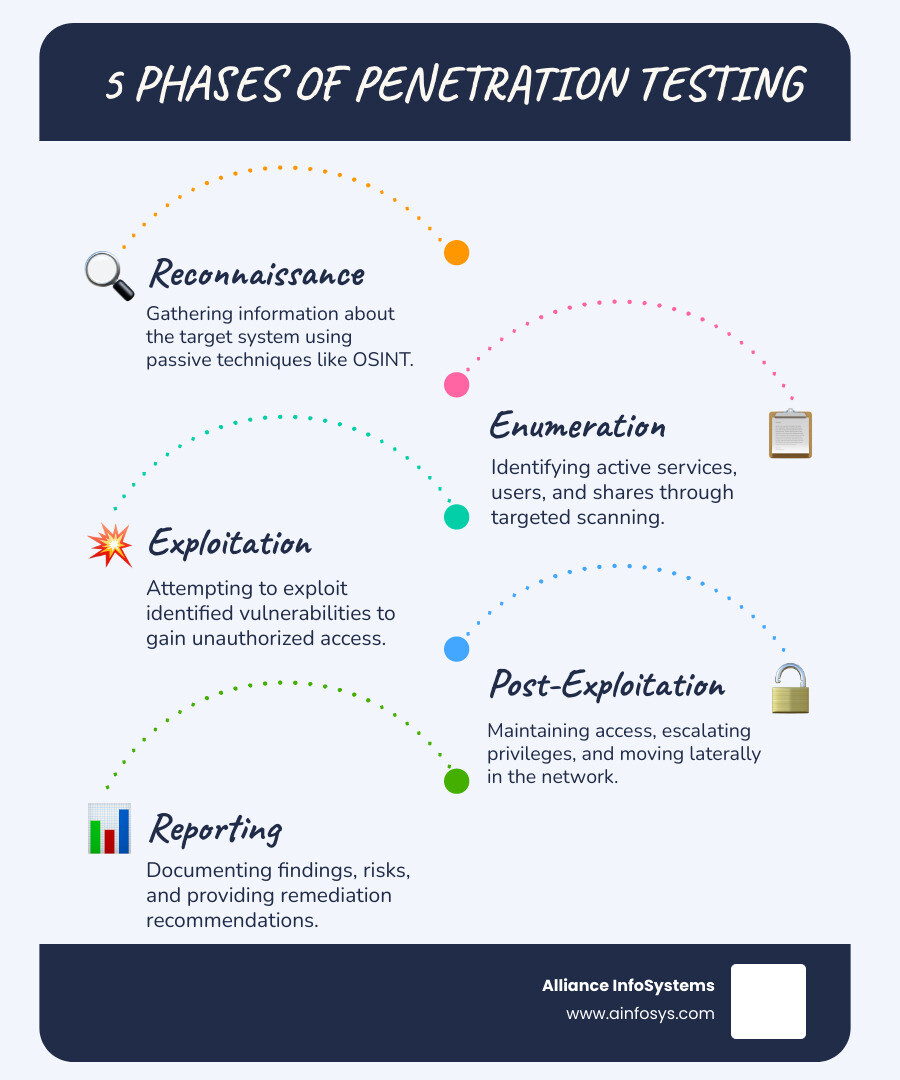
When we perform a pen test, we follow a systematic, five-phase approach. This ensures that the testing is thorough, safe, and provides the most value to you.
1. Planning and Reconnaissance
We start by defining the “rules of engagement.” What are we allowed to test? When can we test it? Then, we perform reconnaissance—gathering as much information as possible about the target using Open Source Intelligence (OSINT). We look for leaked passwords, public-facing IP addresses, and employee details.
2. Enumeration and Scanning
In this phase, we look for entry points. We scan the network to see what services are running (like web servers or databases) and identify potential vulnerabilities. This is where we look for the “unlocked windows” in your digital house.
3. Exploitation and Lateral Movement
This is where the “hacking” happens. We attempt to exploit the vulnerabilities we found in a controlled manner. If we get into one computer, we don’t stop there. We test for Privilege Escalation (trying to become an “Admin”) and Lateral Movement (moving from one computer to another) to see if we can reach your most sensitive data. This demonstrates the real-world impact of a breach, showing you exactly how a cyber defense strategy might fail in practice.
4. Post-Exploitation and Persistence
We determine how long an attacker could stay in your system without being noticed. Could they create a “backdoor” to come back later? This phase is crucial for assessing your team’s detection capabilities.
5. Reporting and Remediation Roadmaps
The most important part of the process is the report. We provide an executive summary for your leadership team and a deep-dive technical report for your IT staff. We don’t just hand you a list of problems; we provide a prioritized roadmap for fixes. For many clients, this leads to a managed SOC (Security Operations Center) approach, where we provide ongoing monitoring to ensure those vulnerabilities stay closed.
Frequently Asked Questions
How often should Maryland businesses conduct penetration tests?
At a minimum, we recommend annual testing. However, you should also schedule a test whenever you make major infrastructure changes, move to a new office, or launch a new web application. Compliance cycles (like PCI-DSS) often mandate a specific frequency. Regular vulnerability management services should happen even more frequently (monthly or quarterly) to catch new bugs between pen tests.
What factors determine the cost of a penetration test?
Several factors influence the price:
- Scope: Testing a 5-person office is different than testing a multi-site hospital system.
- Complexity: A static website is easier to test than a custom-built financial portal.
- Methodology: A “Black Box” test (where we have zero prior info) takes more time than a “White Box” test.
- Remote vs. Onsite: While many tests can be done remotely, some wireless or physical security tests require us to be on the ground in Maryland.
What certifications should a reputable pen tester hold?
You want to make sure the people “attacking” your network are true professionals. Look for certifications like:
- OSCP (Offensive Security Certified Professional): The gold standard for hands-on hacking skills.
- CISSP (Certified Information Systems Security Professional): Focuses on broad security management.
- CEH (Certified Ethical Hacker): Demonstrates knowledge of hacker tools and techniques.
- LPT Master (Licensed Penetration Tester): An advanced certification for expert-level testers.
Conclusion
In today’s digital landscape, hope is not a strategy. You can’t simply “hope” your firewall is enough or “hope” that hackers won’t find your business. Maryland penetration testing services provide the clarity and confidence you need to operate in an increasingly dangerous world.
At Alliance InfoSystems, we’ve spent over 20 years serving the Maryland community. We understand the local business climate, from the bustling Port of Baltimore to the tech corridors of Howard and Montgomery counties. Our mission is to provide flexible, customized, and cost-efficient security solutions that don’t just tick a compliance box but actually make you safer.
Whether you are a healthcare provider needing to secure patient data, a defense contractor aiming for CMMC certification, or a local manufacturer protecting your operations from ransomware, we are here to help. Don’t wait for a real breach to find out where your weaknesses are.
If you’re ready to take the next step in securing your organization, we invite you to explore our IT Consulting Services or contact us today to schedule a consultation. Let’s work together to build a defense that’s as strong as your business.