Why Network Security Services Are Critical for Your Business

Network security services are the tools, technologies, and managed offerings that protect your organization’s network from cyberattacks, data loss, and other threats. They range from firewalls and threat monitoring to comprehensive managed services providing round-the-clock protection.
Quick Answer: What Do Network Security Services Include?
- Managed Security Services (MSSP) – 24/7 monitoring, threat detection, and incident response
- Perimeter Protection – Firewalls, intrusion prevention, and DDoS mitigation
- Endpoint Security – Antivirus, endpoint detection and response (EDR), and device management
- Cloud & Web Security – Secure web gateways, email filtering, and cloud workload protection
- Advisory Services – Security assessments, compliance audits, and strategic planning
- Business Continuity – Backup, disaster recovery, and ransomware protection
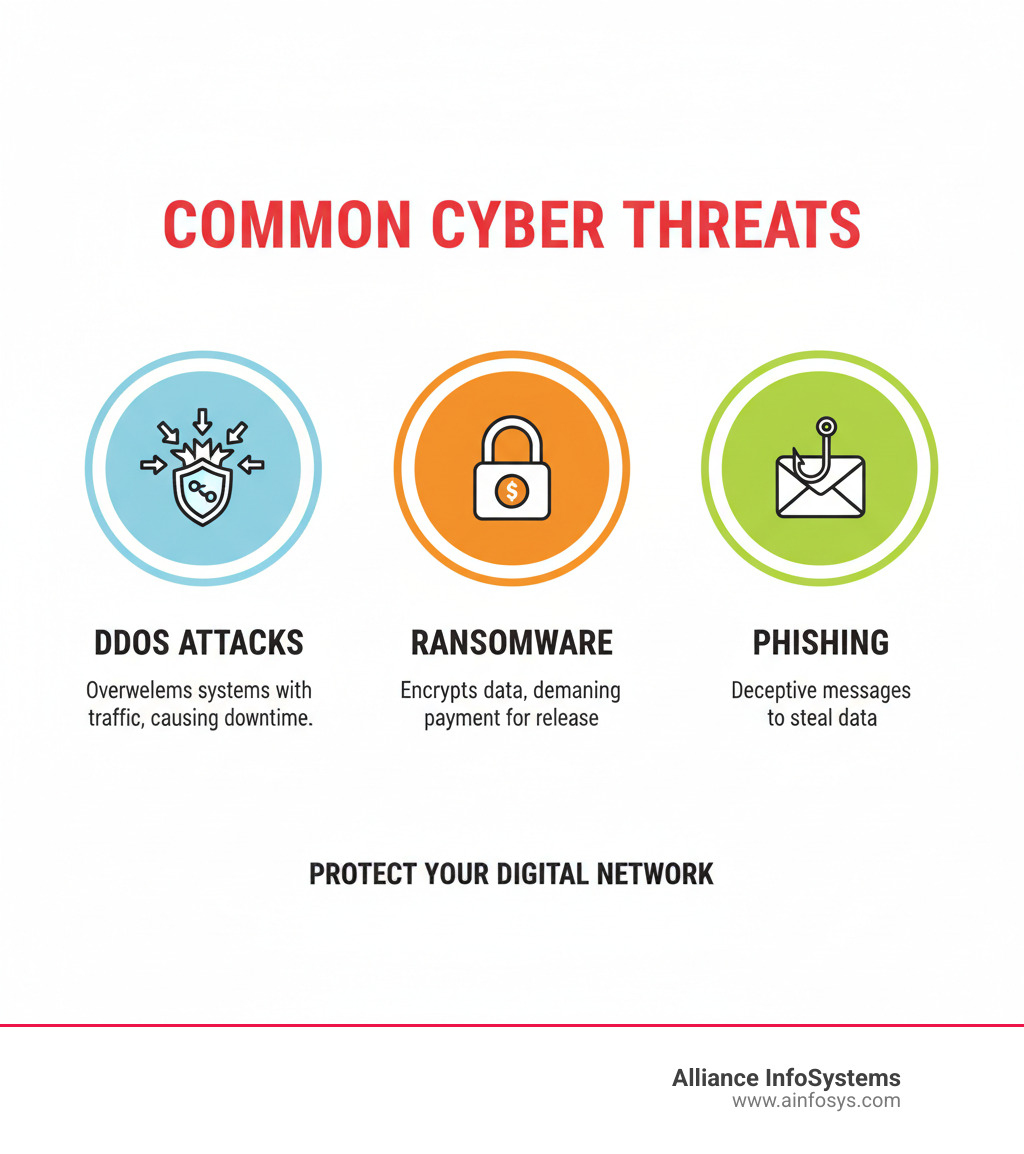
Your network is your business’s backbone. A compromise from malware, ransomware, or a DDoS attack can lead to devastating consequences like lost revenue, a damaged reputation, and operational downtime.
The threat landscape is evolving rapidly, with billions of cyberattacks launched annually. AI is accelerating the velocity and sophistication of these attacks, making them harder to detect. For small to medium-sized businesses, the challenge is acute: you need enterprise-grade protection but often lack the budget or in-house expertise to manage it.
Fortunately, you have options. From fully managed services that handle everything to advisory services that help build your strategy, there is a security service model that fits your needs and budget.
Understanding the Core Components of Network Security
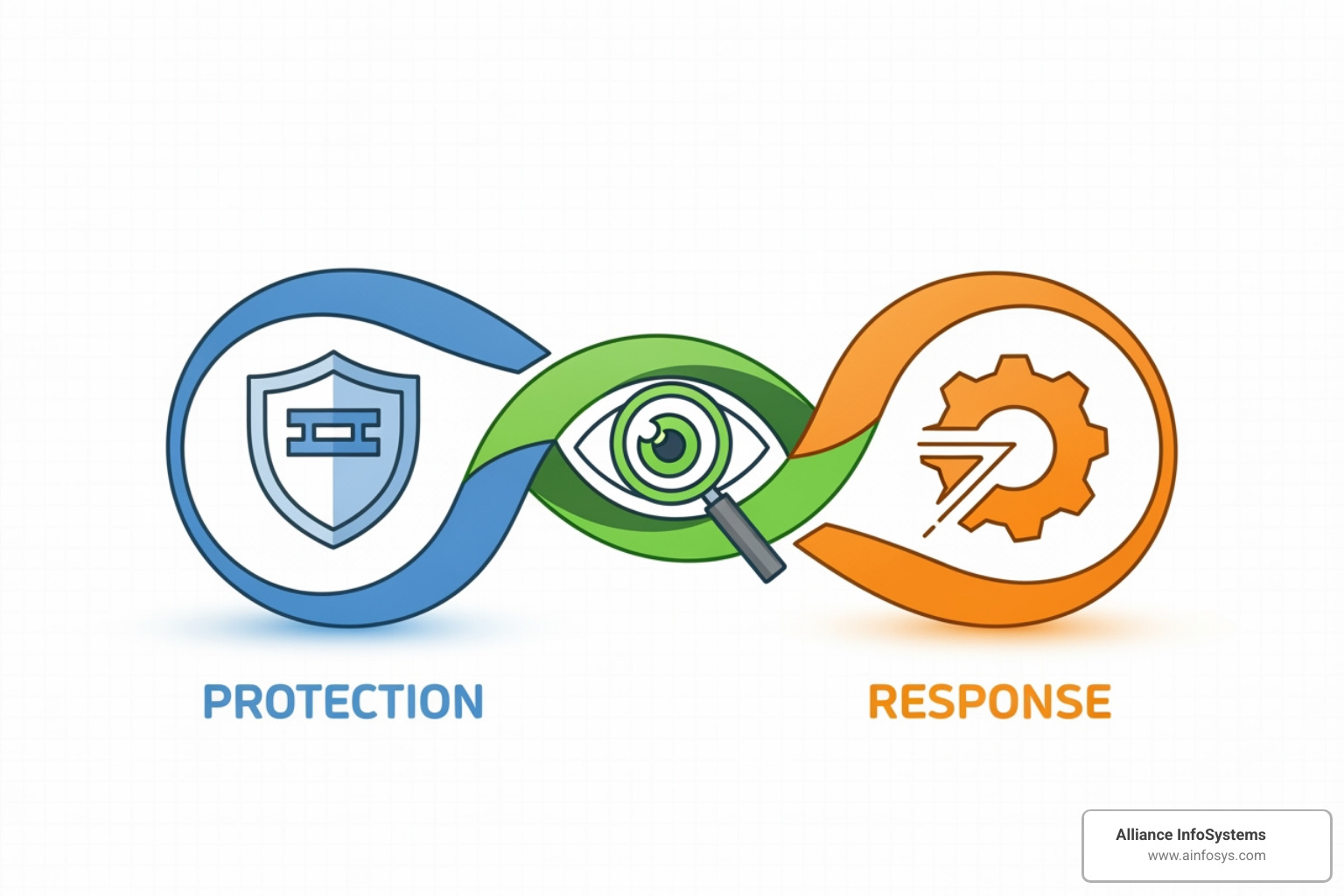
Effective network security services are built on three pillars that work in a continuous cycle: Protection, Detection, and Response. This integrated approach ensures that when one element catches what another might miss, your business stays secure.
At Alliance InfoSystems, we’ve seen the industry shift from a reactive model—fixing problems after they happen—to a proactive one. Staying ahead of threats before they can cause disruption is the key to keeping your business running smoothly and maintaining customer trust.
For more insights into building a stronger security foundation, explore our resources on Cybersecurity.
Proactive Protection
Proactive protection is your first line of defense, designed to keep attackers out. This layered approach includes several key components:
- Firewalls: Modern Next-Generation Firewalls act as primary gatekeepers, inspecting the content of data packets and identifying specific applications to stop intrusion attempts in real-time.
- Access Control: This ensures only authorized users can access sensitive data. We implement strong authentication measures like multi-factor authentication (MFA), which requires a second verification step beyond a password.
- Encryption: Your data is scrambled into unreadable code, making it worthless to anyone who intercepts it, whether it’s stored on a server or in transit.
- Vulnerability Management: We continuously scan your environment to find and fix weaknesses in software and system configurations before attackers can exploit them.
- Security Policies: Clear, documented guidelines ensure your entire team understands their role in maintaining security, from password requirements to data handling procedures.
Active Threat Detection
Because no defense is perfect, active threat detection acts as your 24/7 alarm system. It uses advanced tools to process enormous amounts of data and find patterns that signal an attack.
Real-time monitoring and log analysis provide constant visibility into your network traffic, endpoints, and system logs, searching for suspicious activity. Behavioral analytics takes this a step further by learning what’s normal for your environment. This anomaly detection helps catch brand-new threats by flagging any deviation from that baseline, such as an employee suddenly accessing an unusual number of files. Our Enhanced cyber-attacks’ detection capabilities mean threats are found and addressed quickly.
Rapid Incident Response
When an incident occurs, every minute counts. A swift, effective response can be the difference between a minor issue and a major disaster. Our incident response plans follow a clear, structured process:
First, containment stops the attack from spreading by isolating infected machines or blocking malicious traffic. Next, eradication involves removing every trace of the threat, including malicious files and compromised credentials. Then, recovery gets you back to business by restoring systems and data from clean backups, which is why our Disaster Recovery solutions are so critical. Finally, forensics helps us understand what happened, allowing us to learn from the incident and strengthen your defenses for the future.
A Breakdown of Key Network Security Services
Network security services are not one-size-fits-all. Businesses can manage security in-house by purchasing their own tools and hiring staff, which offers maximum control but comes with high costs and the challenge of retaining cybersecurity talent. The increasingly popular alternative is outsourcing to a specialized provider. This approach provides access to expert knowledge and advanced technology without the massive upfront investment and management overhead.
The right model depends on your business reality. Do you have the resources for an in-house team, or would you rather focus on your core business while specialists handle security? With over 20 years of experience, we design flexible, cost-efficient services to meet you where you are.
Managed Network Security Services (MSSP)
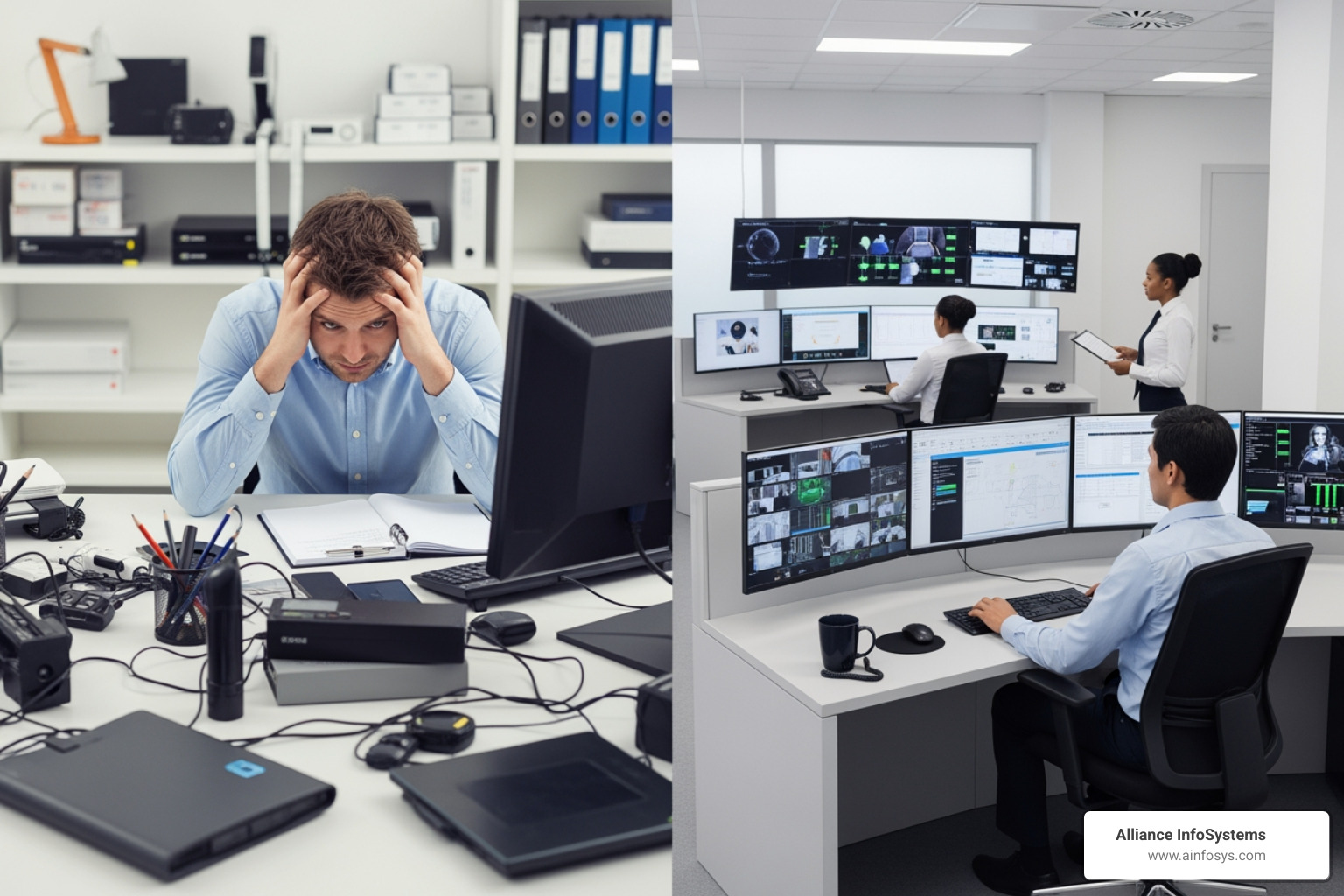
A Managed Security Service Provider (MSSP) acts as your outsourced security department. Instead of building a costly security operations center, you partner with experts who provide 24/7 monitoring of your entire digital environment. Cybercriminals don’t sleep, and neither does an MSSP.
MSSPs go beyond passive monitoring by engaging in active threat hunting to find signs of a breach before alarms are triggered. Many offer SOC-as-a-Service (SOCaaS), giving you access to a full-fledged Security Operations Center with advanced tools and experienced analysts. They handle everything from patch management to incident response.
The benefits are significant: MSSPs reduce the burden on your IT team, fill skill gaps, and provide enterprise-grade protection for a predictable monthly cost. It’s cost-efficient security that scales with your business. Our Managed Security services reduce complexity while improving the security and availability of your IT systems.
Professional and Advisory Services
Sometimes, you need expert guidance rather than continuous monitoring. Professional and advisory network security services help you assess your vulnerabilities and build a sensible security strategy.
- Security assessments provide an external evaluation of your systems and practices to identify weaknesses.
- Risk management helps you prioritize which threats pose the greatest danger to your operations.
- Compliance audits assist businesses in regulated industries (healthcare, finance) in navigating complex standards like HIPAA, PCI, and GDPR.
- Penetration testing simulates real-world attacks to test your defenses, providing invaluable insights.
- Strategic planning and security awareness training help you build a long-term roadmap and empower your employees to become a strong defense against phishing and social engineering.
For comprehensive strategic guidance, our IT Governance Consulting helps you develop the right strategy to protect your digital business.
Security-as-a-Service (SECaaS)
Security-as-a-Service (SECaaS) applies a cloud-based subscription model to cybersecurity. Instead of buying and maintaining hardware, you access security tools over the internet for a predictable fee. This subscription pricing makes enterprise-grade security accessible to smaller businesses.
The cloud-based model is ideal for today’s hybrid work environments, as it protects users wherever they are. The Cloud Security Alliance identifies key SECaaS categories like Email Security, Identity and Access Management (IAM), and Web Security. While you are reliant on the provider’s security, the benefits of cost savings, access to expertise, and reduced administrative burden are compelling for most organizations. You can Learn more about the SECaaS model to see if it’s a good fit.
Key Solutions That Power Modern Security
Modern cybersecurity requires a layered defense approach, where multiple security controls work together to protect your business. No single tool can stop every threat, but combining them ensures that each layer catches what others might miss. AI and machine learning are no longer buzzwords; they are game-changers that power today’s most effective security solutions, spotting patterns and responding to threats in milliseconds. While attackers also use AI, we use it to make our defenses stronger.
Automation ties these elements together, handling repetitive tasks so security analysts can focus on complex strategic work. This combination of layered defenses, AI, and automation is what makes modern network security services so effective.

Perimeter and Network-Level Protection
Your network perimeter is the front door to your business, and it needs strong defenses to stop attacks before they reach internal systems. Key solutions include Next-Generation Firewalls (NGFWs), which inspect traffic content, not just addresses; Intrusion Prevention Systems (IPS), which actively block malicious activity in real-time; Secure Web Gateways (SWGs), which protect users from malicious websites; and DDoS mitigation, which keeps your business online during traffic-flooding attacks. You can learn more about how network security services protect against modern cyber threats on our blog.
Endpoint and User-Centric Security
With the rise of remote work, the security focus has shifted from the network perimeter to individual devices and user accounts. Endpoint Detection & Response (EDR) solutions go beyond traditional antivirus by continuously monitoring activity on laptops and servers to spot sophisticated attacks. Managed Detection & Response (MDR) adds a 24/7 team of expert analysts who hunt for threats, investigate alerts, and respond immediately.
Multi-Factor Authentication (MFA) is a simple yet powerful tool that makes it exponentially harder for attackers to compromise accounts, even with a stolen password. Finally, security awareness training is crucial for turning your employees from a potential target into a strong line of defense against phishing and social engineering.
Advanced Architectural Frameworks
The traditional security model of a trusted internal network is obsolete. Modern frameworks are needed to protect distributed workforces. Zero Trust Network Access (ZTNA) operates on the principle of “never trust, always verify,” granting users access only to the specific resources they need, and nothing more. This aligns with the core belief that organizations should assume breach and verify everything.
Secure Access Service Edge (SASE) converges networking and security into a single, cloud-delivered service. Its security-focused component, Security Service Edge (SSE), is ideal for securing hybrid work by delivering consistent security policies to all users, regardless of their location. These architectures provide the flexibility and strong, consistent security that modern businesses require.
How to Choose the Right Provider
Selecting a partner for your network security services is a critical business decision. You’re entrusting them with the safety of your digital operations, so it deserves careful thought. By knowing what to look for, you can find the right fit without feeling overwhelmed.
Start by assessing your business needs. What are you trying to protect? Do you have specific compliance requirements like HIPAA or PCI? Understanding your unique situation helps you find a relevant solution and avoid paying for services you don’t need.
Next, evaluate expertise. Look for providers with industry-recognized certifications (CISSP, CISM, etc.) and a proven track record. Ask about their process for handling threats. At Alliance InfoSystems, our 20+ years of experience means we’ve seen nearly every scenario and know how to respond effectively.
Don’t overlook scalability. Your business isn’t static, and your security shouldn’t be either. Your provider must be able to scale services up or down as your business evolves, ensuring you’re never left with gaps in protection.
Finally, review the support and SLAs (Service Level Agreements). When an incident occurs, can you reach someone 24/7? What are the guaranteed response times? A clear SLA is your assurance that help will be there when you need it most. The right provider acts as a strategic partner, helping you build a resilient security posture. For more guidance, see our insights on 7 Factors for Choosing IT & Cybersecurity Services.
| Criteria | Description | Why it matters |
|---|---|---|
| Business Needs Fit | Does the provider understand your industry, size, and specific challenges? | Ensures solutions are relevant and effective, not one-size-fits-all. |
| Expertise & Certs | Team’s certifications, experience, and continuous training. | Guarantees access to cutting-edge knowledge and skilled incident response. |
| Scalability | Ability to adjust services up or down with your business growth. | Avoids overpaying or being under-protected as your needs evolve. |
| Support & SLAs | Availability of support (e.g., 24/7), guaranteed response times. | Critical for rapid incident resolution and minimizing downtime. |
| Technology Stack | The tools and platforms they use (AI, EDR, NGFW, etc.). | Reflects their capability to handle modern, sophisticated threats. |
| Transparency | Clear reporting, audit trails, and communication processes. | Builds trust and allows you to understand your security posture. |
| Cost-Efficiency | Clear pricing models and demonstrable ROI. | Ensures you get maximum protection within your budget. |
Frequently Asked Questions about Network Security Services
Choosing and implementing network security services can be complex. Here are straightforward answers to the questions we hear most often from business leaders.
What is the difference between an MSSP and just buying my own security tools?
Buying security tools is like buying ingredients for a meal; you still have to do all the work of preparing, cooking, and cleaning up. You’re responsible for installation, 24/7 monitoring, updates, and incident response, which requires significant investment in both capital and a highly skilled in-house team.
Partnering with an MSSP (Managed Security Service Provider) is like hiring a professional chef. They bring the expertise, tools, and a full Security Operations Center (SOC) to provide round-the-clock protection. The key differences are:
- Expertise: You gain access to certified security professionals you likely couldn’t hire directly.
- Availability: You get 24/7/365 coverage, which is prohibitively expensive to staff internally.
- Cost-Efficiency: You convert large capital expenses into a predictable monthly operational cost.
- Focus: The management burden shifts to the MSSP, freeing your team to focus on business-driving initiatives.
An MSSP doesn’t just give you tools; they manage your entire security operation to protect you from threats you might never see coming.
How can I justify the cost of network security services to my leadership?
Frame network security services as a strategic investment in business resilience, not just a cost. The conversation should focus on the high cost of inaction versus the value of protection.
Start by highlighting the risks: a single breach can lead to catastrophic financial losses from downtime, regulatory fines (HIPAA, PCI), legal fees, and reputational damage. One ransomware attack can easily cost more than years of security services.
Position security as an enabler of business continuity. Proactive protection and rapid response minimize disruptions, keeping your operations running and your team productive. It’s a form of risk management that protects your most valuable assets, including intellectual property and customer data.
Emphasize the efficiency of outsourcing. Building an equivalent in-house security team is far more expensive and difficult than partnering with a provider. Finally, strong security can be a competitive advantage, building trust with customers and partners who need to know their data is safe.
How do security services adapt to new and emerging cyber threats?
Effective network security services are in a constant state of adaptation, as the threat landscape never stands still. This is achieved through several key methods:
First is continuous threat intelligence. We gather and analyze global data on new malware, phishing campaigns, and attack techniques in real-time, feeding this information directly into our defensive systems.
AI and machine learning are critical for detecting anomalies and previously unknown threats with a speed and accuracy that humans cannot match. These systems constantly learn and evolve as new threat patterns emerge.
However, AI alone isn’t enough. The real power comes from combining technology with expert human analysis. Our elite MDR threat hunters interpret AI insights, conduct complex investigations, and make nuanced decisions that machines can’t. This partnership between human and artificial intelligence is what stops more threats.
This combination of cutting-edge technology, global intelligence, and expert human oversight ensures our services remain agile and resilient, protecting your business from the threats of today and tomorrow.
Conclusion: Building a Resilient Security Posture
The truth is, you can’t afford to put network security services on the back burner. The threats are real, constant, and targeting businesses like yours. The good news is that you now have a roadmap for protecting what matters most.
We’ve covered the core pillars of protection, detection, and response, different service models, and the key technologies that power modern defenses. The first step is to take action by embracing a proactive strategy. Don’t wait for an attack to happen; invest in preventative measures, manage vulnerabilities, and train your team.
Think in terms of a layered defense. When your firewall, endpoint protection, and access controls work together, you create a redundant system where one layer catches what another might miss. Security also demands continuous improvement. The threat landscape evolves daily, and your defenses must evolve with it through regular assessments, updates, and adaptation.
For many businesses, the smartest move is an expert partnership. Working with an experienced provider gives you access to enterprise-grade protection and 24/7 monitoring without the immense cost and complexity of building it yourself. You can focus on your business, knowing seasoned professionals are watching your back.
At Alliance InfoSystems, we’ve spent over 20 years helping businesses secure their digital operations with flexible, customized solutions. We’re here to help you build a security foundation that makes sense for your budget and your goals.
The digital world isn’t getting any safer, but you don’t have to face the challenges alone. Now is the time to act. Secure your network with our Managed Security services and let’s build a resilient future for your business together.